At its final meeting of the 2025-26 school year, the Alameda Unified School District (AUSD) Board of Education discussed student survey outcomes. It also voted to approve the Local Control Accountability Plan (LCAP) and budget for the upcoming school year, which were both discussed previously in detail during the June 9 Board meeting.

Lindsey Jenkins-Stark, AUSD Senior Manager of Research, Data, and Assessment, led the discussion on the sole informational item of the evening, which focused on local indicators—metrics that measure school performance where data is not collected at the state level—to accompany the LCAP approval that would follow. AUSD collects some of that data through two key indicators: the Family Relationships and Trust Survey, and the California Healthy Kids Survey (CHKS).
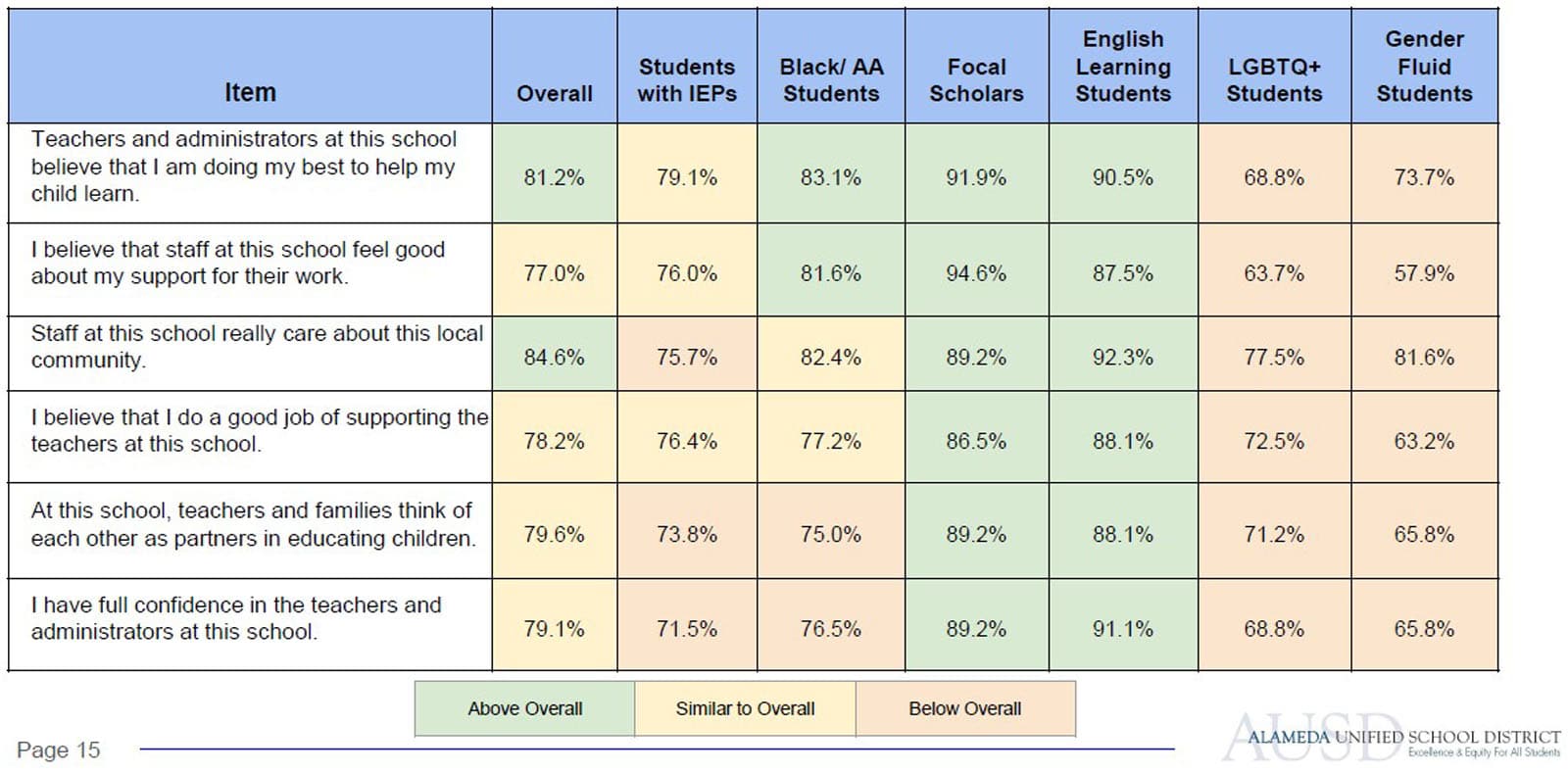
The first is a tool intended to gather information about how families feel about their relationships with the school community and the district. Now in its fifth year of administration, it prompts respondents to rank a series of statements from a scale of one (strongly disagree) to five (strongly agree), such as “Staff at this school work hard to build a trusting relationship with parents,” and “I feel respected by teachers and administrators at this school.” The data allows AUSD to track progress as staff at schools across the district deploy strategies to strengthen relationships with families.
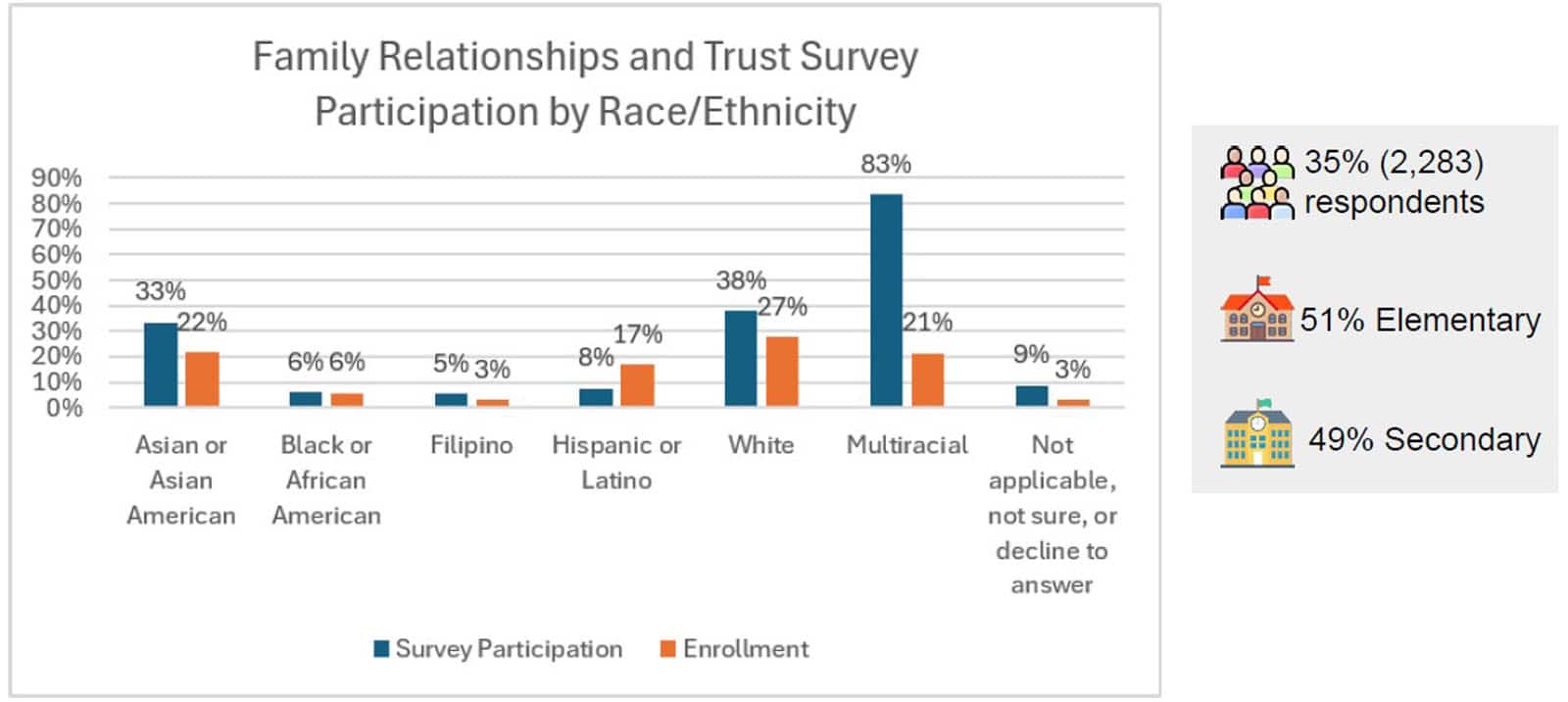
Overall, the survey found that families of Focal Scholars, defined as students from historically underserved backgrounds that receive focused observation and learning support, as well as English Learning Students, felt the most positive about their relationship with teachers and administrators at their respective school sites, and reported feeling supported and cared for. Families of LGBTQ+ and Gender Fluid Students, however, tended to have lower-than-average sentiments on the same metrics. These student groups recognized the progress being made so far to boost support for students, but many wished it could be more consistent.
Separately, the CHKS asks fifth, seventh, ninth, and eleventh grade students a series of questions centering on health risks, behaviors, and school climate. Findings reveal that, like families, students largely agree that there are supportive adults and an inclusive community at schools. However, there is a consistency gap among certain student groups, and there is a notable dip in feelings of connection and support between the transition from middle school to high school.
During public comment, Carolyn, a parent, noted that it was “hard to draw conclusions from a survey that only one-third of the population responds to,” referring to the first survey’s 35 percent response rate. Board members echoed that concern, though Jenkins-Stark emphasized that staff worked to ensure it would be a representative survey across demographic and student groups. Board Vice President Heather Little noted that the participation rate is similar to that of an election’s turnout, and inquired about efforts to get people to take the survey.
“Our approach was to have persistent and consistent communication with families,” responded Susan Davis, AUSD Senior Manager of Community Affairs. She added that links to the surveys were sent to principals to forward to families, posted on social media, and placed on the home page of every school’s website. Parents also received reminders through the ParentSquare portal.
AHS baseball community urges Arnerich reinstatement
Earlier in the meeting, during public comment on Consent Calendar items, over a dozen speakers took to the podium to demand an explanation for why the district decided to not to renew the contract of Alameda High School’s (AHS) head baseball coach Kenneth Arnerich, Sr. The district also did not renew the contracts of assistant coaches Kenneth Arnerich, Jr., Richard Krinks, and George Konstantino.



An online petition on change.org has reached over 1,000 signatures by Tuesday evening, urging the district to reinstate Arnerich, Sr., who has dedicated 24 years to leading the team. As the first speaker, Arnerich himself addressed the Board directly to ask why he was let go.
“I stand before you with mixed emotion,” said Arnerich, arguing that his long-standing devotion to AHS and its baseball team meant that he was at least owed the respect and dignity to know why he could not serve as head coach for one final year, after which he had previously planned to retire.
He also surmised that his contract not being renewed may have been the result of an anonymous letter of complaint that district leadership received. Arnerich revealed that AHS Assistant Principal Michael Lee first informed him of the letter’s existence, but then never followed up with him despite Arnerich’s repeated follow-up inquiries. He claimed the letter was “filled with inaccuracies and outright lies” penned by “keyboard warriors.”
Earlier this month, Arnerich received an email from Timothy Erwin, Assistant Superintendent of Human Resources, informing him of his contract’s termination upon the conclusion of the school year because AHS leadership had determined it was time to begin a new chapter, according to Arnerich’s wife, Colleen.
Several friends, family members, and current and former students also chimed in, extolling Arnerich’s leadership, dedication, and love of baseball.
The Board voted 4-0, with Trustee Carrie Hahnel absent, to approve the Consent Calendar, which included staff’s recommendation for certificated personnel actions. The Board did not discuss Arnerich’s release, as it cannot comment publicly on personnel matters.
Ken Der is a contributing writer for the Alameda Post. Contact him via [email protected]. His writing is collected at AlamedaPost.com/Ken-Der.

