On June 22, the Planning Board advanced two proposals aimed at expanding housing opportunities and economic activity, unanimously recommending updates to the City’s Accessory Dwelling Unit (ADU) ordinance to allow ADU-to-condominium conversions and beginning its review of a plan that could bring professional soccer matches to Bay Farm Island. The Board emphasized the need for additional analysis of traffic, noise, and neighborhood impacts before any soccer venue proposal moves forward.
Pro soccer proposal
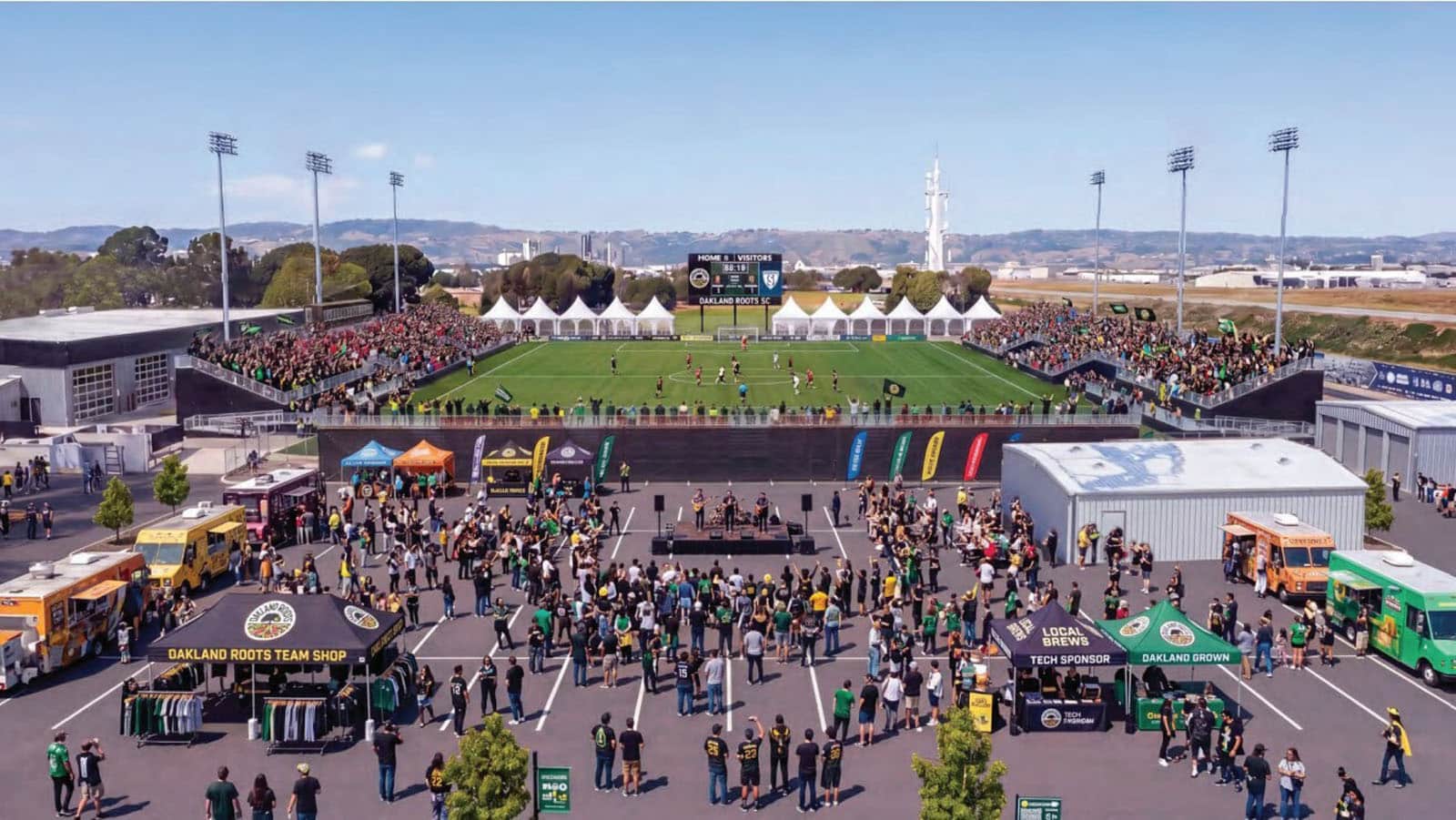
The Oakland Roots Soccer Club seeks approval to host professional soccer matches at its headquarters and training facility at 1150 and 1220 Harbor Bay Parkway, presenting the proposal as a temporary three-to-five-year solution while the club pursues a permanent stadium in Oakland. The club has occupied the former Oakland Raiders facility since 2021 and recently secured a long-term lease enabling it to host community events, youth programs, and international teams, including the Australian National Men’s Team during the 2026 World Cup.
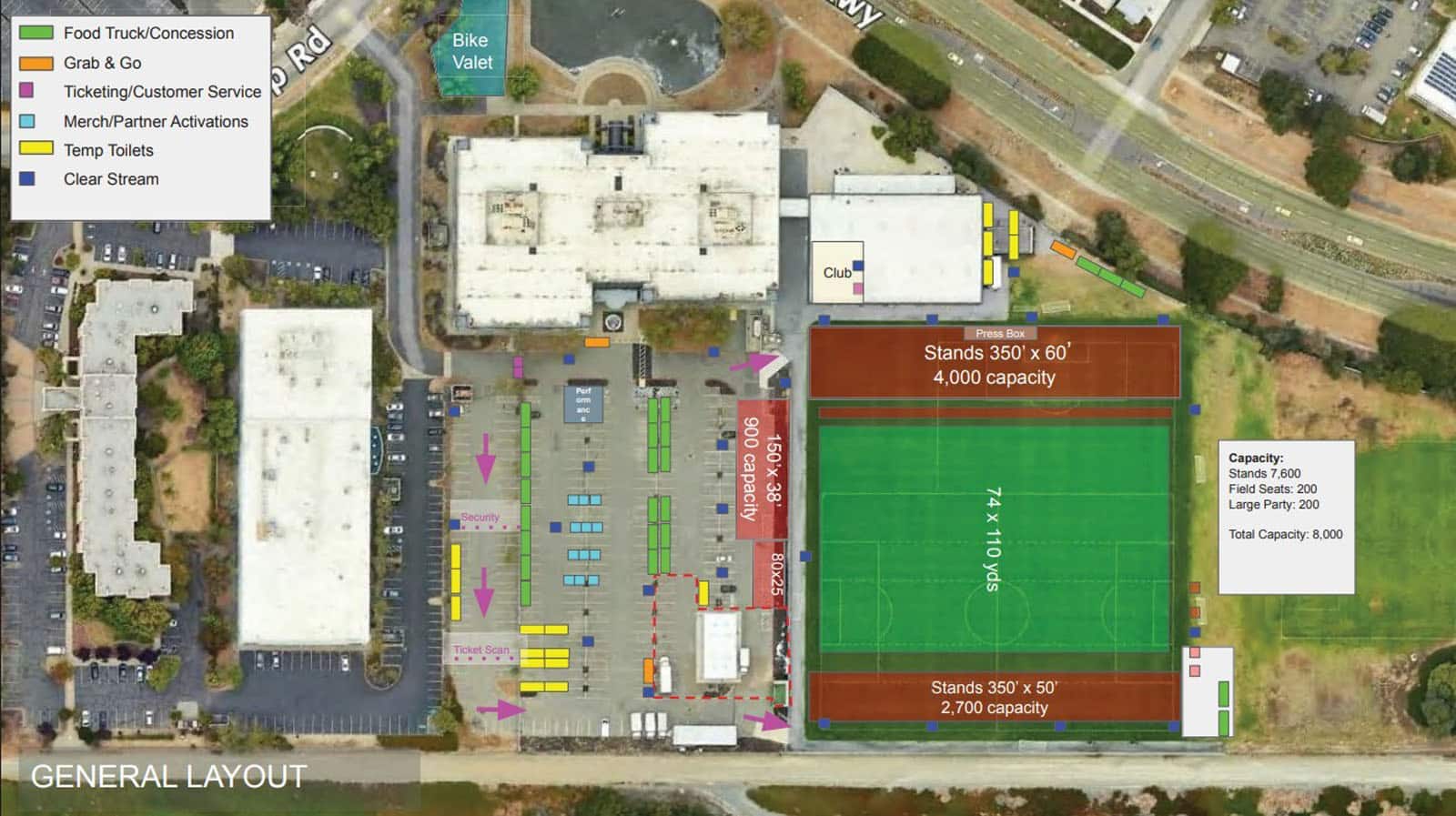
The plan would transform part of the training complex into a venue featuring grandstands, food vendors, and merchandise booths capable of accommodating up to 8,000 spectators for approximately 24 professional matches annually, as well as several smaller events. Roots Chief Real Estate Officer Lydia Tam noted, “We really do want to provide an amazing, intimate experience for our fans.”
The proposal requires both a conditional use permit and design review approval. City Planner Brian McGuire outlined potential permit conditions to address community concerns, including limits on event frequency and attendance, a detailed traffic control plan, public safety and operations requirements, compliance with the City’s noise ordinance, Federal Aviation Administration and Airport Land Use Commission review, and adherence to Alameda’s dark skies regulations. The project may qualify for California Environmental Quality Act streamlining because it is consistent with the City’s General Plan. McGuire further recommended annual Planning Board reviews to evaluate the project’s performance and compliance.
To address traffic, noise, and lighting concerns, the Roots propose shared parking agreements within the Harbor Bay Business Park, BART shuttles, bicycle valet parking, rideshare management, and traffic control measures designed to keep visitors on major roadways and out of residential neighborhoods. The club estimates a sellout crowd would require roughly 3,200 parking spaces, while staff estimates more than 5,000 spaces are available within a half-mile. Stadium lighting would use directional LED fixtures, and the venue would be oriented so that crowd noise and amplified sound face the airport rather than nearby homes.
Divided public comment
Public comment was sharply divided. Several residents argued that the proposed venue is incompatible with its location near residential neighborhoods. Bay Farm resident Marie Kane said the project could worsen traffic, reduce air quality, and hinder emergency evacuations from an island with only two primary access routes: “Please consider that lives could be lost due to your decisions.”
Resident Stephanie Brochier questioned how the club would prevent drivers from bypassing planned routes and raised concerns about noise: “I’m hearing (noise) already from the Roots…in Oakland, and it’s just going to be closer.”
Supporters, however, characterized the proposal as an opportunity to bring energy and economic activity to Bay Farm. Resident Melissa De Boer said increased traffic should be viewed as “a sign of success, not a threat” and praised the club’s efforts to address noise concerns.
Bay Farm resident Judy Stanton argued the proposal would “bring life and energy to an area that I think is so completely underused and underutilized.” She described the proposed use as a positive, family-oriented activity that could provide wholesome entertainment for young people.
Alameda Chamber & Economic Alliance President and CEO Madlen Saddik noted that match days would benefit local restaurants, retailers, hotels, and service businesses while showcasing Alameda to a wider audience. She argued that the club had established itself as an active community partner by “working with local businesses, supporting youth programs, participating in community events, and investing in relationships throughout the city.”
Other speakers were cautious. Reyla Graber questioned whether the City would realize sufficient benefits to justify the effort required to support the project, raising concerns about traffic, policing, alcohol sales, and the possibility that the temporary venue could become a longer-term arrangement if a permanent stadium is never built.
Board feedback
Boardmembers identified major issues they expect to be addressed before considering a formal use permit application, focusing heavily on traffic, parking, noise, lighting, and neighborhood impacts. Hanson Hom called traffic the “number one issue” and requested detailed information on shuttle operations, parking management, ferry connections, neighborhood traffic diversion, community benefits, recycling and trash reduction, and outreach to nearby residents.
Teresa Ruiz said she wanted to see specific measures to address Bay Farm Island Bridge traffic and suggested that fireworks be explicitly prohibited through permit conditions. Andy Wang and Board President Xiomara Cisneros raised concerns that navigation apps such as Google Maps and Waze could redirect drivers through residential neighborhoods despite official routing plans, urging staff and the applicant to explore ways to coordinate traffic management with those platforms.



Noise was another significant topic. Boardmembers questioned how the project would comply with the City’s existing noise ordinance while the City simultaneously considers broader ordinance revisions. Staff said the venue would be evaluated under current regulations and that consultants are modeling sound levels and designing mitigation measures to ensure compliance. Any future proposal would include detailed operational restrictions and performance standards.
Board members also highlighted opportunities to improve the project’s design and community value. Diana Ariza encouraged the club to incorporate sustainability measures, improved wayfinding, and a more welcoming arrival experience. Asheshh Saheba expressed concern about weekday events and the movement of large crowds entering and exiting the venue.
Despite raising numerous questions, Boardmembers generally viewed the proposal as a potentially beneficial addition to Harbor Bay that could generate economic activity and activate an underutilized site. Ruiz noted, “In the past few years, I’ve seen a lot of businesses leave Bay Farm Island, a lot of businesses close in the shopping center…it would be good to see some economic engine to keep the busy streets.”

Draft updated ADU ordinance
Planner Tristan Suire presented proposed amendments to the City’s ADU ordinance that would expand homeowner opportunities to create and sell accessory housing units. Changes aim to help the City meet its housing goals and Regional Housing Needs Allocation obligations. Suire argued that ADUs are an important tool for increasing housing supply because they are less expensive and easier to build than larger developments.
A central feature of the proposal is the implementation of California’s AB 1033, which allows cities to authorize the conversion of ADUs into condominiums that can be sold separately from the primary residence. Based on feedback from an earlier study session, staff drafted a new process that would permit such conversions. Supporters, including the Casita Coalition and California Housing Defense Fund, argued that allowing ADU ownership would expand housing options and create new pathways to homeownership.
The amendments would also establish a clearer front-yard setback standard for ADUs, maintain Alameda’s more permissive approach to converting portions of existing multifamily buildings into ADUs, and ensure that expansions of legal nonconforming structures comply with current setback requirements. Staff also proposed codifying policies for removing curb cuts when garages are converted into housing units.
Other changes focus on streamlining the permitting process. Suire noted that Alameda currently charges no development impact fees on ADUs and junior ADUs, making further changes unnecessary. (Junior ADUs are smaller ADUs within single-family homes.) The proposal would also remove owner-occupancy requirements for junior ADUs, limit deed restrictions to those required by state law, and incorporate several technical updates and code corrections.
State and local tenant protections would continue to apply to occupied ADUs that are converted to condominiums. For instance, existing tenants must receive at least 60 days advance notice before a conversion proceeds and receive the opportunity to purchase the unit before it is offered for sale to the general public.
Board approval
The Board unanimously recommended that the City Council approve the proposed ordinance updates after refining several provisions. Much of the discussion focused on how best to implement California’s new ADU-to-condominium conversion law while preserving homeowners’ flexibility and avoiding conflicts with evolving state requirements.
The Board debated design standards, with members favoring more flexibility in how new units relate to existing homes. Ruiz argued that ADUs should be required to “match or complement” existing architecture rather than exactly replicate roof pitches or building materials. Discussion also focused on whether small rooftop decks should continue to trigger staff-level design review, with Boardmembers ultimately accepting staff’s explanation that the review process exists to address privacy, light, and view impacts on neighboring properties.
Board Member Andy Wang reiterated his support for ADU-to-condominium conversions, arguing that the change is unlikely to dramatically affect either housing supply or rental availability but would provide homeowners with additional flexibility and modestly expand homeownership opportunities.
Following incorporation of the Board’s feedback, the proposal will go before the City Council for consideration.
Contributing writer Karin K. Jensen covers boards and commissions for the Alameda Post. Contact her via [email protected]. Her writing is collected at https://linktr.ee/karinkjensen and https://alamedapost.com/Karin-K-Jensen.

