Alameda residents seemed comfortable with the police department’s use of tools like surveillance drones and an armored car, but had questions about privacy and the burden of equipment and training on the City’s budget at a sparsely-attended public meeting on Thursday, April 9, at the O’ Club on Alameda Point.
As police departments around the nation jumped at federal incentives to acquire military-style equipment—a trend accelerated by the War on Drugs and the September 11, 2001 terror attacks—citizens and elected officials in many communities reacted with concern.
How much money was being spent on such equipment, they asked, and why? Would it make their communities safer, or could it be used against them?
California lawmakers reacted to the trend by passing legislation that requires police departments in the state to get approval from elected officials before buying military equipment. Signed into law in 2021, AB 481 also requires police departments to produce an annual report describing what military-style equipment they own and how it’s being used.
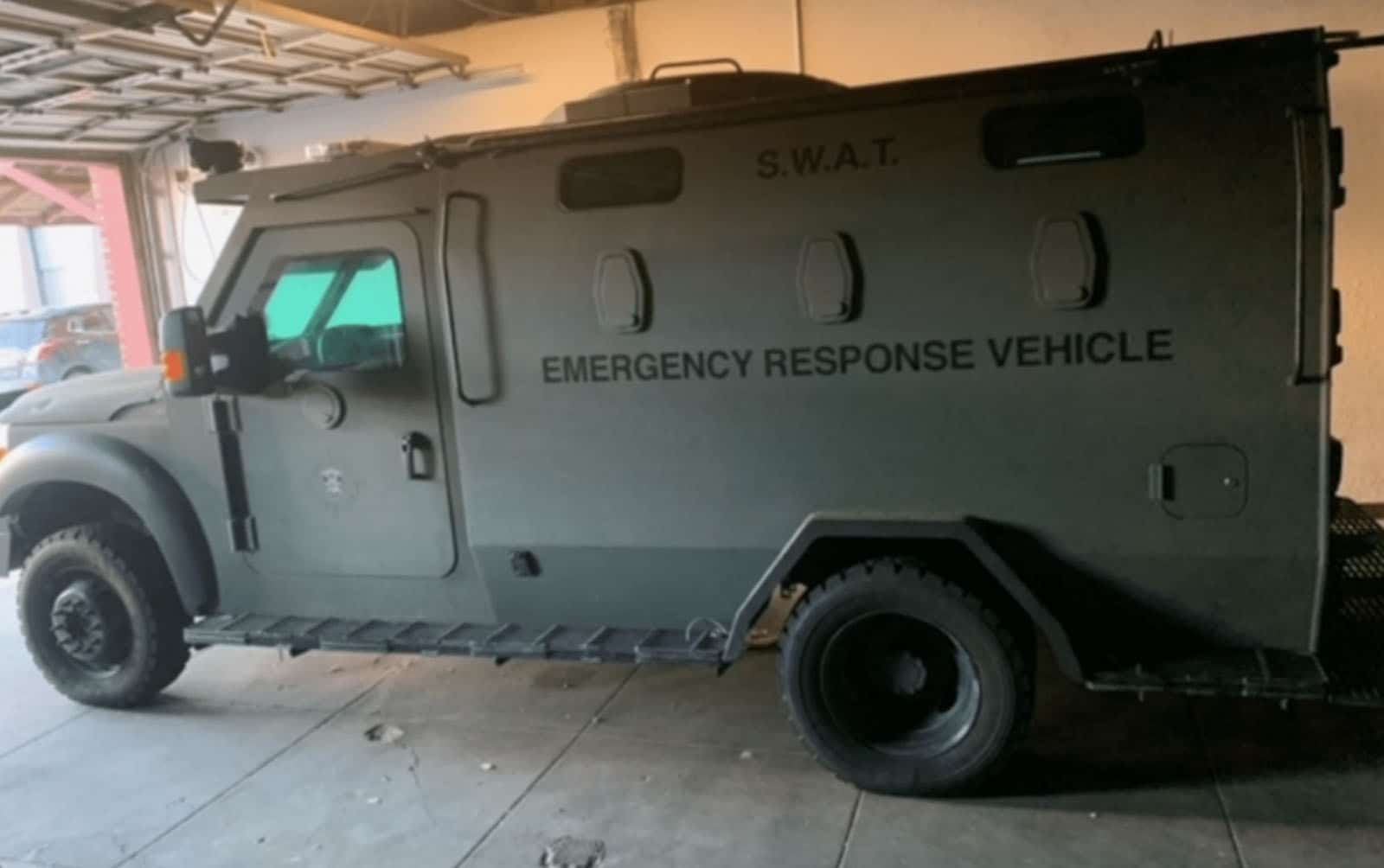
In its 2025 Annual Military Equipment Report, the Alameda Police Department (APD) said it deployed the Skydio X10 surveillance drones the City purchased in 2024 a total of 14 times last year (2025) and its Ballistic Armored Tactical Transport—an armored vehicle built on a 2012 Ford F-550 truck chassis—went on two calls.
Although the purchase of two drones generated some controversy when City Council approved them in the summer of 2024, elected officials also adopted a policy prohibiting the use of drones to monitor unpermitted car shows or non-violent crimes, the Alameda Post reported at the time.
APD says it received no complaints about its use of military equipment last year, and now plans to buy two more drones. The department is also looking to replace antiquated Remington 870 shotguns converted to fire “less-lethal” beanbag rounds with six more modern Defense Technology 40mm single-shot launchers.
City Council will consider at its next regular meeting on April 21 whether to approve the annual Military Equipment Report, and continue to allow the police department to use existing military equipment. The request has been placed on the consent calendar together with other actions considered by City staff to be routine for passage in a single vote.
Any councilmember with questions about the request can ask that it be pulled from the consent calendar for further discussion and a separate vote.
Having four drones instead of two would improve the department’s ability to monitor multiple incidents at the same time, and ensure that police can continuously monitor situations that stretch beyond a drone’s 30-minute battery life, said APD Captain Jeffery Emmitt, the department’s designated military equipment coordinator.
Both purchases—two new drones and six 40 mm single-shot launchers—would come from the department’s existing funds, Emmitt said.
“When we initially went to the Council and asked to establish a drone program, we asked for four and they told us, no, you could buy two,” Emmitt said. “So we’re sticking with our original plan of what we thought was appropriate to help us police the city.”
According to the APD 2024 Military Equipment Report accessed via the Internet Archive, the first two Skydio drones were purchased along with software in a package totalling for $124,562.
In its report to the City Council, the police department submitted quotes from Axion Enterprise showing it expects to pay about half that for the second two drones. An Axon Air R10 Team Kit Bundle with Skydio Connect Data Plan would total $41,338, with payments spread out over 5 years. The City would pay an additional $20,762 for night vision capabilities and additional software and services, for a total of $62,100.
Emmitt said the department wants to retire the beanbag shotguns it relies on for situations where less-than-lethal force is required because the 40mm launchers are a “way more accurate weapon system” that give officers more “standoff distance” —up to 40 yards—when dealing with potential threats.
When the department purchased those 40mm single-shot launchers more than 20 years ago, it paid $1,000 per launcher, the 2025 report said.
The six additional launchers the department proposes to buy now will cost $13,395 with the addition of “red dot” optical sights, according to a quote provided to the City by LC Action Police Supply in San Jose.
Most of the $209,000 Alameda spent on its existing military-style equipment last year went to training. The 715 hours Alameda police officers spent learning to use drones cost the City $106,000, while officers racked up $83,000 in expenses training to use the department’s arsenal of AR-15 and related semi-automatic rifles.
Many, if not most, police departments have swapped out the shotguns once carried in squad cars for AR-15 rifles, as the criminals they encounter are more likely to be armed with such weapons and protected by body armor. The Firearm Industry Trade Association estimates there are more than 32 million “modern sporting rifles” in circulation in the United States.


Alameda spent about $66,000 in 2002 to purchase 55 Colt AR-15 .223-caliber rifles for patrol vehicles, and $22,000 in 2023 for 20 additional AR-15s, so that rifles could be assigned to individual officers rather than vehicles.
The Alameda Police Department also owns two Bushmaster AR-15 carbines with shorter barrels for use by Special Weapons and Tactics (SWAT) team leaders, and two ArmaLite AR-10 rifles chambered for the more powerful .308 Winchester round. The AR-10s are equipped with scoped optics and can only be used by officers who have completed sniper training.
Anyone who might need to use an AR-15 in the line of duty—about four dozen police officers— must complete 16 hours of training twice a year, Emmitt said. APD has nine officers and three sergeants trained to use the department’s drones, ensuring that they can be deployed during any shift.
Most of the questions raised about APD’s use of military equipment at Thursday’s City Council meeting related to its use of drones, including when and why they are deployed, and how information they collect is stored and shared.
Emmitt said video footage is wiped after 30 days unless it’s evidence, and only shared with other jurisdictions if they can demonstrate that it’s linked directly to a crime they are investigating.
“They would have to show us how that link (between drone footage and a crime) is met, and then we probably wouldn’t even provide it to them,” he said. “It would be provided to the District Attorney’s office.”
The department’s policy is that drones can’t be used for passive surveillance of events where people are exercising their First Amendment rights, like the March 28 No Kings rally.
But if violence is reported at such events, “we can put a drone in the air and try to assess what we need to know and how to respond,” Emmitt said.
Last year Alameda police deployed a drone after receiving a report of shots being fired at a large public gathering, in support of a search warrant operation, to locate stolen vehicles, and to investigate a report of an explosion on a rooftop.
“I think they’re very successful,” Emmitt said of the department’s drone program. “It has helped us to locate missing people. It has helped us to locate violent and armed suspects that have fled.”
The City’s armored Emergency Response Vehicle (ERV) only saw action twice in 2025—once to assist the U.S. Marshals Service Fugitive Task Force to execute a search warrant arrest, and in support of the Alameda Fourth of July Parade.
Asked by one person at the public meeting whether the City really needs a SWAT team, Emmitt said that “it’s probably been a couple years,” since it was needed, but “we have them in case you guys or our police officers are faced with a situation that they can’t deal with because of their level of training.”
Serving on the SWAT team is “an ancillary duty” and officers assigned to it spend most of their time on patrol, conducting investigations, or performing other duties, he noted.
Only seven members of the public showed up at the public meeting at the O’ Club. The meeting, which was scheduled for an hour, lasted just 40 minutes after all questions were answered. But Emmitt said fulfilling AB 481’s reporting requirements is still worthwhile.
“I think that the legislators understand that we report to the people and that we should be accountable to the people for how we do our jobs,” he said of the origins of the law.
“Attendance has gone down every year since we started,” Emmitt said after thanking those who came. “Any time you have the opportunity to engage your community in discussion about what we do and how we do it, I think that is a really good thing.”
One Alameda resident who attended, Cy Sorensen, said after the meeting that he appreciated “the open dialog with the police and with the people here.” He said one of his reasons for attending the meeting was that, “with the traffic cams that went up last year, it’s important to ask the questions before they start using things.”
City Council authorized an agreement with Flock Safety to install 35 cameras at 14 locations to read and record license plates of cars entering and leaving Alameda in 2022, the Post reported at the time.
Matt Carter is a contributing writer for the Alameda Post. Contact him via [email protected]. His writing is collected at AlamedaPost.com/matt-carter.

