In a contentious meeting that began on June 4 and didn’t end until 1:15 a.m. the following day, City Council authorized the purchase of drones for law enforcement and a policy governing their use, accepted the annual military equipment report for the Alameda Police Department (APD), and approved a permit to allow Natel Energy to perform outdoor research and development using a 25-foot tall hydraulic test facility at Alameda Point. The Council also unanimously denied landlord consent for a cloud brightening experiment on the USS Hornet. Read Ken Der’s article for details of Council’s denial.

Drones for APD
APD requested that Council authorize a policy governing its use of Uncrewed Aerial Systems (drones) and the purchase of two drones from Axon Enterprise. APD previously shared how the City is preventing sideshows and planning to step up enforcement, which led to the request.
APD Chief Nishant Joshi noted that drones are easy to deploy, economical, and offer two-way voice and visual communication. Only trained, authorized operators could use them, and deployment would require supervisor approval. Allowed uses would include life preservation, felony crimes presenting a risk to public or officer safety, sideshows, riots, mass casualty events, disaster response and recovery, and post-incident crime scene documentation.
Prohibited uses would include weaponization, facial recognition, random surveillance, targeting of people based on actual or perceived characteristics, harassment or intimidation, and personal business. APD will publicly document its drone use on the City’s website.
Chief Joshi added that drones allow APD to collect information for intervention and enforcement without jeopardizing officer safety and escalating danger. As an example, he told of officers pursuing a car thief armed with a handgun. The thief fled into a backyard, and officers set up a perimeter. Realizing the danger, the commander requested a County Sheriff’s Office drone operator. The operator located the suspect hiding in a bush, still armed, and communicated with him through the drone. Once the suspect realized there was no room to flee, he emerged, and APD took him into custody without confrontation.
In preparing its draft use policy, APD held community meetings, consulted with Alameda Point and Harbor Bay businesses, and sought guidance from Secure Justice, a civilian oversight organization focused on surveillance technology. Brian Hofer, Secure Justice Executive Director, wrote, “Should you enact this policy, Alameda will be among the best in class as to the rules governing Unmanned Aerial Vehicles (UAV) use… (I)f use adheres strictly to the policy, civil liberties and privacy will be adequately safeguarded.”
Public comment
While most public comment at the May meeting supported APD drone use, the majority at this meeting was opposed, with many expressing fear of unwarranted surveillance of marginalized groups. Jeanne wrote, “Drones used to surveil people (are) a slippery slope to civil rights violations.” Dr. Claire Valderama-Wallace, an Associate Professor at Cal State East Bay, said, “This equipment enables aggressive tactics used locally and around the world to control, criminalize, and violently harm people deemed dangerous—code for poor people, unhoused people, (and) people of color.” Kristelle said that given the history of police in this country, “ I cannot be assured they will not use their power and equipment … to target the queer community.” Others expressed concern about Axon as a vendor, noting its reputation for a toxic corporate culture.
Laura, a housing advocate, said skyrocketing costs and an environmental crisis are the real problems facing Alameda, and better-equipped police won’t help. Bike Walk Alameda preferred that APD focus on enforcing traffic safety laws, stating, “We’re experiencing an epidemic of dangerous driving … and traffic violation citations are still at historic lows.”
Supporters argued that drones would improve safety and quality of life. Abhishek wrote he noticed a worrying trend of tire marks, fallen lamp posts, and destroyed property near the ferry terminal, attributing these to sideshows near the base and remarking that similar events in Oakland often turn violent. Mahesh wrote, “We did not move and buy a home at Alameda Point to have our weekend afternoons ruined by … screeching tires and loud music.”
Madlen Saddik, President of the Alameda Chamber and Economic Alliance, said, “The scourge of sideshows in Alameda has reached a critical juncture, disrupting the lives of residents, jeopardizing local businesses….” Kenneth wrote, “Crime has an outsized impact on our hotel operations in Harbor Bay.”
Council discussion and vote
The original draft use policy stipulated using drones to monitor unpermitted car shows and sideshows. Councilmember Trish Herrera Spencer objected to monitoring unpermitted car shows, which she characterized as nonviolent. Vice Mayor Tony Daysog countered that significant speeding is associated with such shows. Police Chief Joshi added that unpermitted car shows often lead to sideshows, but he was willing to forego drone use until a sideshow starts.
Herrera Spencer also expressed concern about Axon as a vendor, and Chief Joshi noted that APD buys a lot of technology from Axon, including body-worn cameras. Councilmember Malia Vella was also concerned about Axon but said she was more concerned about sideshows’ reputation for fatalities and serious injuries. No fatalities have occurred in Alameda, but Vella deemed it was a matter of time.
The original draft use policy called for using drones in response to all felony crimes. Councilmember Tracy Jensen noted that not all felony crimes are violent and wanted to limit drone use to felony crimes posing a safety risk.
Mayor Marilyn Ezzy Ashcraft expressed that Alameda had come a long way since 2021, referencing police reforms implemented after the death of Mario Gonzalez.
“There’s no police auditor. We hired a new chief,” the Mayor said. “Every class of new officers that have come to Alameda reflects a remarkable diversity in every sense of the word, with multiple languages spoken. This is a modern police department in the best sense of the word, and we have a forward-thinking, progressive police chief. That said, any policy has to outlast a chief and Councilmembers.” She praised the policy suggestions made by her fellow Councilmembers as practical.
Vice Mayor Daysog’s motion to purchase two drones for APD and approve a policy governing their use, excluding drone use to monitor unpermitted car shows and for non-violent crimes, passed unanimously. Councilmember Vella acknowledged an outstanding need to address vendor integrity.
Annual Military Equipment Report
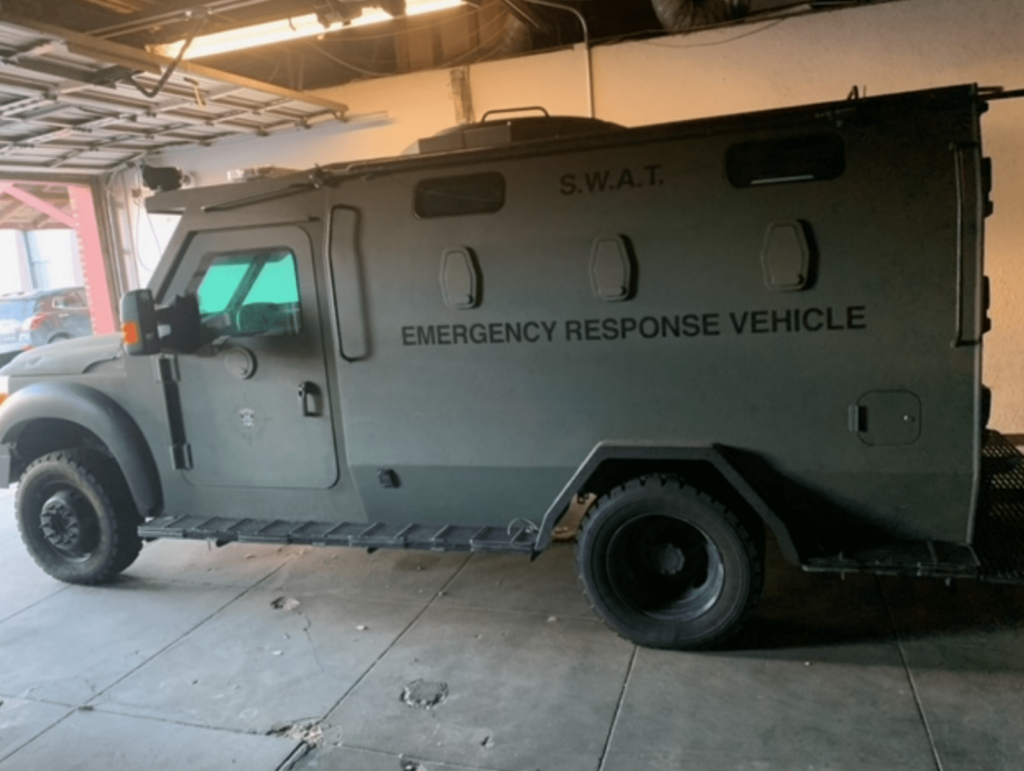
Police Chief Joshi also presented APD’s Annual Military Equipment Report as required by Assembly Bill 481. APD deployed its Emergency Response Vehicle (ERV) 12 times in 2023, using it to transport officers/agents to provide protection for high-risk operations, such as arresting a barricaded subject, in Alameda or as requested by the Oakland Police Department or the U.S. Marshal. The ERV was also staged out of view during the 4th of July parade but was never needed.
APD has received no complaints about its equipment use since adopting the Military Equipment Use Policy. An equipment inventory and audit revealed all military equipment was accounted for and in its assigned storage areas. In 2023, military equipment cost $25,086, primarily for the purchase of 20 new AR-15-style rifles. This year, APD intends to acquire ammunition for its rifles to conduct annual training.



Councilmember Jensen’s motion to accept the military equipment report passed 5-0.
Natel’s hydraulic test facility
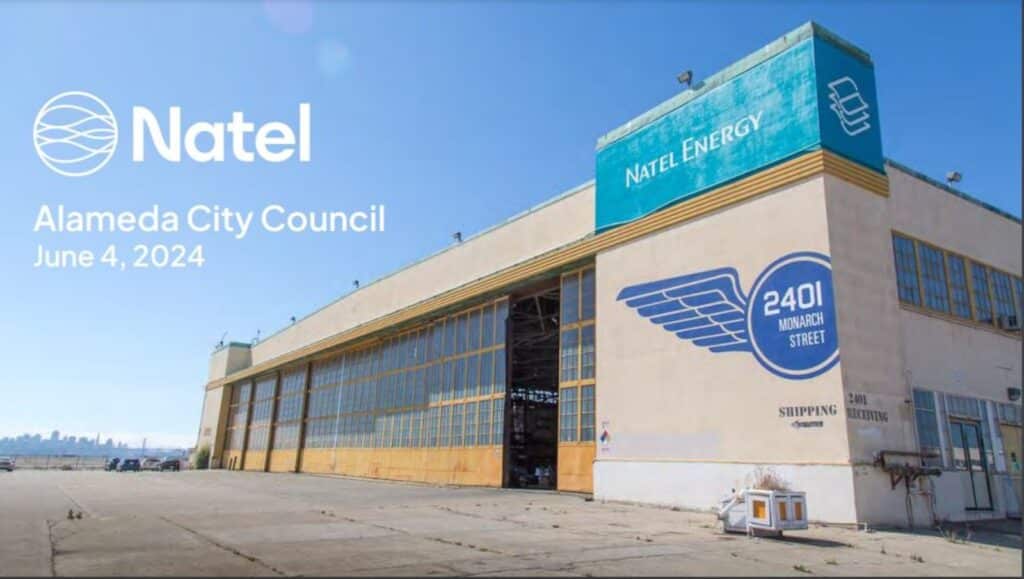
Natel Energy is a climate technology company that designs fish-safe hydraulic turbines for the hydropower industry. It was one of the first clean technology companies to locate at Alameda Point. Natel leased 2401 Monarch Street in 2015. Its investors purchased the property in 2018.
Natel uses its operations yard on the north side of Hangar 23 for research and development (R&D), testing fish-safe turbine designs. Natel seeks to expand its facility by adding a test loop with overhead piping and a 20,000-gallon reservoir.
In April, the Planning Board approved Natel’s use permit to allow outdoor storage, outdoor R&D, and the design for a 25-foot tall, 5,500-square-foot hydraulic test facility. The approval will facilitate Natel expanding its testing platform for the fish-safe hydraulic turbines the company has been developing for over 14 years.
In May, Councilmembers Herrera Spencer and Vice Mayor Daysog filed a Call for Review of the Planning Board’s decision, contending that:
- The Planning Board hearing was not properly noticed.
- Natel’s test facility is incompatible with Spirits Alley due to view blockage.
- The project generates vibration and excessive noise incompatible with protecting the nearby endangered California Least Tern colony.
- View impacts on nearby tenants, especially Building 43 Winery, are an unacceptable reduction in lease values.
- The Board findings were inadequate.
Staff rebutted each contention. Most significantly, staff stated that “the view in question is not part of any city-adopted view corridor nor is it a character defining feature of the Naval Air Station Alameda Historic District.” Staff added that while the project does expand the existing 25-foot-tall test equipment, the approved plans reduce and consolidate as much as possible Natel’s storage and support equipment near the hangar and include a “no-build” area to maximize views from Monarch Street.
Public comment
Public comment was primarily in favor of the permit, with supporters encompassing neighboring businesses such as Rain, Navier, and Pyka, the Alameda Chamber and Economic Alliance, Community Action for a Sustainable Alameda (CASA), and Alameda residents.
Kenny Jensen, CTO of Navier, argued that Alameda Point is unique in the Bay Area. “It is one of the few places that has the space and infrastructure to support developing large-scale hardware such as Natel’s hydraulic testing facility.” He noted that startups bring investment, jobs, and building improvements.
Elizabeth Goodine, Head of Manufacturing at Pyka, called Natel’s expansion “a crucial step in scaling their revolutionary hydropower technology,” while Erik Chubb, a former member of the Alameda Economic Development Advisory Panel, said, “Natel has a mission aligned with the values of Alamedans.”
Alameda parent Christine agreed, saying, “Natel is part of inspiring the next generation.” Ruth Abbe of CASA added that CASA supports the tourism and quality of life provided by tenants of Spirits Alley, but “we must balance those with an investment in the future.”
However, Tod Hickman, Building 43 Winery (Building 43) co-owner and winemaker, referred to Natel as “a great project, great concept, just the wrong location.” Referring to a photo he provided of Natel’s operations yard, he said, “As you can see, nothing but junk.”

Hickman noted that Building 43 started its business at 2440 Monarch Street in 2014 before Natel. He said that at the time of their arrival, “There was never any talk of industrial/manufacturing uses on Spirits Alley. Our view…was amazing and the primary value in our long-term lease.” He argued that the City has a higher duty to first-in tenants and decried the City intermixing industrial manufacturing with Spirits Alley. He contended that the structure is illegal and not exempt from CEQA review as the City claims.
Council discussion and vote
Mayor Ashcraft said that Natel is the kind of business Alameda should be proud of and asked all to remember that this is private property and, at the time of purchase, there was no negotiation over views. She further called for a permit condition requiring Natel not to place structures or storage in the northeast corner of the lot to be removed, arguing the property owner should be able to use their property as they see fit.
Councilmember Vella concurred, saying she was concerned about placing additional conditions on buyers after a sale. Vice Mayor Daysog countered that although he agreed there was no discussion of views at the time of sale, property owners understand they must follow the local municipal code. The Planning Board asked only that Natel use areas on the western portion of the site “to the maximum extent possible.” Vella responded that a condition worded as a request, rather than a requirement, is difficult to enforce.
Councilmember Herrera Spencer said this is not what Building 43 signed on for when they became a tenant. She said at the time of their signing a 10-year lease, there was a different city manager who strongly promoted Spirits Alley and a different vision for the area. Consequently, Building 43, as a small business, invested significant time and money. She added, “The city has an obligation when they bring in tenants to support those tenants,” and called it the City’s problem if they didn’t inform Natel at the time of sale about view needs.
Vice Mayor Daysog’s motion to uphold the Planning Board’s decision but to strike the permit condition calling for Natel not to place any structures or storage containers in the northeast corner passed 4-1, with Herrera Spencer voting against.
Contributing writer Karin K. Jensen covers boards and commissions for the Alameda Post. Contact her via [email protected]. Her writing is collected at https://linktr.ee/karinkjensen and https://alamedapost.com/Karin-K-Jensen.

