Proposal to eliminate “the Kevins” dropped
On Tuesday, July 21, City Council discussed whether to place a measure on the November 2026 ballot to eliminate the elected City Auditor and City Treasurer positions, and voted to prohibit parking in any designated Class II, Class III, or Class IV bicycle facilities. Council also adopted resolutions appointing and reappointing members to various City boards, and approved in a 4-to-1 vote—with Councilmember Tony Daysog dissenting—the final passage of an ordinance to place a $300 million general obligation bond measure on the November 2026 ballot.
Debate over Auditor and Treasurer positions
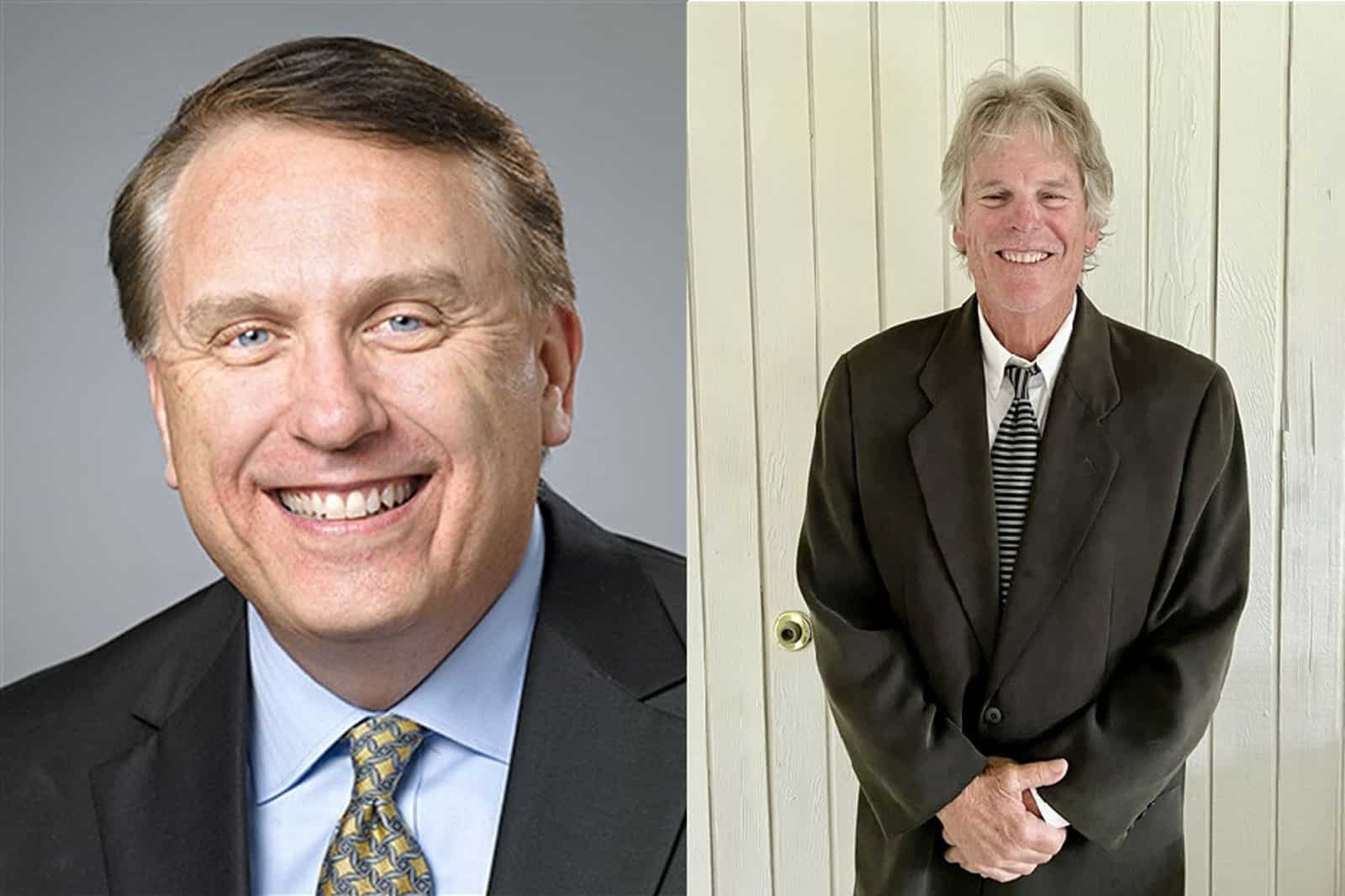
The Council’s Charter Review Subcommittee, made up of Mayor Marilyn Ezzy Ashcraft and Vice Mayor Michele Pryor, introduced a proposed resolution to place a City Charter amendment on the November 2026 ballot that would eliminate the offices of the elected City Auditor and City Treasurer, held currently by Kevin Kearney and Kevin Kennedy, respectively.
In introducing the item, Ashcraft explained that the positions were first established in 1937, when the current City Charter was adopted. Since then, she and Pryor argued, a lot has changed.
For example, many state laws are now in place that govern municipal finances and auditing and reporting functions. Furthermore, only two other cities in Alameda County—Berkeley and Oakland—have elected auditors, and they perform a different function than Kearney’s assigned role. Ashcraft also questioned whether continuing the positions would be the best use of City funds, revealing that although the annual salaries have been fixed at $3,600 since 1937, each official receives benefits that total around $470,000. Eliminating the roles could save the City about $84,000 annually.
“At a time when every city, including ours, is facing budget deficits, I think it behooves us, as part of the fiduciary duty we hold as elected representatives…to give it to the voters to decide because this is public money,” Ashcraft said.
“This is not a referendum on their hard work,” added Pryor, emphasizing that it was more a matter of addressing redundancy. “The City regularly uses third-party auditors and the City has a Finance Department that regularly reports to Council in public meetings,” she added.
The other three Councilmembers had plenty of clarifying questions. Councilmember Tracy Jensen inquired which laws or practices overlap with Kearney and Kennedy’s duties.
In response, City Manager Gerry Beaudin clarified that Council now reviews the City’s investment portfolio. Finance Director Ross McCarthy added that the creation of the Government Accounting Standards Board (GASB) in the 1980s outlined standards for the oversight of accounting practices in local government, along with transparency requirements and checks.
Councilmember Greg Boller probed further, questioning the duties of the third-party auditors that the City hires, and ultimately concluded that the core issue underlying the debate was electoral independence. Similarly, Daysog asked pointed questions by reciting portions of the City Charter to ultimately demonstrate that City staff and department directors answer to the City Manager, who, in turn, answers to the Council, whereas the elected Auditor and Treasurer answer directly to the voters.
“The Kevins” speak out
Known colloquially as “the Kevins,” Kearney and Kennedy were allowed to speak and answer Council questions during public comment through a motion made by Boller and a unanimous vote by Council.
Kennedy spoke first and began by emphasizing that he does not intend to run for Treasurer again once his term expires in 2028.
“I am not here tonight to try to preserve my job, preserve my benefits. This isn’t at all about me,” said Kennedy. “This is about a position that—as a resident, someone who has firsthand experience with it—is critical for this government to have.”
He indicated he was “shocked and dismayed” by the proposal and considered it a step backward in government transparency and accountability. He expressed frustration with the lack of public engagement and outreach, noting that he and Kearney only found out about it at the same time as everyone else—when it was posted as an item on Council’s agenda.
Kennedy argued that Alameda needs independent, elected watchdogs, not just financial experts, and relayed a series of achievements that he and Kearney have made over the decades, such as exposing liabilities like Alameda Municipal Power’s “failed telecom venture” back in 2006, as well as his and Kearney’s ongoing collaboration with various Councilmembers and City departments.
When Kearney took to the podium, he called out Ashcraft and Pryor for proposing to eliminate his position despite never speaking with him about his duties.
“I’m the elected Auditor. I don’t answer to anyone in this building. I answer to the people of Alameda. I cannot be fired for finding the truth, can’t be fired because you don’t like me,” he declared. “In summary, the elected Auditor negates collusion, it counsels out undue influence, it ensures that the books are clean, the staff is safe, and the public is protected.”
Like Kennedy, Kearney revealed he will not seek reelection, but detailed several experiences over the years where his independence made him a valuable asset as an advocate for voters and an independent, confidential whistleblower for City staff.
Councilmembers sought to hear more about their duties and how they view their independence as an asset to the community.


“The laws have changed, but it doesn’t make the job any less relevant and it never will,” Kennedy responded. “If it was as simple as following a law, then companies wouldn’t get in trouble, cities wouldn’t get in trouble.”
He also noted that his responsibilities have expanded beyond the codified core duty of guiding the City’s investment policy to also working closely with City staff to develop cash-flow models or investing funds, or chairing financial task forces.
Kearney also highlighted how both roles are ultimately accountable to the voters, whereas third-party auditors hired by the City are largely inaccessible.
For the remainder of public comment, all four speakers opposed the proposal to eliminate the roles.
“Eliminating an independently elected Auditor and Treasurer moves financial oversight away from the voters and away from the people, and into the hands of officials who answer to City Hall rather than directly to the public,” said speaker Amos.
“Both Kevin Kearney and Kevin Kennedy have shown to be consummate professionals and have been doing a great job keeping the City solvent,” added speaker Karen. “Getting rid of these elected officials feels a lot like Trump firing his five-star generals.”
Council discussion and conclusion
During discussion, both Ashcraft and Pryor applauded Kearney and Kennedy’s contributions but ultimately reiterated that their roles do not align with typical municipal practices and are duplicative of City staff responsibilities and outside auditors.
Boller expressed reluctance at eliminating the positions without a replacement model, and suggested consolidating duties into a single Auditor position, while permitting Kearney and Kennedy to complete their terms. He made a motion as such, along with a companion motion to direct staff to return after the election to develop long-term options. However, he received no second and both motions failed to move forward.
Daysog voiced his opposition both to the proposal and any effort to table the discussion until a future meeting. He argued that the relatively small cost is worth it to have independent individuals in both positions, and launched into an extensive story detailing how municipal malfeasance in 1936 led to the charter reforms in 1937 that created the elected Treasurer and Auditor roles.
Jensen also expressed disapproval of the proposal and noted that a previous charter subcommittee helmed by Daysog and former Vice Mayor John Knox White, which explored the same proposal in 2019, had polled attendees at a League of Women Voters meeting at the time and found that most opposed eliminating the positions.
As it became clear to Ashcraft that the required four Council votes to approve the resolution could not be reached, she decided to move forward without calling for a vote on the item, which means that “the Kevins” will retain their jobs and the elected Treasurer and Auditor positions will continue to exist.
No parking in all bike lanes
Later in the meeting, Council discussed a proposed ordinance to amend the Alameda Municipal Code to prohibit parking that obstructs Class II (bicycle lanes), Class III (bike routes or Alameda’s Neighborhood Greenways), or Class IV (separated or protected bike lanes) facilities, and to amend the master fee schedule to add fine amounts for such violations.
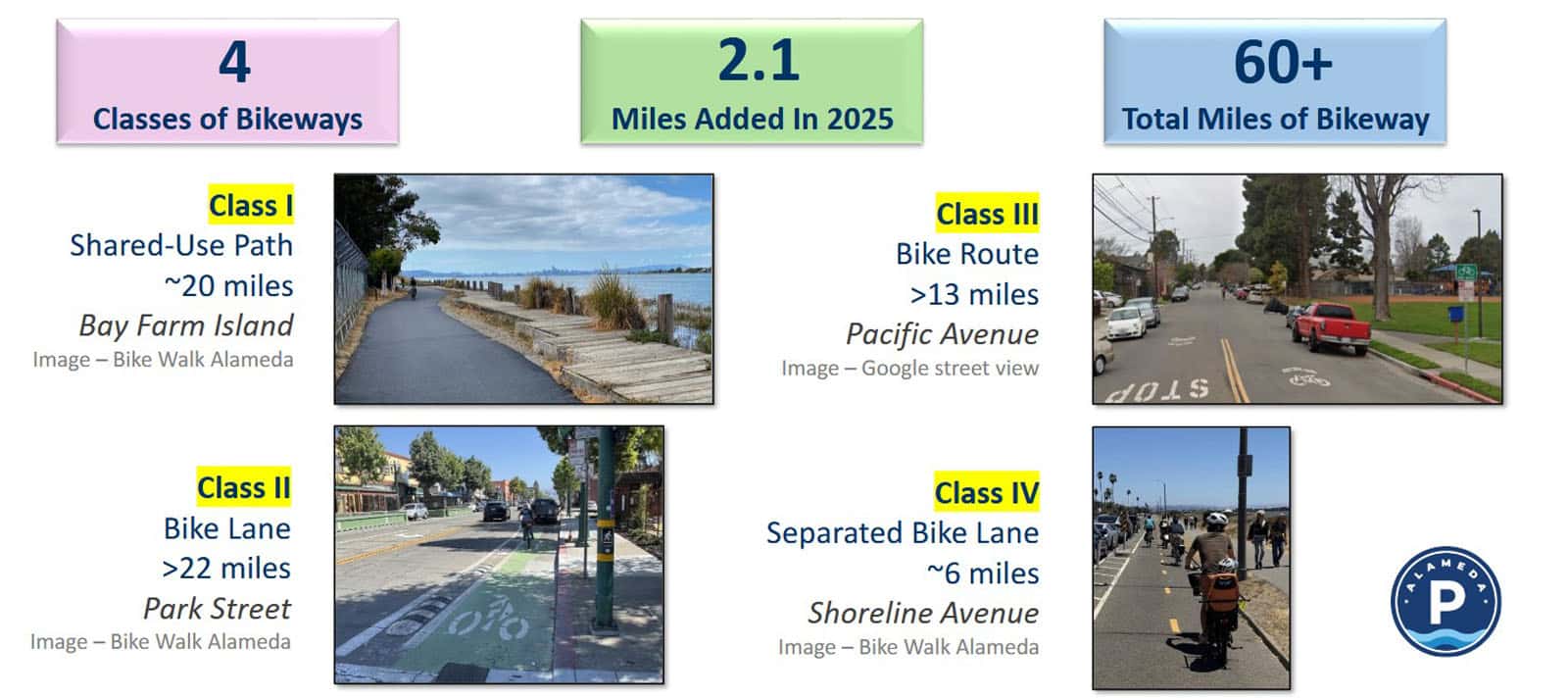
Parking Manager Ricardo de la Torre started his presentation with a map and explanation of each type of bikeway, then pivoted to describing the existing enforcement gap. Currently, the California Vehicle Code only explicitly prohibits parking in Class I facilities, known more commonly as shared-use paths. No state prohibitions cover the other classes. Therefore, citations issued by traffic enforcement relating to bike lane blockages rely on workarounds, such as “no double parking” or “out-of-marked-space,” with no citywide uniformity.
The proposed ordinance would create an initial fine of $79 for parking in bike lanes, with a late penalty of $53. They would become effective on October 1, 2026, following the final passage of the ordinance in September.
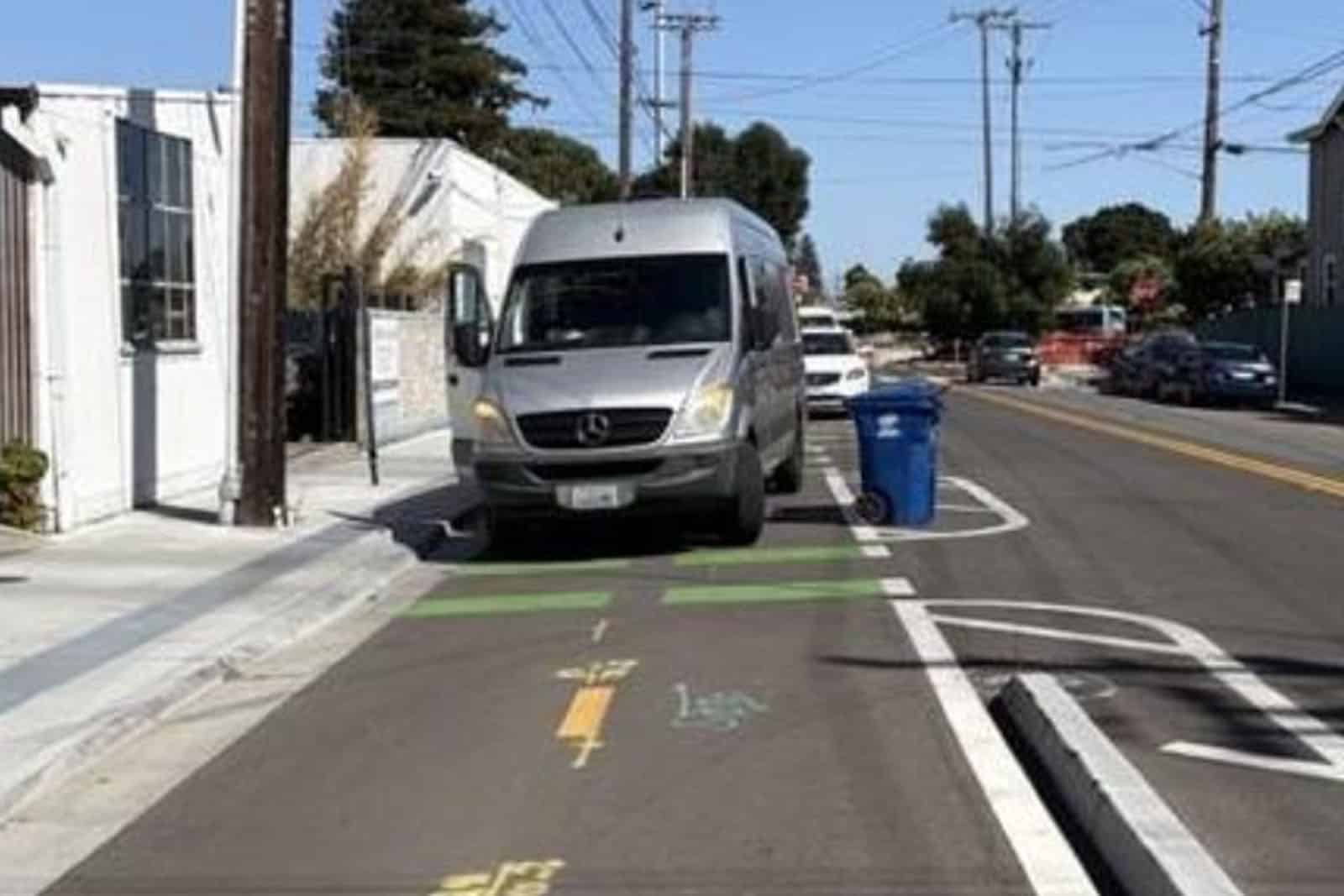
Ashcraft expressed concerns about how the new language could impact how businesses, particularly along Park and Webster Streets, receive deliveries from trucks. In response, Public Works Director Erin Smith clarified that there are designated loading zones at curbside and on side streets for this purpose.
Council voted unanimously to approve the proposed ordinance, which will come before Council for final passage during its next meeting on Tuesday, September 1 after its summer hiatus in August.
Ken Der is a contributing writer for the Alameda Post. Contact him via [email protected]. His writing is collected at AlamedaPost.com/Ken-Der.

