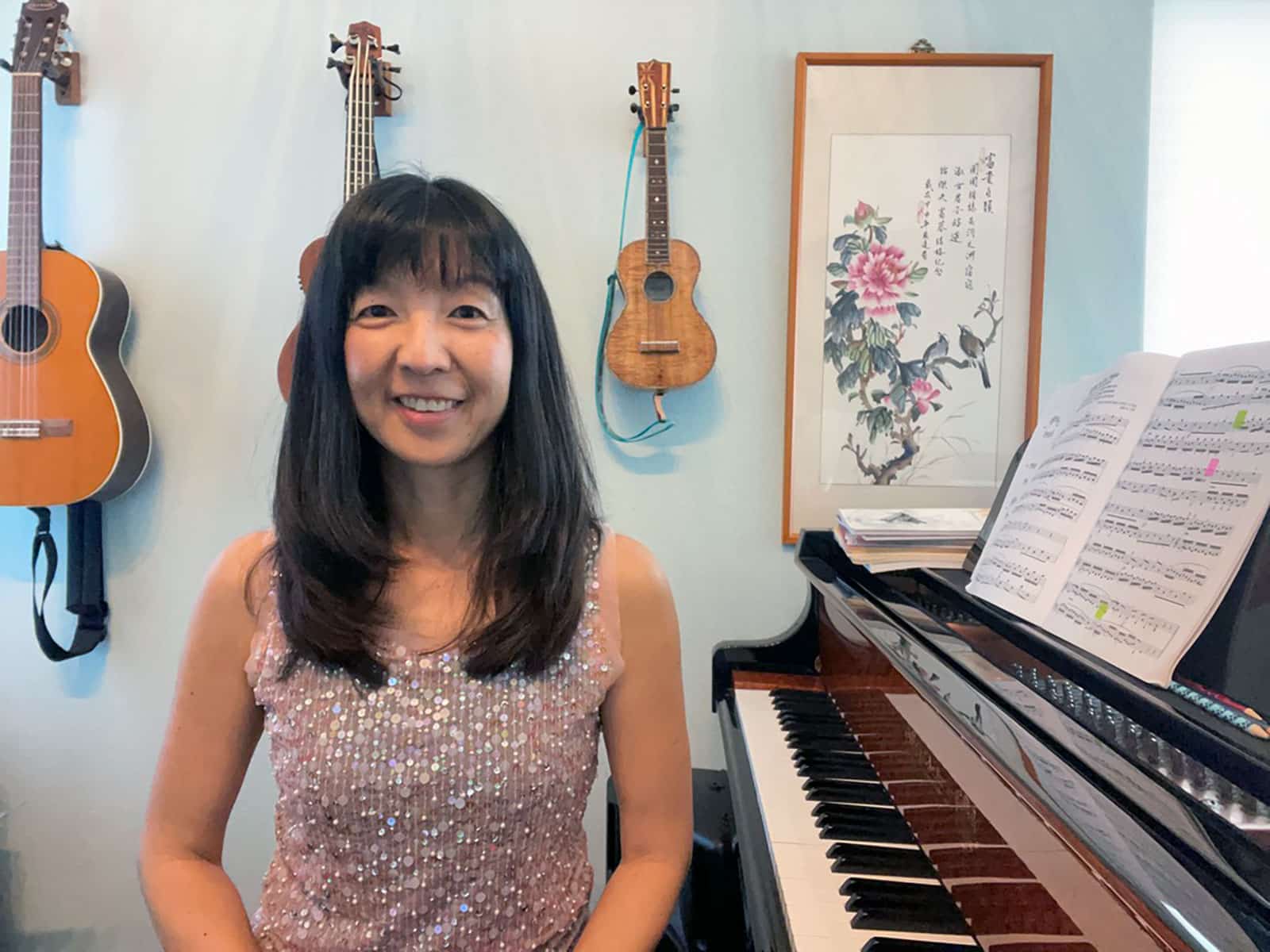
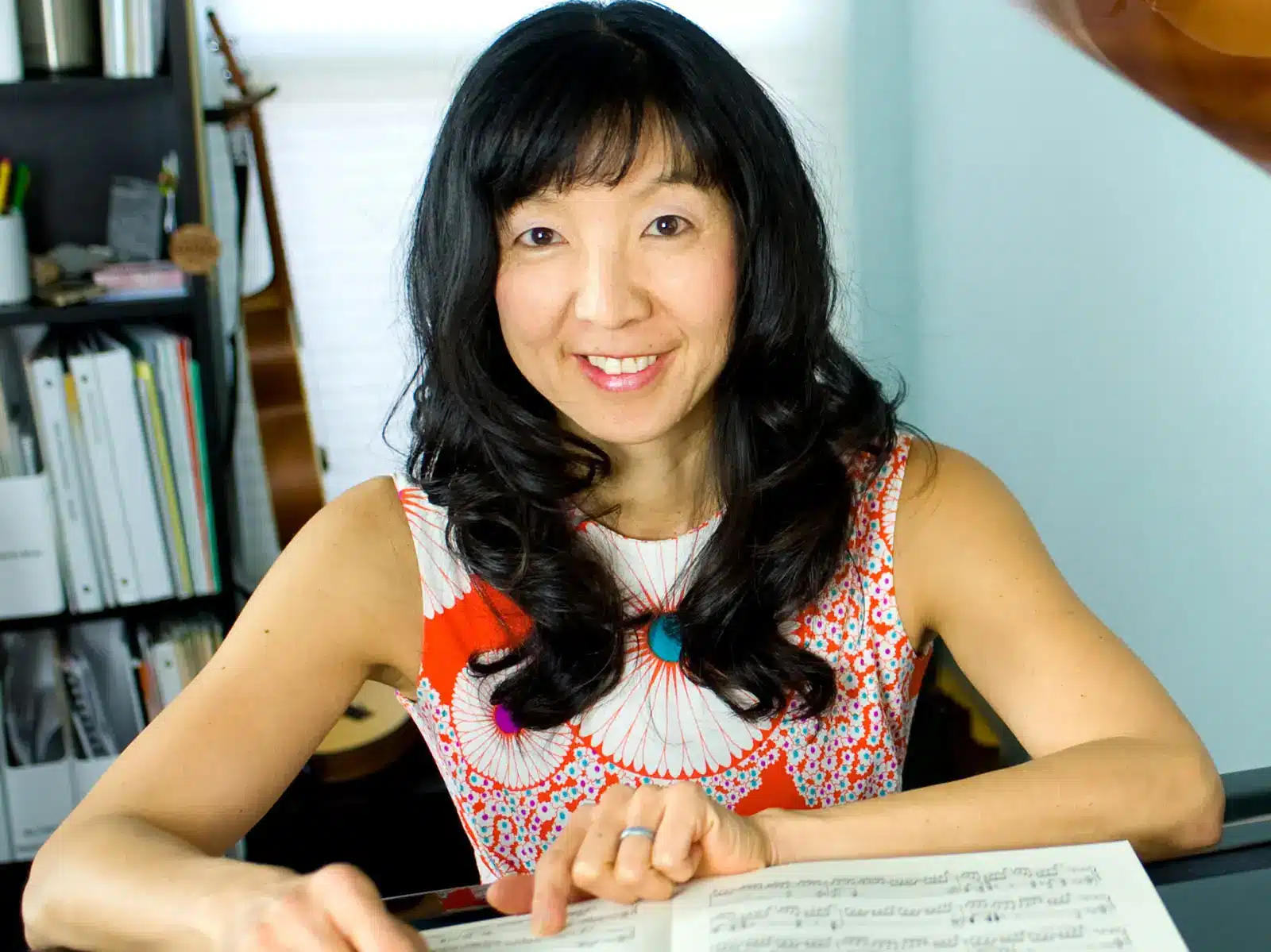
It’s hard to pick my favorite Barbie Wong moment (when she used to come into Books Inc. with her kids, her schlepping Aris, offspring and beloved member of the Foodbank Players, to and from rehearsals), but I’m going to go with this: Prior to opening A Christmas Carol, we arranged to sing carols in front of Daisy’s Mercantile on Park Street. Barbie offered to accompany us on her accordion. So we donned our Dickensian gear and gathered, when all of a sudden Barbie arrived dressed super-duper splendidly and toting her instrument. Suddenly we were a thing—not a gaggle of actor/singers, but a choir, and without much rehearsal and very little direction from yours truly, the voices and music blended into something mighty special. People stopped on the street, Ron Mooney of Daisy’s recorded the event, and up and down the avenue holiday spirit flowed. Barbie’s contribution spoke to her nature as an artist, a parent, a person—talent rich, generous of heart, and full of fun, fun, fun. Read below to find out more about one of my favorite people on this whole darn adorable island: 5Q4 Barbie Wong.
At what moment did you discover that you wanted to be an artist?
Being a musician was simply part of what I did growing up. All the kids in our family took piano lessons, and I also played the flute and sang in choir. My parents were not musicians but they prioritized music lessons. I suppose going to college and switching from pre-med to a major in music may have further solidified my identity as an artist. I loved studying music at Stanford—being in choir, learning to conduct, and falling in love with musicology. I really enjoyed learning about the history and theory behind the music I was playing.
Who was the most influential person who helped you achieve your goal?
This is a tough question because there were so many people who supported my journey. In terms of making my life in the arts possible, it would have to be my parents, Leon and Judy Wong. They would drive us an hour each way to piano lessons, saving every penny so that we could learn music. Honestly, they sacrificed so much to pay for music lessons. We collected cans, ate the cheapest vegetables, and only shopped in the clearance racks.
My mom also made sure all four of us practiced, even though she had a demanding job. And I remember really hating practice. But without her reminders and insistence that we practice, none of us would be so musical today. My mom was also open to new ideas, very creative, and a lifelong learner. Even though she is not musical at all, the way she approached life gave me a model to follow. I now love playing a variety of music—from tango to Hawaiian—and I’m always up for learning new things. For example, in the past five years, I have learned to play the accordion and drums, and I’m constantly creating new content for my workshops for parents and music teachers.


Tell about the best—or a best—experience you had as a performer.
I’m not that interested in performing solo, so my favorite performances happen with other people. My kids play the piano and cello, and they have been performing regularly at Water’s Edge Lodge, a local retirement home, for several years. Near the end of their hour-long set, we pass out songbooks and encourage the residents to sing with us. I will join in on the piano or ukulele. I love seeing how happy the residents become when we all make music together, and I love how my kids have learned to communicate with these wonderful seniors.
Conversely, tell us about a pretty bad experience.
A tango band needed a pianist to fill in for a gig, so I agreed, having never played any of the music before. I had only a few days to learn 30 pieces and only one rehearsal with the band. Luckily, not too many attended the performance, because I got lost so many times. The band members were kind to me afterwards, and I actually ended up joining that band when their pianist left. But that was the last time I will ever agree to perform that many pieces on such short notice.
Any advice to folks out there hoping to pursue a life in the arts?
Yes! Two pieces of advice: (1.) Find a role model. This could be an artist you admire or a mentor. Especially when you’re just starting out, having someone you look up to can really help. And if you can find one or more people that can guide you on your path, that can make things so much easier. (2.) For those who want to become a musician or some kind of performer, it’s important to recognize the difference between practicing and playing. Playing is when a performer is on stage and looks like they are having the time of their life. Playing is easy and fun, and it comes from hundreds of hours of practice. Practice, on the other hand, is hard work and is often not fun. But practice is necessary to become great at your craft. Realize that you will have to put in a lot of work (practice) until mastery. Knowing this, don’t compare your private self—the one who struggles and deals with failures—with other people’s public selves, the ones that seem like they are having loads of fun. Everyone is on their own path, so listen to your intuition and know that your journey will be uniquely yours.
Gene Kahane is the founder of the Foodbank Players, a lifelong teacher, and former Poet Laureate for the City of Alameda. Reach him at [email protected]. His writing is collected at AlamedaPost.com/Gene-Kahane.
