On April 7, City Council advanced two major policy efforts—the next phase of the Bay Farm Island Shoreline Adaptation Project, a long-term effort to protect the area from rising sea levels and flooding, and sweeping updates to the City’s rent ordinance, the first comprehensive overhaul since 2019, which includes strengthening tenant protections, clarifying rules for landlords, and improving enforcement.

Bay Farm Island Shoreline Adaptation Project
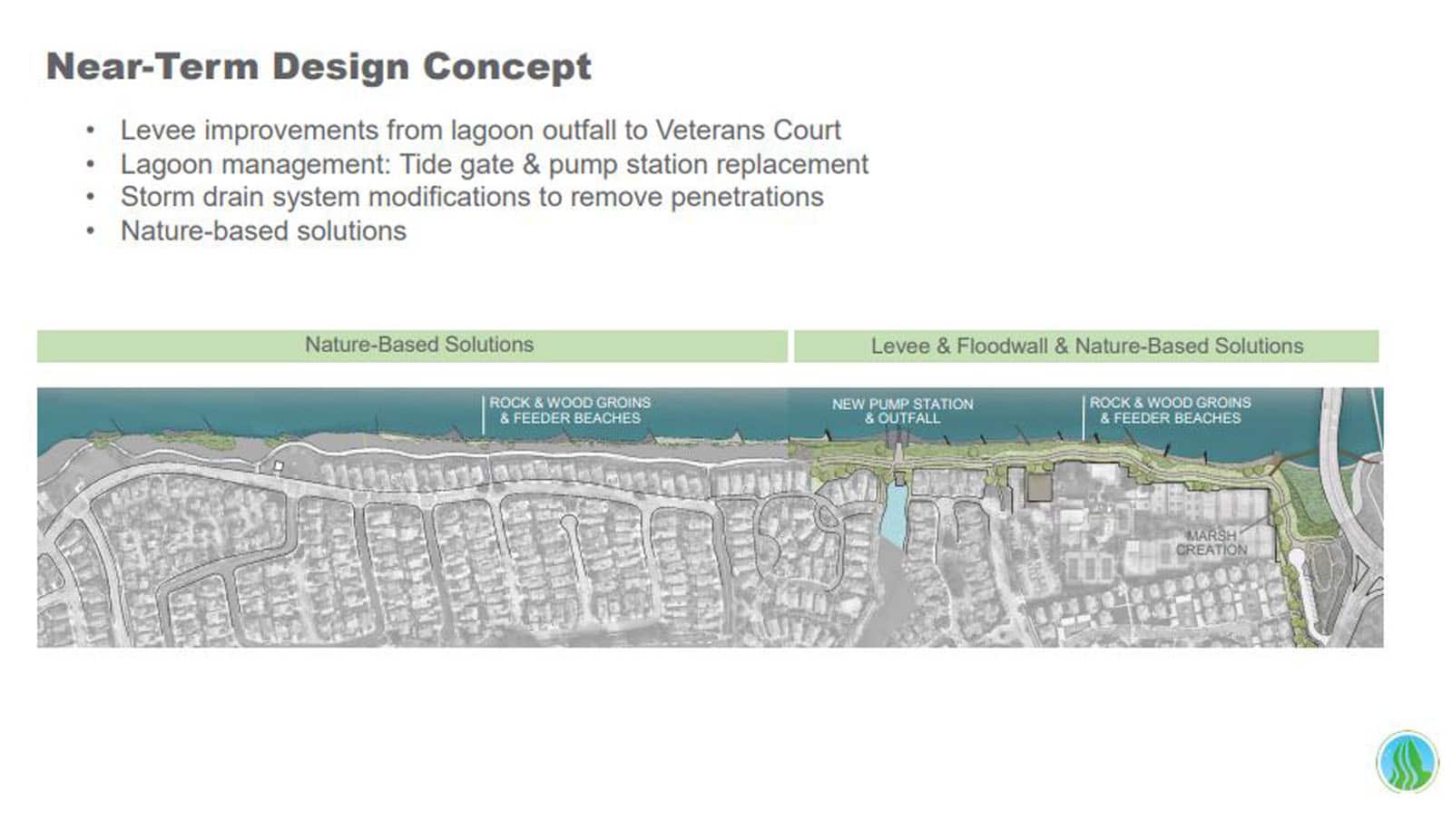
Sustainability and Resilience Manager Danielle Mieler proposed the next phase of the Bay Farm Island (BFI) Adaptation Project, which aims to protect BFI from rising seas. The City will use new grant funds to advance design and permitting, community engagement, and an interim measure to protect Island Drive, while laying the groundwork for long-term climate resilience.
Mieler requested approval to: 1) accept $2.64 million in grant funding from the State Coastal Conservancy, 2) allocate $50,000 from the General Fund for Public Works staff costs, and 3) administer contract amendments for key contractors, including CMG Landscape Architecture, the Greenbelt Alliance, Community Action for a Sustainable Alameda (CASA), and the San Francisco Estuary Institute.
The BFI Adaptation Project is part of the broader Shoreline Adaptation Plan, which addresses the entire city and is required by state law. Alameda has completed its initial phase and secured additional funding to complete a compliant plan by 2027-2028, in partnership with Oakland.
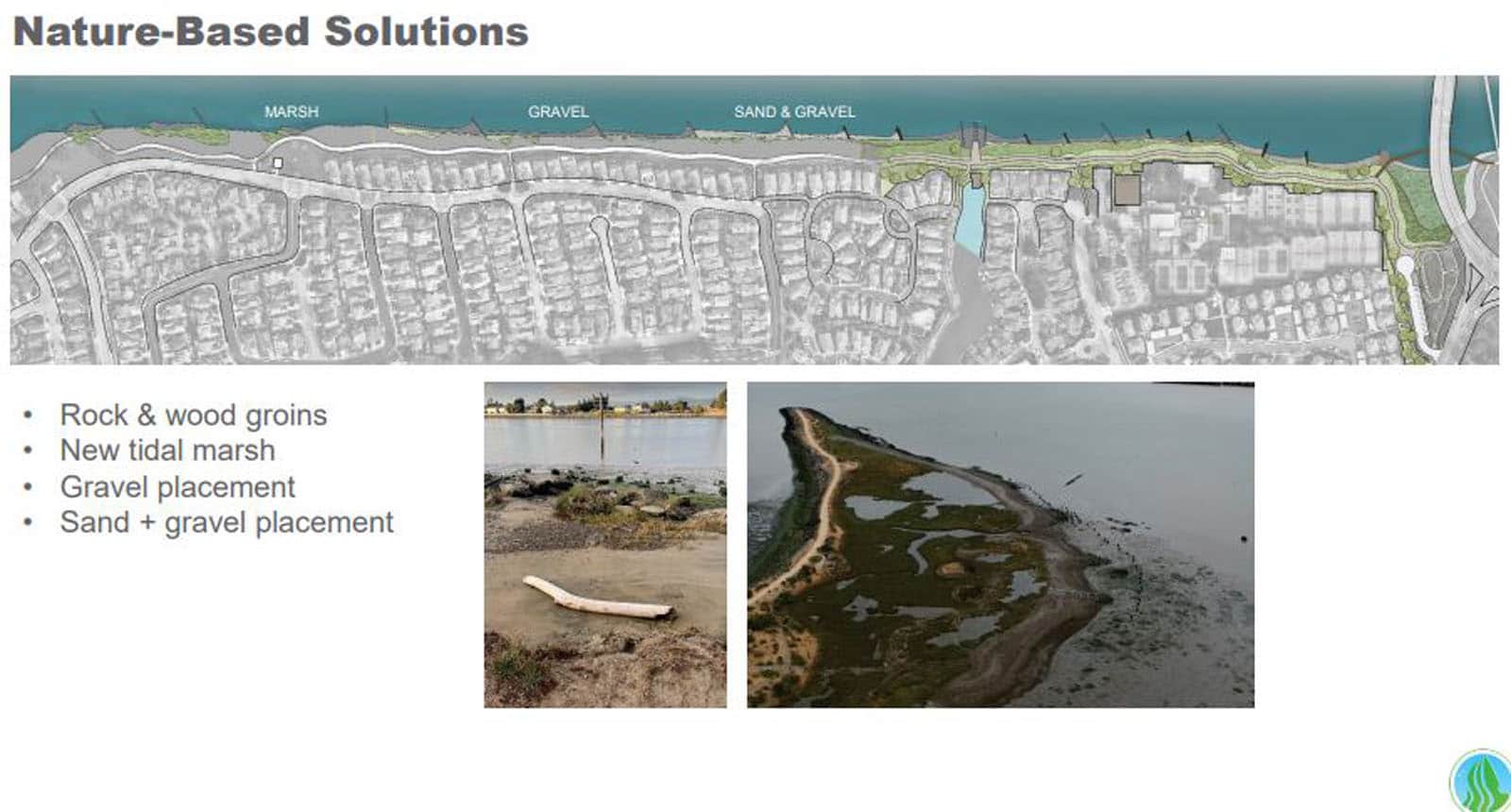
The BFI Adaptation Project focuses on near-term lagoon-area flood risks (up to 2 feet of sea-level rise) and integrates nature-based shoreline protections, ecological restoration, and public amenities. Proposed features include upgraded Bay Trail access, ADA paths to the shoreline, a new fishing pier, improved parking, a pump station, and innovative erosion-control elements, such as cobble headlands designed to retain sediment and support marsh formation.
Design has reached 30% completion, with the new grant funding enabling advancement to 60% design and permitting. The planned interim measure for Island Drive is to raise the roadway’s elevation. The raised roadway will act as a temporary barrier against flooding, particularly against water coming from the Oakland side, protecting Bay Farm Island neighborhoods until longer-term shoreline adaptation projects can be designed and funded.
Community engagement is ongoing, with construction tentatively targeted around 2030, pending additional funding.
Water from all sides amid funding uncertainty
The state’s latest sea level rise guidance reports that sea levels could rise by about a foot by midcentury and by more than 6 feet by the end of the century. Alameda can expect water from all sides, including rising seas, heavy rainfall events driven by rising temperatures, high tides exacerbated by coastal storms, and rising groundwater due to soil saturation. Alamedans have experienced a preview of potential mid-century conditions during recent king tides.
In a recent interview with KQED, Mieler noted that if the City took a do-nothing approach, water could engulf streets, homes, businesses, and the Posey and Webster Street tubes that connect traffic to Oakland and the mainland.
During last December’s infrastructure workshop, Mieler reported that, overall, near-term shoreline adaptation will require $295 million. Regionally, the Bay Conservation and Development Commission (BCDC) estimates $110 billion is needed Bay-wide by 2050 to protect communities, infrastructure, and natural habitats.
At Tuesday’s City Council meeting, Mieler discussed challenges with federal funding, noting that a previously promising $50 million FEMA BRIC (Building Resilient Infrastructure and Communities) grant was canceled when the federal administration canceled the entire BRIC program in April 2024. Consequently, the City has shifted toward a piecemeal funding strategy and has begun considering interim protections, such as raising Island Drive.
Subsequent lawsuits and a court order directed FEMA to resume the program, and a new funding opportunity was issued, but Mieler emphasized that it is “a very different program” from the original, and it is unclear whether the City can continue its original application or needs to reapply. Until FEMA stabilizes, key details remain unresolved. In the meantime, Mieler underscored a step-by-step, grant-driven approach to advancing climate resilience projects amid funding uncertainty.
Public comment and Council vote
Public speakers broadly supported Alameda’s shoreline adaptation efforts. Lauren Eisele with Community Action for a Sustainable Alameda said, “The design… with the nature-based solutions as well as the public amenities… all reflect what the public has identified as priorities.” Zoe Siegel, Senior Director for the Greenbelt Alliance, agreed, saying, “This item is more than a contract. It’s about ensuring Alameda shoreline adaptation efforts are shaped by the people who are most affected.”
Councilmembers unanimously approved the proposal, praising staff—especially Mieler—for advancing a complex, grant-funded effort to address sea level rise. Mayor Marilyn Ezzy Ashcraft noted that other Bay Area officials have praised Alameda as an example for climate adaptation: “We are on the cutting edge… Alameda has a forward-thinking [approach].”
Rent program amendments
Council considered a sweeping update to the City’s rent ordinance—the first comprehensive overhaul since 2019—aimed at strengthening enforcement and clarifying tenant and landlord rights. Presented by Rent Program Director Bill Chapin, the proposed amendments reflect what he described as a “wish list” of changes developed over more than six years to improve how the law functions in practice.




A central change would reshape the appeals process for rent disputes. Currently, only tenants or landlords can challenge a hearing officer’s decision in court. The proposal would allow City Council to step in—affirming, modifying, or reversing decisions—before any judicial review, aiming to ensure that individual rulings do not undermine broader City policy.
The amendments also revise relocation payment rules, requiring tenants to be displaced for at least seven days before qualifying for permanent relocation assistance, while preserving daily payments for shorter disruptions. Staff said the change balances tenant protections with fairness to landlords who are addressing minor habitability issues in good faith.
In cases of unlawful evictions, tenants would gain the right to return to their unit or receive relocation compensation if they decline to reoccupy.
Several updates focused on compliance and enforcement. Landlords would be barred from raising rents unless fully compliant with the ordinance, including outstanding hearing officer orders, and could not increase rents on one unit while violations persist elsewhere on the property.
The proposal also formalizes pandemic-era practices, allowing temporary rent reductions. The idea is that landlords could temporarily lower rent to help tenants experiencing short-term financial hardship. The rent could later be restored to its prior level once the tenant’s situation improves. This would only be allowed if there is clear documentation showing that both parties understood the reduction was temporary, not a permanent reset of the base rent.
Additional clarifications address how the ordinance applies to subsidized housing. Publicly owned affordable housing would remain fully exempt, while privately owned subsidized units—including Section 8 and below-market-rate units—would continue to be partially regulated.
The City would also reaffirm that new property owners inherit responsibility for any existing violations, and the ordinance would add a definition of “master tenant” to clarify obligations in subletting situations.
Alongside the ordinance changes, staff recommended adopting two resolutions: one updating rent program fees and maintaining fee waivers for Section 8 units, estimated to cost about $50,000 annually from the General Fund, and another repealing an outdated Ellis Act resolution now covered by administrative regulation. The Ellis Act is a state law that gives landlords the right to exit the rental business by evicting tenants and removing rental units from the market, typically to change the building’s use.
More complex issues, including rules governing how landlords charge tenants for utilities, are not included in the current package. Chapin said those policies require additional stakeholder input and will be returned to Council for consideration at a later date, potentially in June.
Council Discussion and Vote
Councilmember Tracy Jensen asked for clarification on the issue of landlords being barred from raising rents unless fully compliant with the ordinance, asking whether there was the potential for landlords to face hefty rent repayment requirements if, for instance, an issue such as a stove requiring repair, was not reported for several years.
Chapin emphasized that enforcement is not retroactive without due process. A landlord is only considered out of compliance after a tenant reports the issue and, if the landlord is non-responsive, files a petition to the rent program, and a hearing officer issues a formal order. As long as landlords respond to notices and correct issues when identified, they can avoid repayment obligations.
Jensen also raised concerns about property sales involving violations. Chapin confirmed that when a rental property is sold, the new owner assumes responsibility for outstanding violations, including financial liabilities. He encouraged buyers to check a property’s compliance status with the rent program before purchasing. Sellers are legally required to disclose violations, though enforcement may depend on private legal action between the buyer and seller.
Council approved the proposal with four affirmative votes and one recusal by Councilmember Greg Boller.
Contributing writer Karin K. Jensen covers boards and commissions for the Alameda Post. Contact her via [email protected]. Her writing is collected at https://linktr.ee/karinkjensen and https://alamedapost.com/Karin-K-Jensen.

