Slippahs? Packed. Swimsuit? Packed two. Sunscreen? Hold on—before you pack that bottle into your suitcase, be sure you are not bringing an illegal substance to the islands. While technically you may have it in your possession, if your sunscreen contains the chemical oxybenzone and/or octinoxate, you will be prohibited access to many of our 50th state’s popular beaches and marine areas. Hawaii state law prohibits the sale, offer of sale, or distribution of these sunscreens.

Unless you have a medical reason requiring a prescription from a licensed healthcare provider, shop for a mineral sunscreen to take on your trip, because the law on Maui, the “Valley Isle,” is even more strict than the rest of the state and requires mineral-only sunscreen. Defy the law and it may result in a $1,000 fine.
I recommend regular use of sunscreen, as I shared in Demystifying Sunscreen. In addition to choosing and using the correct SPF (Sun Protection Factor) level, there are good reasons to choose a mineral sunscreen. Be sure to read the ingredients, as “Reef Safe” and “Reef Friendly” are not regulated terms and may not meet the requirements for your trip to Hawaii—look for zinc oxide or titanium oxide. Your sunscreen will not only protect your skin’s health, but your choice will help protect the health of our oceans and marine life. On the “Big Island”, Hawaii island, The Hawaii State Department of Land and Natural Resources (DLNR), banned the use of non-mineral sunscreen on commercial vessels that take tourists out on and into the Kealakekua Bay (Kealakekua Bay State Historical Park).
Protecting Marine Health
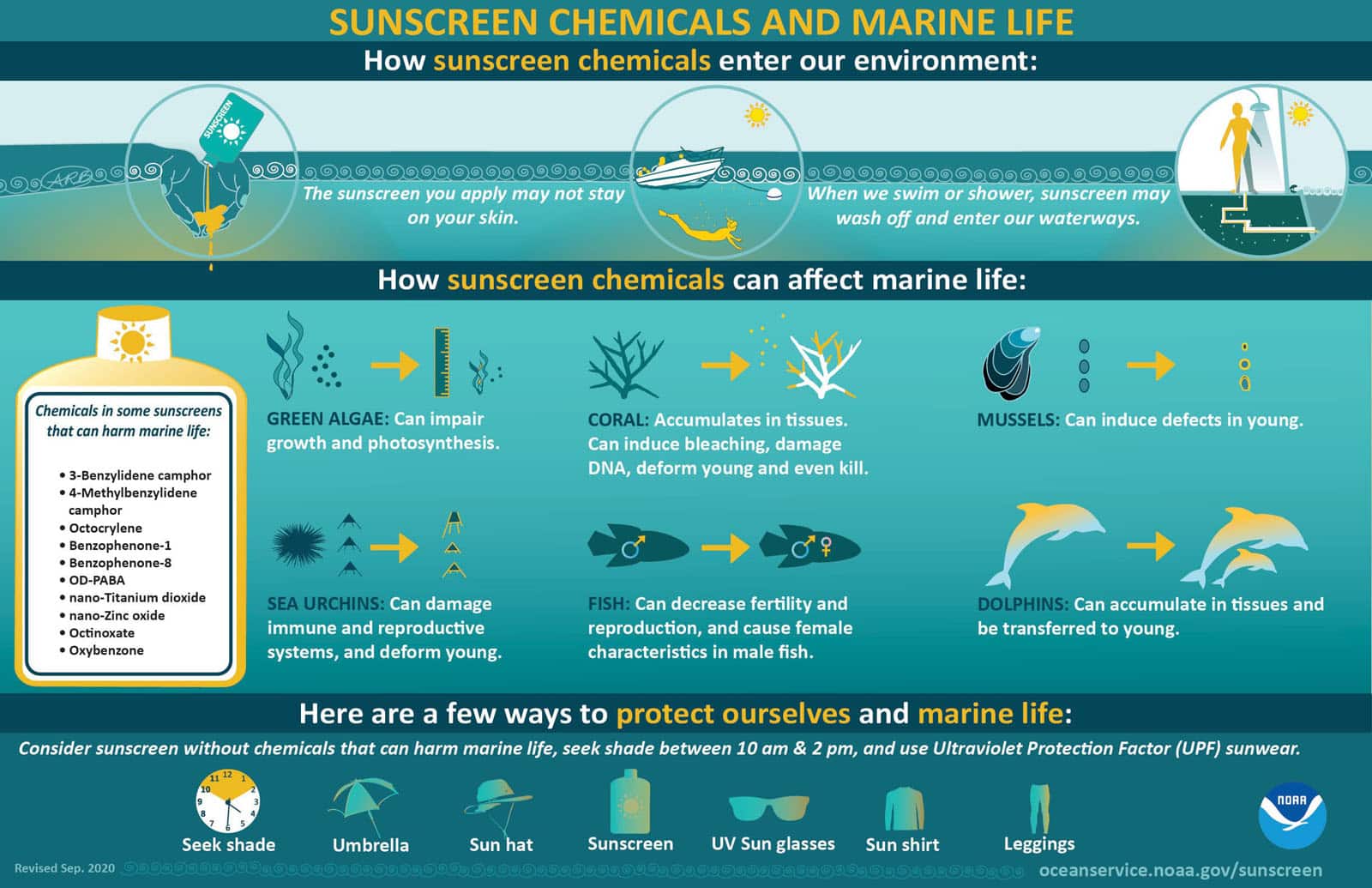
The two “O”-ffending chemicals cause genetic damage to coral and other marine organisms. Oxybenzone and octinoxate kill developing coral and stress mature coral, as indicated in loss of color or “bleaching.”
According to the text of the law, “Scientific studies show that both chemicals can induce feminization in adult male fish and increase reproductive diseases in marine invertebrate species (e.g., sea urchins), vertebrate species (e.g., fish such as wrasses, eels, and parrotfish), and mammals (in species similar to the Hawaiian monk seal). The chemicals also induce deformities in the embryonic development of fish, sea urchins, coral, and shrimp and induce neurological behavioral changes in fish that threaten the continuity of fish populations.”
Related Articles




And it is not just those two, but most chemicals found in FDA (Federal Drug Administration) approved sunscreens are toxic to our oceans.
Protecting Your Health
My sensitive skin was a frustration as a child and teen, but the knowledge that I gained in dealing with my epidermis has been a huge benefit to my children and their skin health. I have always needed to be careful with anything applied topically, and sunscreen was a biggie. Mineral sunscreen was all I could use, and now it is what I choose for my family as well. Not only do I want to avoid irritation, I aim to protect our skin from the harm that exposure to the sun—though I love the caresses of its rays—can cause. Also, for as long as I can remember, I have been a wannabe mermaid, so I need protection that can hang with me being in the water for long periods of time while being reapplied often. My children have inherited my love of water.
Fortunately, mineral sunscreen is more commonly sought after, and therefore, less expensive and more readily available, than when I was younger. The American Academy of Dermatology recommends physical sunscreens (also known as mineral sunscreens) for people with sensitive skin. My dermatologist, who was also a practicing pediatric dermatologist, recommended the same mineral sunscreens for my children as she did for me. All sunscreens absorb the sun’s rays, but mineral sunscreens additionally reflect the sun’s rays.
Not planning to visit the Big Island or Maui? Even if you are heading to Waikiki on the island of Oahu, the “Garden Isle” Kauai, or one of the others, why not opt for a mineral sunscreen? The waters surrounding each of the islands are shared and the marine life in those waters do not keep to the boundaries of each island. Or, bigger picture, as a citizen of this world, consider that 71% of the earth is covered by water and a great many of those bodies of water contain life. Take a little bit of Aloha with you wherever you travel. “Mālama i ke kai, a mālama ke kai iā ʻoe.” Translated, it means, “Care for the ocean and the ocean will care for you.”
Contributing writer Denise Lum is a Health and Fitness Coach raising her family in Alameda. Contact her via [email protected] or FitnessByDsign.com. Her writing is collected at AlamedaPost.com/Denise-Lum.
