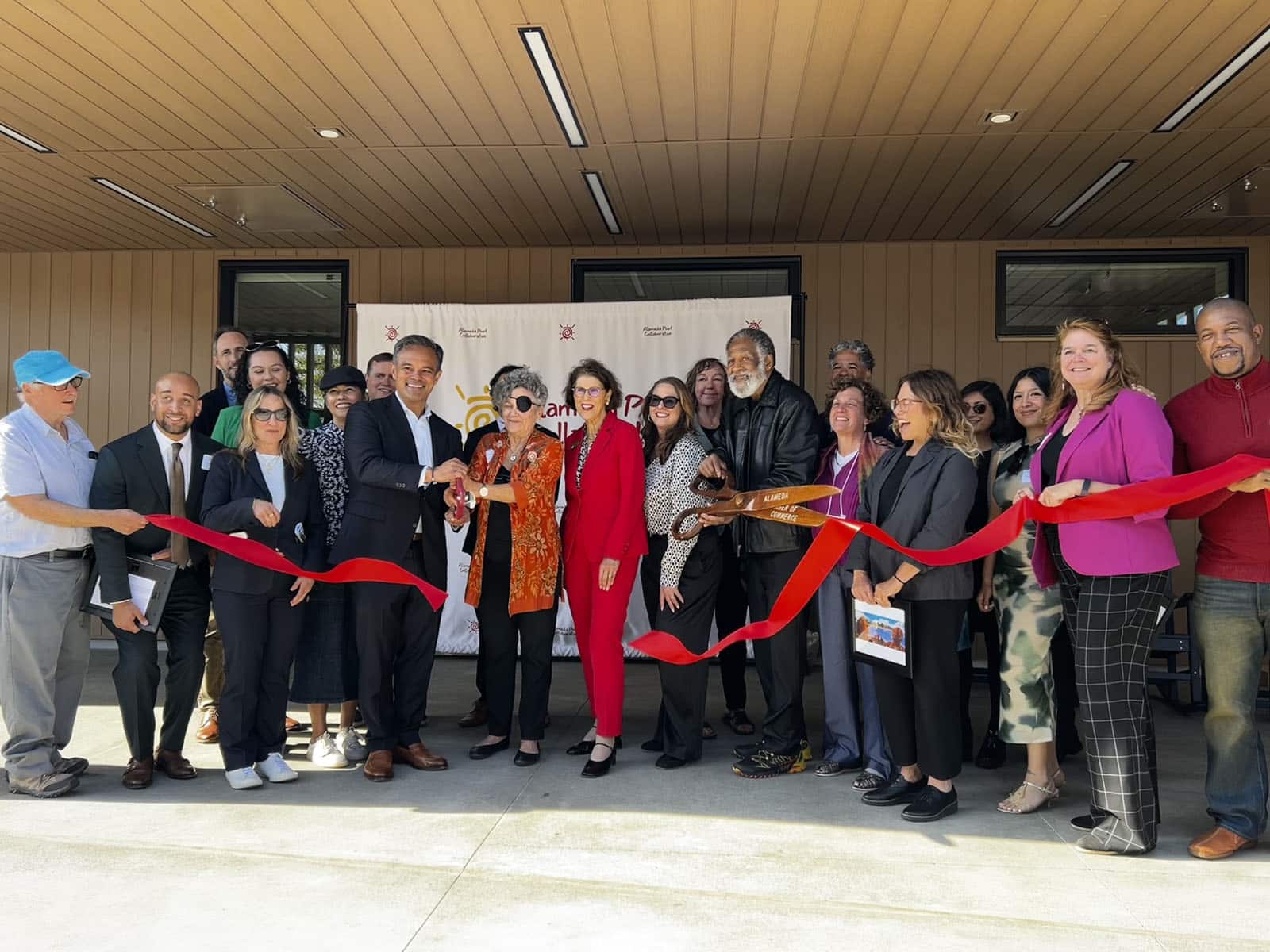
On April 30, Alameda Point Collaborative (APC), in partnership with LifeLong Medical Care, celebrated the completion of Arnold’s Place, formerly known as the “McKay Wellness Center,” a state-of-the-art, trauma-informed, 50-bed medical respite facility designed to support unhoused Alameda County residents as they recover from hospitalization or serious illness.
The ribbon-cutting marked the culmination of years of planning, philanthropy, partnerships, and community commitment and represents a key component of plans to repurpose long-vacant former federal office buildings in the Crab Cove area as a combined senior supportive housing, medical respite, and resource center.
A drumbeat of compassion
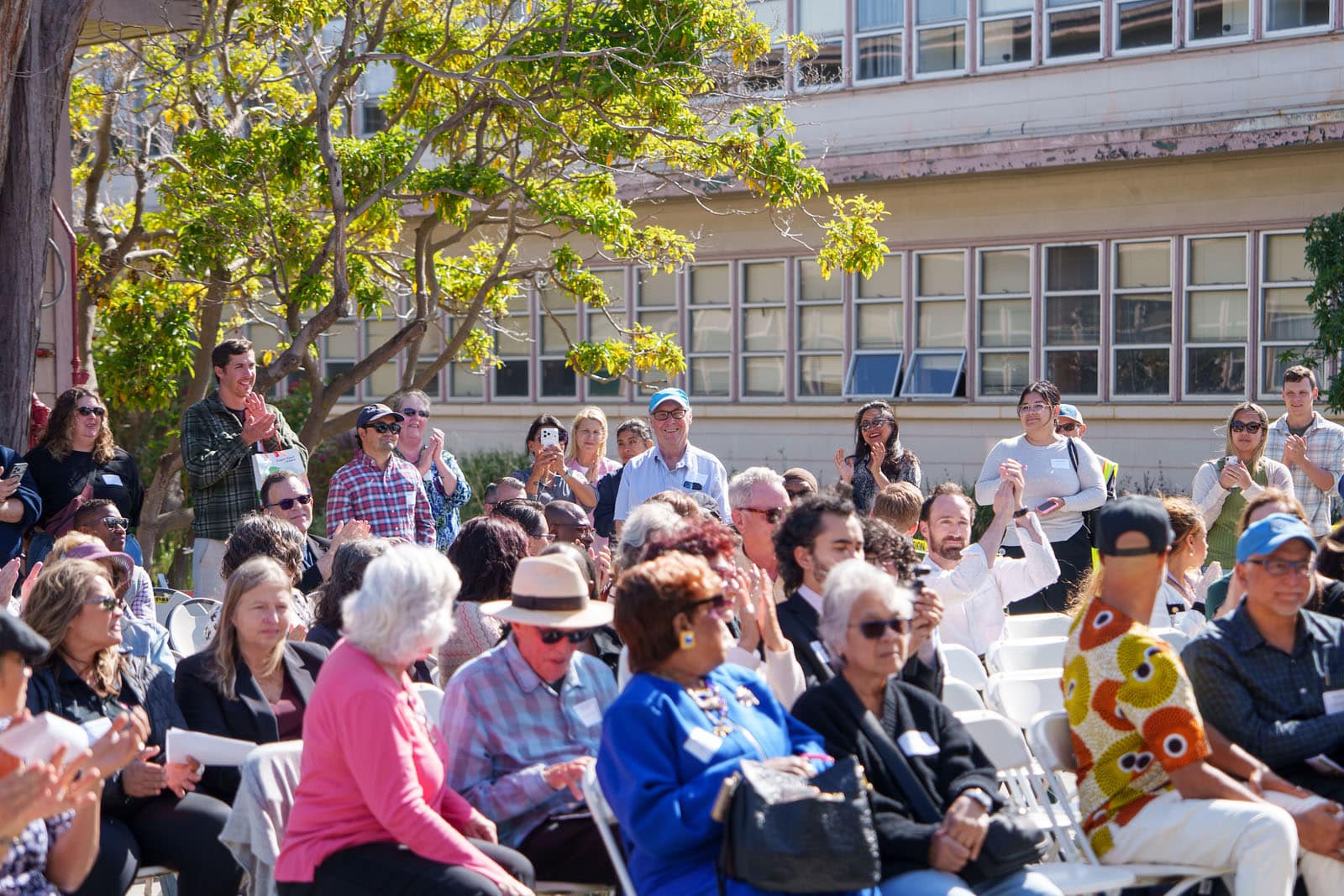
The celebration brought together public officials, healthcare providers, community partners, and advocates who made the project possible. Ryan LaLonde, president of the Alameda Unified School District Board of Education, opened by saying that the project represented “opening doors, doors to healing, to dignity and to a model of care grounded in the simple idea that people need a safe place to recover.” He noted that too many unhoused people have historically been released “back into the streets or into shelters or into conditions that are not meant for healing,” fueling “longer recoveries, preventable complications, and even loss of life.”
LaLonde emphasized that Arnold’s Place emerged only after sustained public organizing and neighborhood persuasion. The project faced numerous public and political obstacles, most notably the 2019 special election that pitted Measure A against Measure B, which forced voters to choose between reaffirming the City Council’s decision to zone the site for redevelopment for housing and services or designating the site as permanent open space to block the project from going forward.
“Getting here wasn’t easy,” LaLonde said, recalling “moments of real debate” when advocates had to “door knock and talk neighbor-to-neighbor to get this project off and going.” What ultimately prevailed, he said, was “a drumbeat of compassion… we refused to let this idea fade.” He described the finished facility as “more than a building,” calling it “a reflection of that persistence,” built around the understanding that “healing doesn’t just happen through medicine. It happens in spaces that feel safe, that feel human.”
Lead fundraiser Bonnie Wolf also emphasized the scale of collaboration required to bring Arnold’s Place to life, noting it was not the product of one agency or donor, but of a coalition of state departments, healthcare institutions, philanthropic foundations, nonprofit leaders, clinicians, and Alameda residents, with the State alone committing over $36 million.

Honoring a public health champion
Andrea Urton, executive director of the Alameda Point Collaborative, noted that naming the facility after longtime Alameda County Public Health Director and homelessness advocate Arnold Perkins was meant to honor “a legacy of service and heart” and to underscore that “every person who enters these doors has a name, has a story, and a right to wellness.”
Perkins delivered the ceremony’s most impassioned moral call, arguing that Arnold’s Place should be seen not as a charitable accomplishment but as a small corrective to a much larger civic failure. He repeatedly told the crowd, “I am my brother and sister’s keeper.” He said the persistence of street homelessness in a nation “teeming with resources” reflects “our own selfishness as people and as a nation.”
Perkins traced today’s homelessness crisis to decades of structural disinvestment—including deinstitutionalization, factory closures, war fallout, addiction, and the concentration of wealth. “We have enough money, so everyone ought to be housed, and it’s a shame that everyone is not housed,” he said.
He urged the audience to stop reducing unhoused people to stereotypes, noting that many turn to substances because they are trying to deaden pain and suffering. In one of his sharpest appeals, he told attendees: “No one should be sleeping on the street. This is the result, just a small token result, of what commitment can do.”
Even as the facility bears his name, Perkins rejected the idea that the achievement belonged to him personally. “It’s not Arnold’s Place,” he said. “This is a people’s thing.” Pointing to the assembled advocates, funders, and organizers, he added, “Those people that stood up, who caused this to happen, that’s Arnold right there.”
An integrated approach
State Senator Jesse Arreguín said that what distinguishes Arnold’s Place is its “integrated approach” that combines “supportive housing, medical respite, primary care, and behavioral health services, all in one place.” He called the campus “a model for the state of California” because it offers “not just treatment, but stability, dignity and a path toward long-term recovery.” He added that “healing requires more than medicine… It requires compassion and deep connection.”
Arreguín underscored the role of state backing and singled out Alameda Mayor Marilyn Ezzy Ashcraft and the City Council, predicting the facility would generate “many success stories” that will “transform hearts and minds… throughout the state of California.”


Ashcraft said that Arnold’s Place will provide respite care for 50 patients at a time and roughly 400 annually, while connecting residents to permanent healthcare, case management, and housing pathways. She called the opening “urgent” amid looming federal cuts to health and food assistance, warning that “people are going to be even more vulnerable. But Arnold’s Place is here.” She also highlighted the upcoming co-located resource center, which will help Alameda residents who are newly homeless or at risk of homelessness access services quickly, arguing that “it is far easier to prevent people from slipping into homelessness in the first place… than it is to work to resolve that problem the longer it goes.”
Framing the project as both compassionate and fiscally practical, Ashcraft said “such a thin line… divides the housed from the unhoused in today’s economy,” where “one auto repair, one health crisis, one missed paycheck” can trigger homelessness. She added that the facility would ease pressure on local hospitals, support Webster Street businesses, and stand as evidence of Alameda’s “can-do spirit and open heart.”
A healing environment
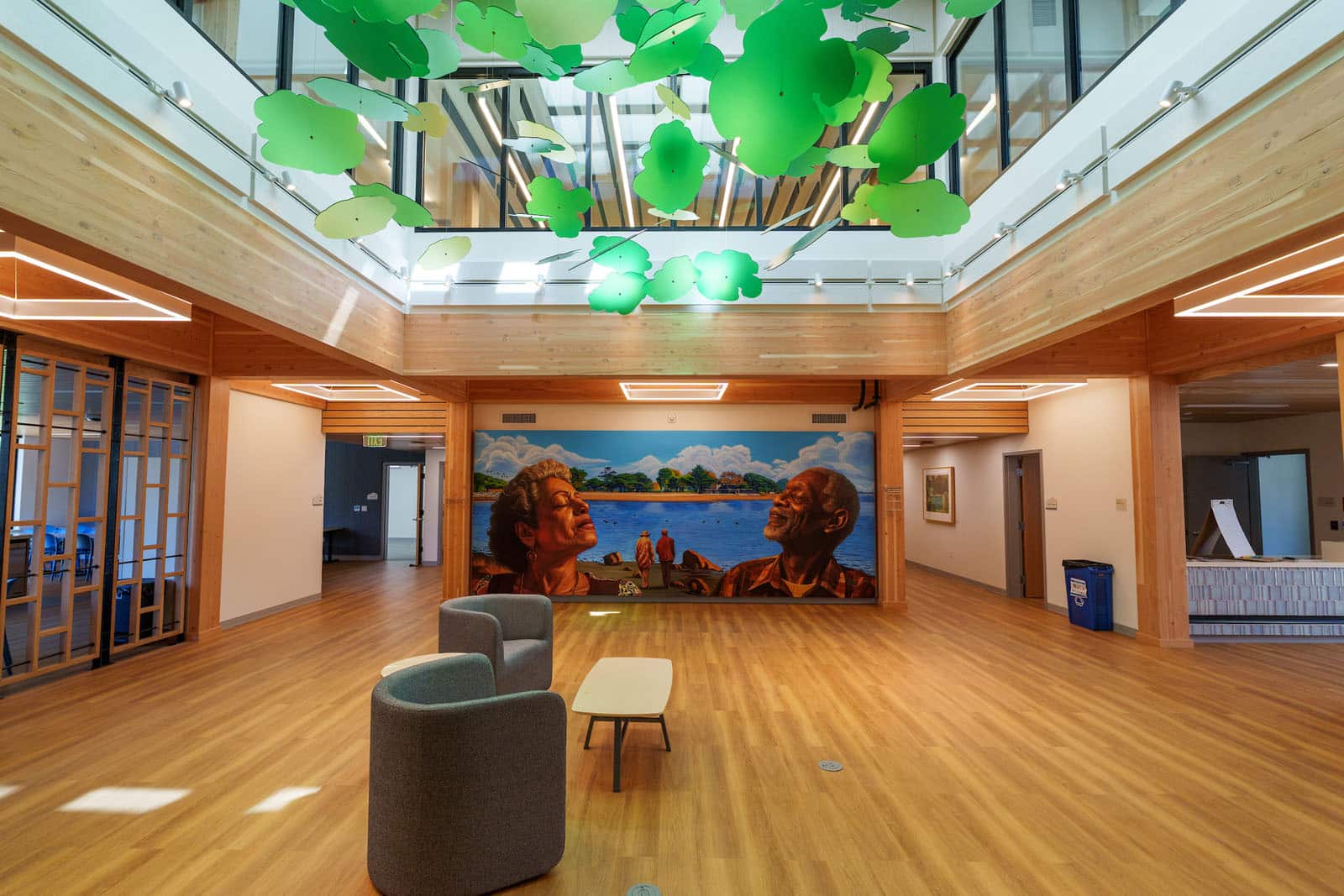
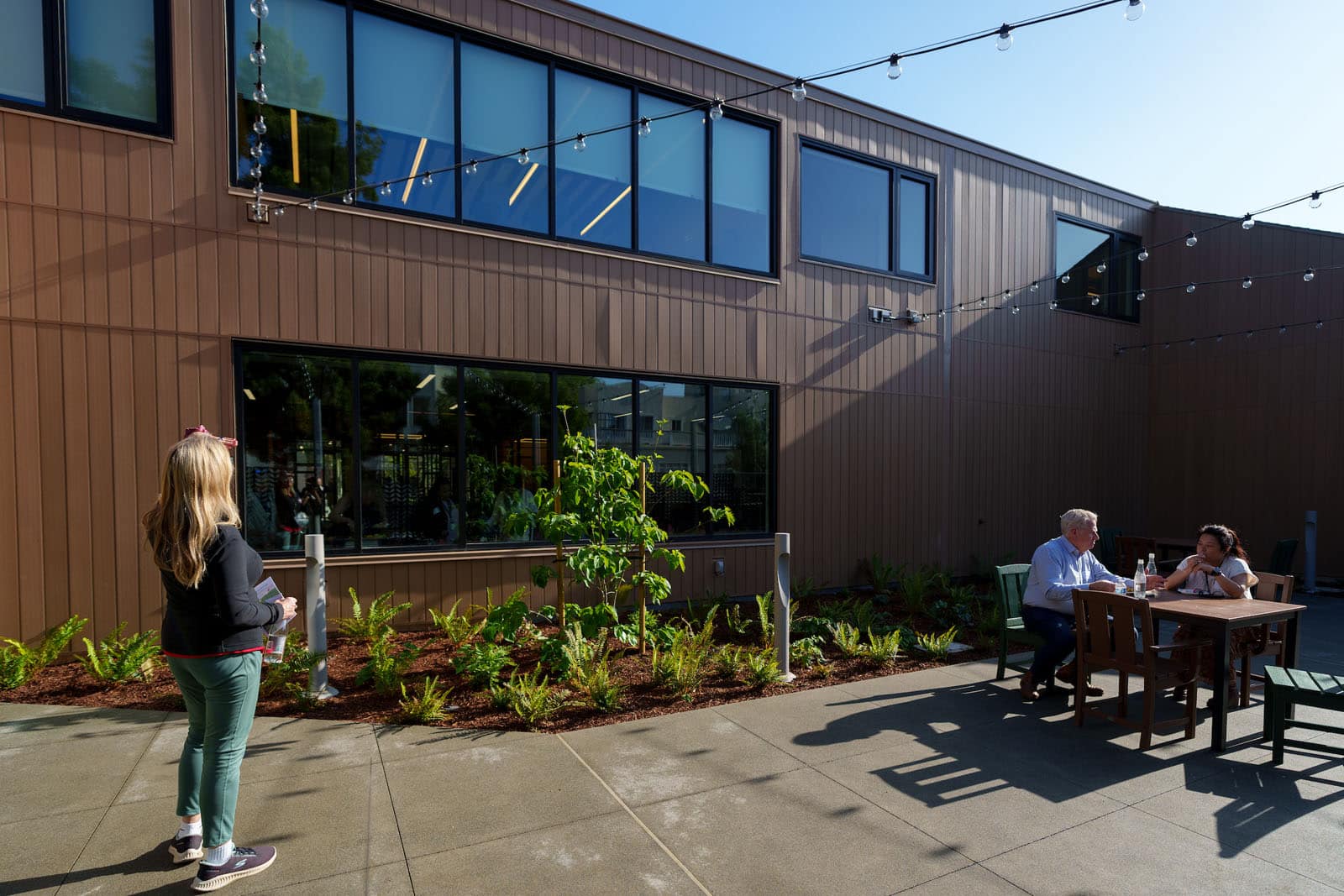
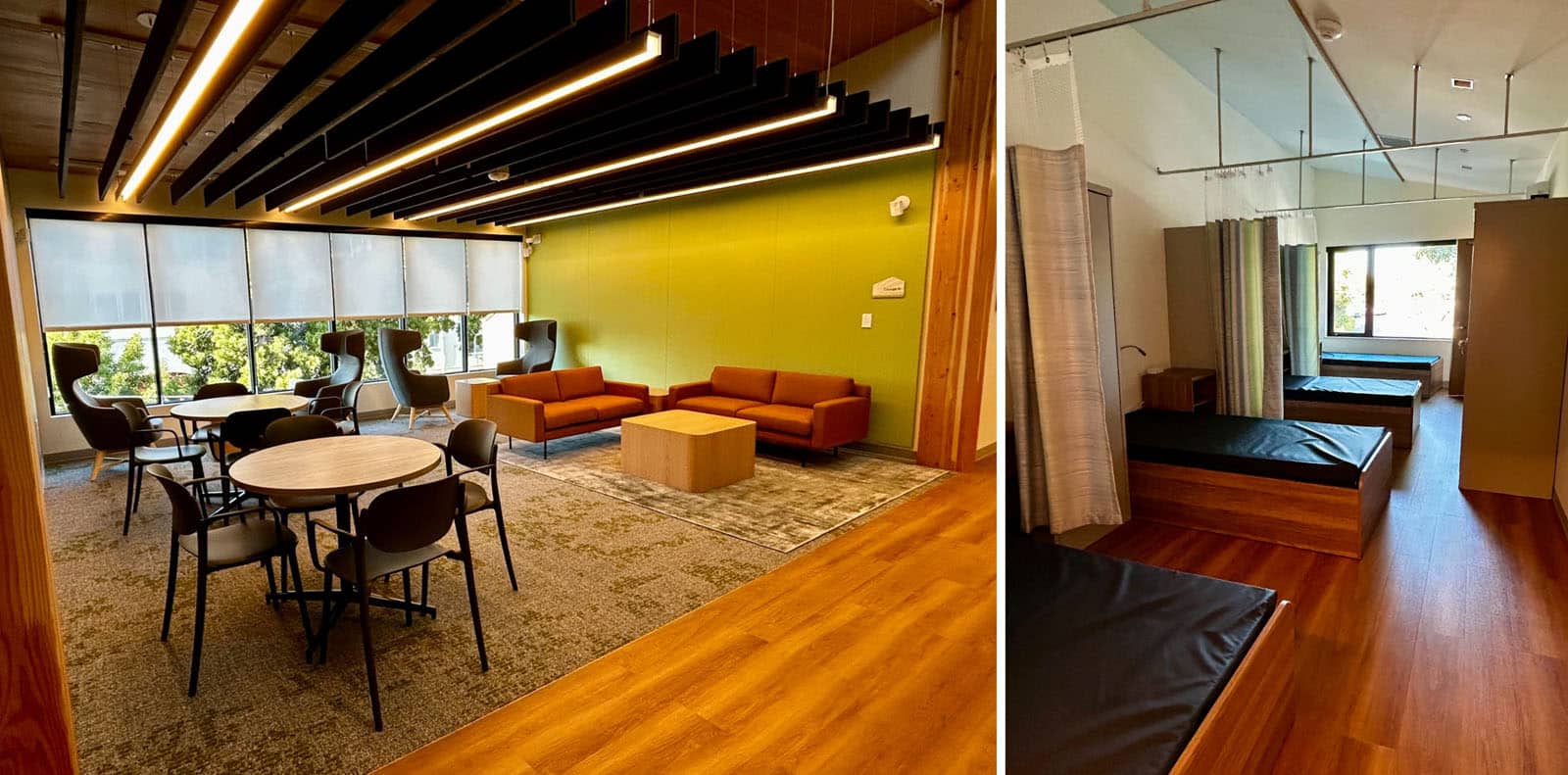
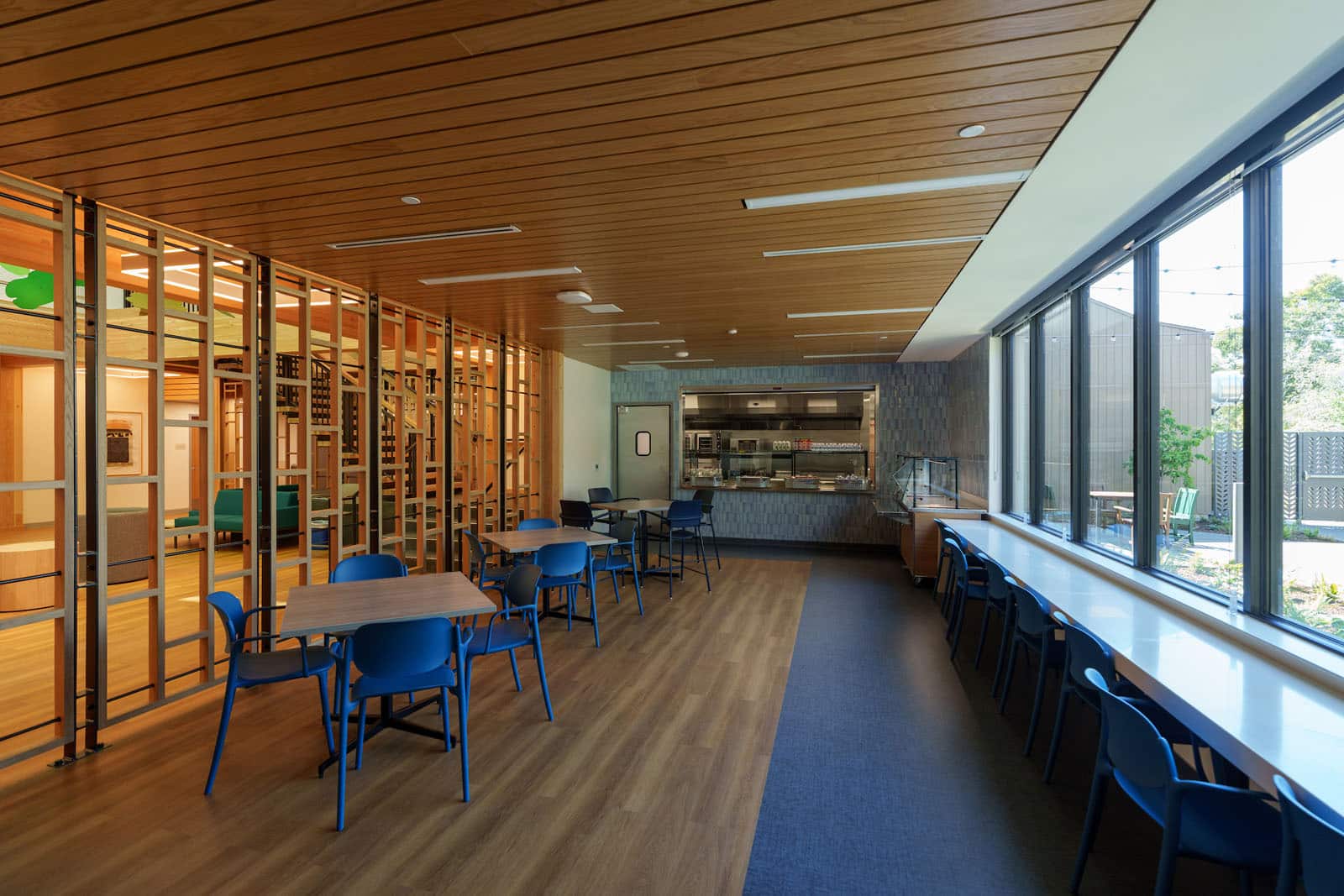
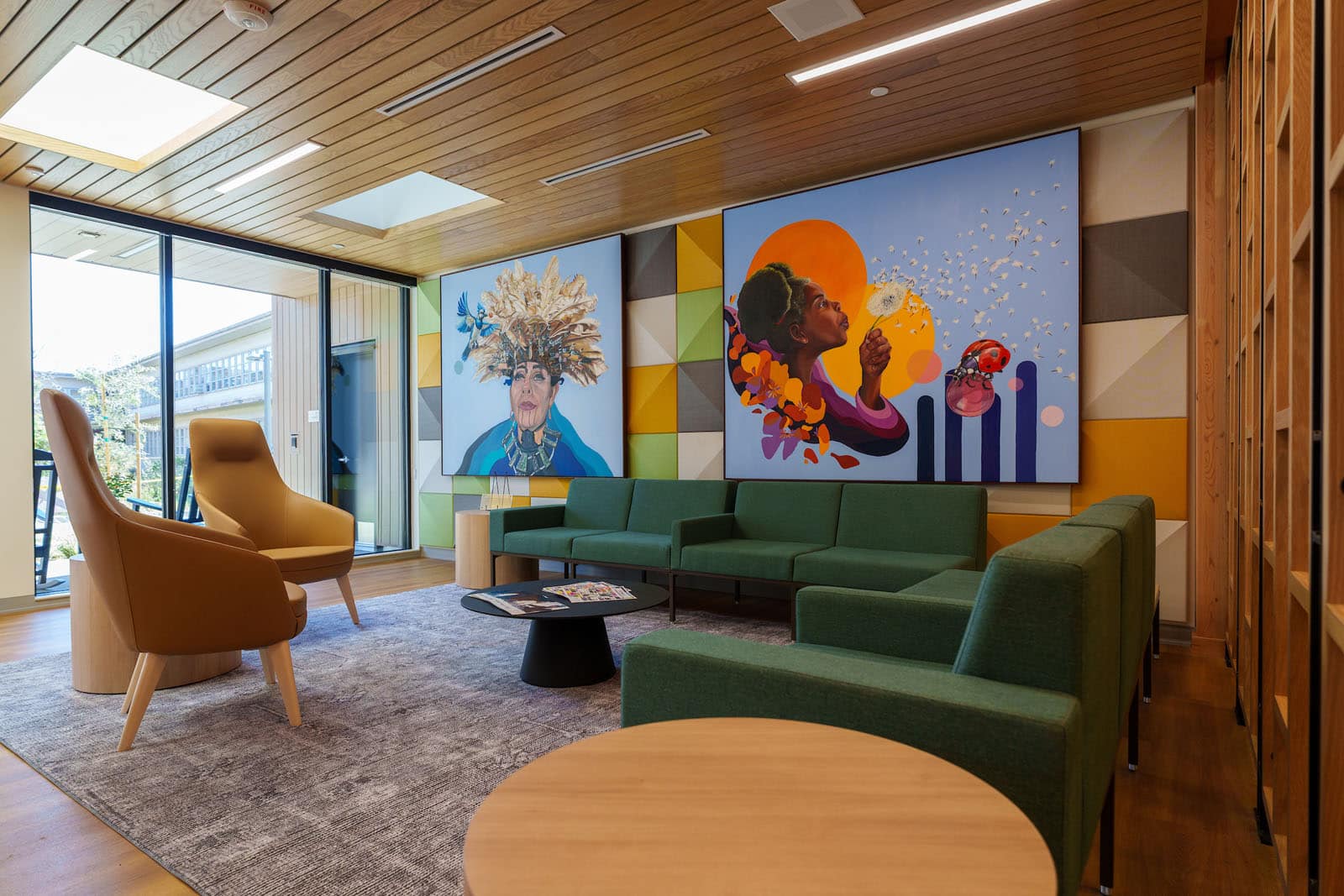
Rather than using a traditional institutional layout, the campus is organized as a low-scale, village-like environment with natural light, clear wayfinding, and connections between indoor and outdoor spaces to reduce stress and support calm. The design emphasizes visibility without surveillance, aiming to help residents feel both secure and respected.
Inside the building, the facility brings together medical respite rooms, clinical exam rooms, nursing support spaces, and behavioral health services, allowing coordination between providers.
Alongside clinical spaces, the interior features residential-style common kitchens, dining areas, and supportive gathering rooms. Case management offices, housing navigation spaces, and flexible rooms for group support reinforce long-term stability. The design blends health care and housing support.
Brenda Goldstein, Chief of Integrated Services, invited attendees to see the building not simply as an architectural accomplishment but as a trauma-informed healing environment designed around dignity. She said guests would notice “the incredible light, the calm color palette, the deeply trauma-informed design, and the beautiful art and views of the sky, the trees, the plants.” She urged them to imagine beyond the empty rooms: “Please, please envision this space filled with patients, people with significant health issues who would otherwise have been discharged to the streets.”
Dr. Jason Reinking, with Lifelong Medical Care, emphasized that the program is not simply a short-term discharge stop with nowhere to go afterward. Participants can stay for up to 90 days, and Reinking described a “network of places people can go after this,” including medically frail transitional housing, shelters, substance use treatment programs, and, in some cases, “directly to permanent housing… Less than 20% of our folks discharge back to the street.”
The future
LaLonde said Arnold’s Place is just the first phase of a much larger Alameda Wellness Campus that will eventually combine medical respite care, a navigation/resource center, and senior housing in one integrated site—something he described as “the first full campus in the state of California like this.” He explained that the adjacent drop-in resource center, to be operated by Alameda Point Collaborative, will offer computers, job searching, resume printing, social workers, and direct support for residents “coming off the street” who might say, “Hey, look, I’m a month away from being homeless. What do I do?”
Beyond that, LaLonde said the next planned phase is roughly 100 beds of senior housing, with construction hoped to begin within the next two years once additional funding is secured.
Overcoming fear
Dr. Damon Francis, Medical Director of the Homeless Health Center at Alameda Health System and an Alameda resident, recalled one woman asking whether the facility’s location would cause him to fear for his son’s safety because his child attended nearby Franklin Elementary.
In response, Francis said he pictured “the people I take care of with oxygen tanks, in wheelchairs” recovering while “looking across the bay, feeling the wind on their face, hearing my son’s laughter.” He told the woman who asked about safety, “I cannot imagine anything more safe or more beautiful than what we are going to do in this location.” Standing at the finished site, he added, “Look around. I was right.”
Contributing writer Karin K. Jensen covers boards and commissions for the Alameda Post. Contact her via [email protected]. Her writing is collected at https://linktr.ee/karinkjensen and https://alamedapost.com/Karin-K-Jensen.

