
A flash of gray swiftly swooping toward the ground alerts me to a peregrine falcon on the hunt. Frightened pigeons screech into the air. The peregrine stuns one with his feet as the others flee. Grasping the pigeon by the neck, the peregrine climbs steeply to a larger female peregrine and drops the pigeon to her as she flies below him. She catches the pigeon but, for reasons that I can only speculate, drops it into the estuary by the Fruitvale Bridge. The hunter flies down, retrieves the pigeon, and re-offers it. This time she takes the pigeon and flies to a perch on the raised, out-of-use train bridge.


Experienced aerial hunters, adult peregrine falcons often pull their wings in to swoop from a high perch to capture a pigeon or other bird, bat, or small mammal. For male peregrines, the offering of this food to a potential mate is part of courtship, perhaps as a sign that he will continue to feed her while she sits for many days to keep eggs warm. During courtship, the male may drop food to the flying female or may pass it directly to her from his talons while they fly together. Pigeons are a frequent meal for peregrines nesting in California, but they also eat other birds. Peregrines are a major predator of least tern adults and chicks at the breeding colony at the Alameda Wildlife Reserve at Alameda Point.
Perching side by side at the nest site is also part of the courtship process, first some distance from each other and then, over time, closer and closer. Copulation usually occurs on or near the nesting site. For thousands of years, peregrines have nested on ledges in high cliffs. They still do, but in urban areas they often replace the cliffs with ledges on bridges or buildings.
For several years, the Fruitvale train bridge has hosted nesting peregrine falcons, often successfully raising their young. Last year, the pair fledged three chicks, two females and one male, which were banded by a team from the Predatory Bird Research Group at UC Santa Cruz. If these two peregrine falcons form a pair, the female will lay three to five eggs at the back of a ledge, high on either the Oakland or the Alameda tower. In our temperate climate, the adults start to sit on the eggs to keep them warm when the second or third egg is laid.
The Fruitvale train bridge has been locked in the open position since railroad traffic stopped crossing into Alameda in 1996.
In colder climates, such as Alaska and northern Canada, incubation starts when the first egg is laid. Both parents incubate the eggs, but the female spends the most time, about two-thirds of each day, for 33 to 35 days until the eggs hatch. While she sits, the male hunts and brings her food.

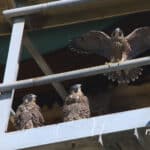
When the eggs hatch, the chicks are covered in off-white downy feathers with their eyes closed. During these first weeks, the male brings most of the food while the female continues to brood the down-covered chicks, which can’t yet keep themselves warm. Gray flight feathers start to appear when the chicks are about three weeks old, and the young birds start to fly, or fledge, at six weeks. The parents continue to feed the fledglings for some time—learning to catch a bird or bat while flying takes lots of practice.
Chicks and fledglings in nests on country cliffs may be killed by great horned owls, golden eagles, or occasionally by mammals. In urban settings, cars, building windows, and power lines are the main dangers, and some birds are shot.
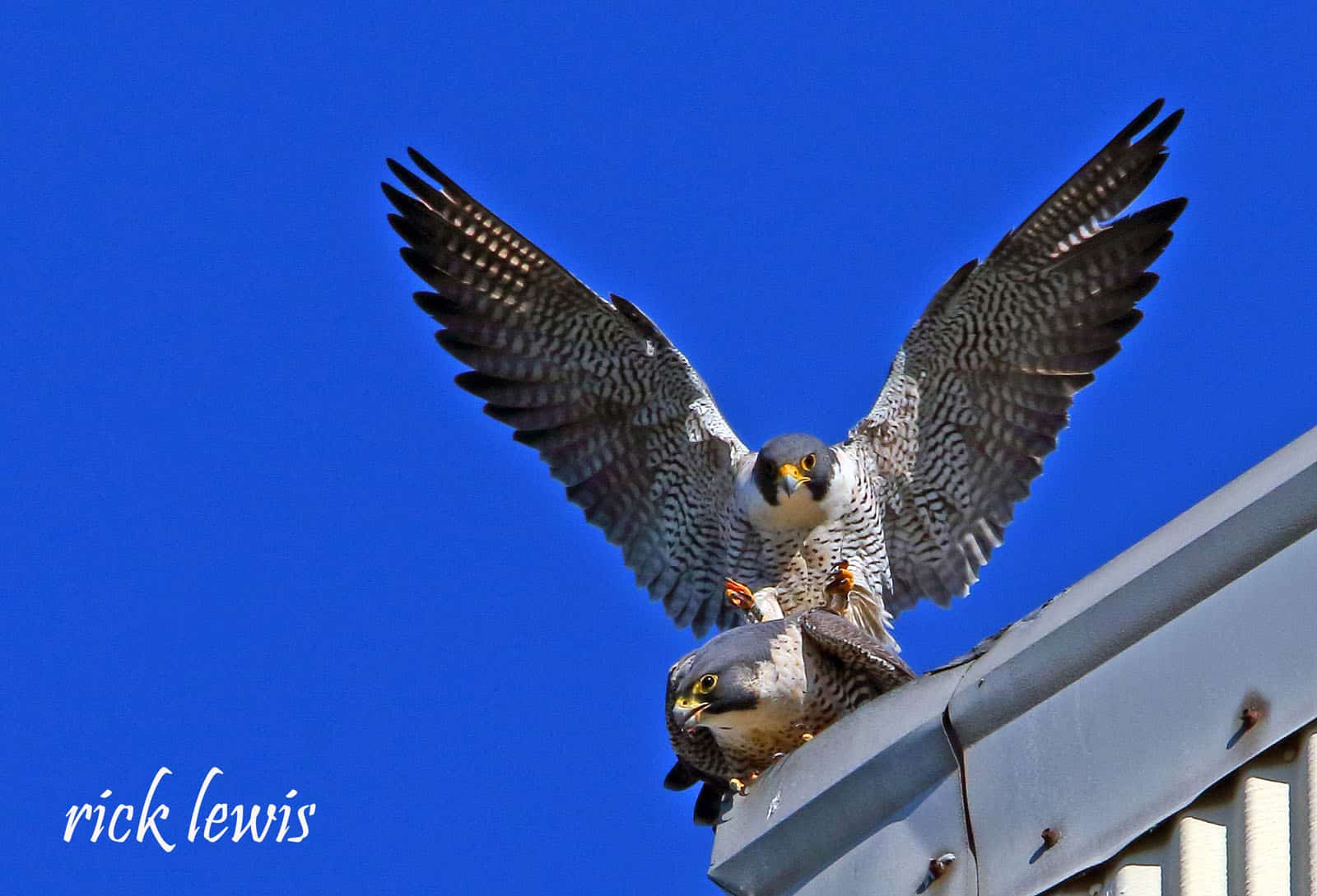

Peregrines remain in the Alameda area year-round and can often be seen perched on the bridge or hunting near the estuary, and sometimes near Seaplane Lagoon. Peregrines breed throughout the Northern Hemisphere and some of them migrate to the Southern Hemisphere in the winter. While “our” peregrines may not be as well-known as those that nest on the UC Berkeley Campanile and have their own live webcam online, they are just as interesting to watch. You can look for them on the Fruitvale Bridge by walking along the Alameda side of the estuary at the Bridgeside Shopping Center. But Alameda is large enough and has enough pigeons and other small birds, such as shorebirds, to support more than one nesting pair. Wherever you are, if you see pigeons suddenly take flight, look up and search for a fast-moving, small gray bird, a peregrine falcon.
Editor’s note: This article was updated on Monday, April 1, 2024 at 3:39 p.m. to correct details about the birds’ diet, how they raise their young, and where they can be seen.
Marjorie Powell moved to Alameda from the East Coast in 2014. A member of Golden Gate Bird Alliance, she serves on its Alameda Conservation Committee, the Friends of the Alameda Wildlife Reserve, and tries to go birding frequently.
