Facing new restrictions that limit its ability to host raves and other large events, the nonprofit foundation that has operated the USS Hornet Sea, Air and Space Museum on Alameda Point since 1998 is taking a long, hard look at moving the 82-year-old aircraft carrier to San Francisco or another Bay Area location.
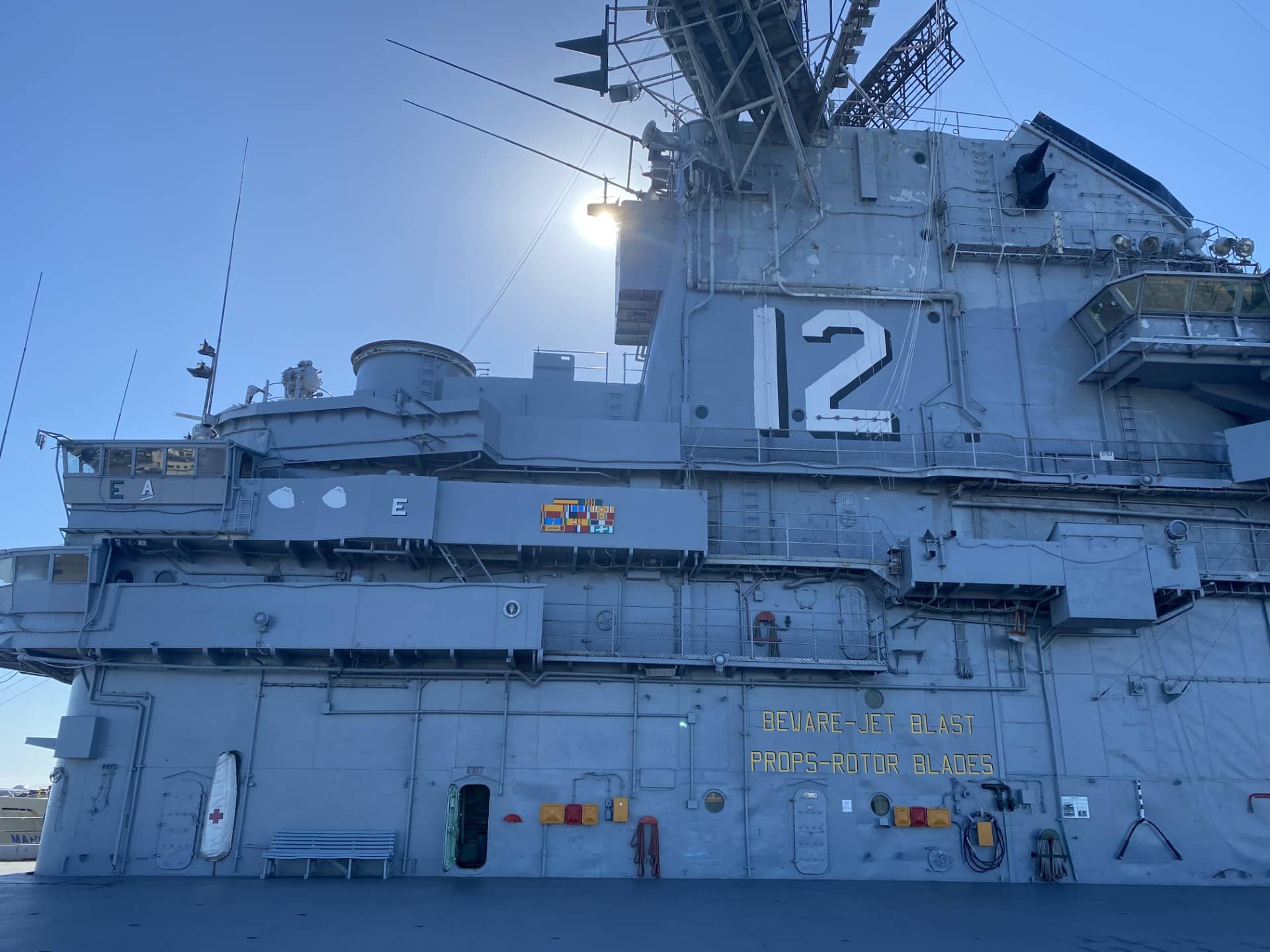
The Aircraft Carrier Hornet Foundation has been exploring the idea of moving the historic ship to a more accessible location for years, foundation board member Sam Lamonica told the Alameda Post. But the City of Alameda may have added a sense of urgency to the search for a new home in February, when it limited the maximum number of visitors permitted on board the ship at one time to 660, due to safety concerns.
“We have been having conversations with the leadership at the Port of San Francisco for some time now, but that’s not our only conversation,” Lamonica said. “Basically, we are on a mission to find a location that’s going to allow us to grow for the next 20 or 30 years.”
Capacity issues
In addition to requiring a “good, solid pier,” Lamonica said the museum needs the ability to host large events for up to 3,000 to 5,000 people. In 2023, nearly 5,000 people visited the ship on Veterans Day, and “Rattleship,” a two-day rave, attracted 5,600 people to the ship on July 1 and July 2, according to the foundation’s annual report for that year.
British DJ and record producer Culture Shock performs at Rattleship 2024 aboard the USS Hornet in July, 2024.
Rattleship returned in 2024, but plans to hold a third one on the Hornet last year fizzled because the City’s capacity limits.
“Some of the City’s emergency personnel attended larger events where they observed conditions that raised safety concerns, including difficulty with exit points due to crowding, and third-party event organizers who failed to comply with the City and the Hornet’s requirements around security controls and alcohol monitoring,” Abby Thorne-Lyman, director of Alameda’s Base Reuse and Economic Development department, stated.
Those concerns prompted inspections and an interdepartmental review—including the Planning, Building, Fire, and Police departments—of existing conditions and operations aboard the ship. The review culminated in a determination by the City that it was not safe for the ship to host more than 660 people, including both visitors and museum staff, at any one time.
The limited carrying capacity of gangways connecting the ship to Pier 3 and stairs between decks would not allow for larger crowds to be evacuated quickly enough in the event of a fire or other emergency, Alameda Chief Building Official Oscar Davalos informed the foundation in a February email.
Because of the distance that people gathering on the ship’s flight deck would have to travel to evacuate the ship, public assemblies of large groups are no longer allowed topside, but are still allowed on the ship’s hanger bays and main deck.
In a 2024 brochure, the Hornet Museum advertised that the 90,000-square-foot flight deck could host up to 3,000 people, and that the 44,500-square-foot hangar deck could accommodate 2,500 people. Davalos said the City may be willing to reevaluate the ship’s maximum occupancy if the museum submits plans to install “additional, code-compliant public access stairways and/or gangways with the appropriate structural calculations and details stamped by a California-licensed engineer, and with Building/Fire approvals.”
In approving an amended use permit in March 2026, the City built in additional restrictions on the use of alcohol, and now requires prior City approval for third-party promoters, Thorne-Lyman noted. It also accommodated the Hornet Museum’s wish to allow up to six helicopter landings per year on the ship, as long as it obtains permits or other approvals that might be needed from the Federal Aviation Administration or Caltrans.

“The City and Hornet have been working well together over the last year to more closely communicate around events in advance, and we have reached a place where we are more comfortable with the safety conditions of events under the new use permit,” Thorne-Lyman said.
“It does come down to more gangways and exit points,” Hornet Museum Executive Director Laura Fies said of the City’s concerns, noting that “it’s not a Hornet-unique problem.”
There are more than 300 museum ships around the country, and each must deal with unique City codes, Fies said. She noted that the Hornet’s sister ship, USS Intrepid—another Essex-class aircraft carrier now being used as a museum in New York—handles a million visitors a year. But the Intrepid is equipped with six gently sloping, 44-inch-wide gangways that meet New York City’s emergency egress standards, according to the company that built them.
Fies said the Hornet Foundation intends to begin raising money this summer to hire an outside consultant to help it prepare a “sustainability feasibility study” to be published later this year or in early 2027.
Staying in Alameda “would be a preferred option,” she said, but the question is “do the numbers add up? …If a move came into play, it would [require] a massive fundraising campaign. Even if we stay here, new fenders and gangways means we’d be looking at a large [fundraising] campaign one way or another.”
According to annual tax returns published by ProPublica’s Nonprofit Explorer, the Hornet Foundation was $864,937 in the red during the fiscal year ending June 2024, with $3.46 million in expenses exceeding the $2.59 million in revenue that came in.



Fies and Lamonica said the foundation’s finances have improved, with 2025 revenue growing to $3.18 million and expenses declining to $3.36 million. At $957,318, special events like Rattleship and a “World Goth Day Festival” accounted for 30 percent of the museum’s revenue, up from 18 percent in 2024.
But visitor-driven spending including museum admissions, tours and store sales remained the biggest source of revenue, totalling $1.09 million.
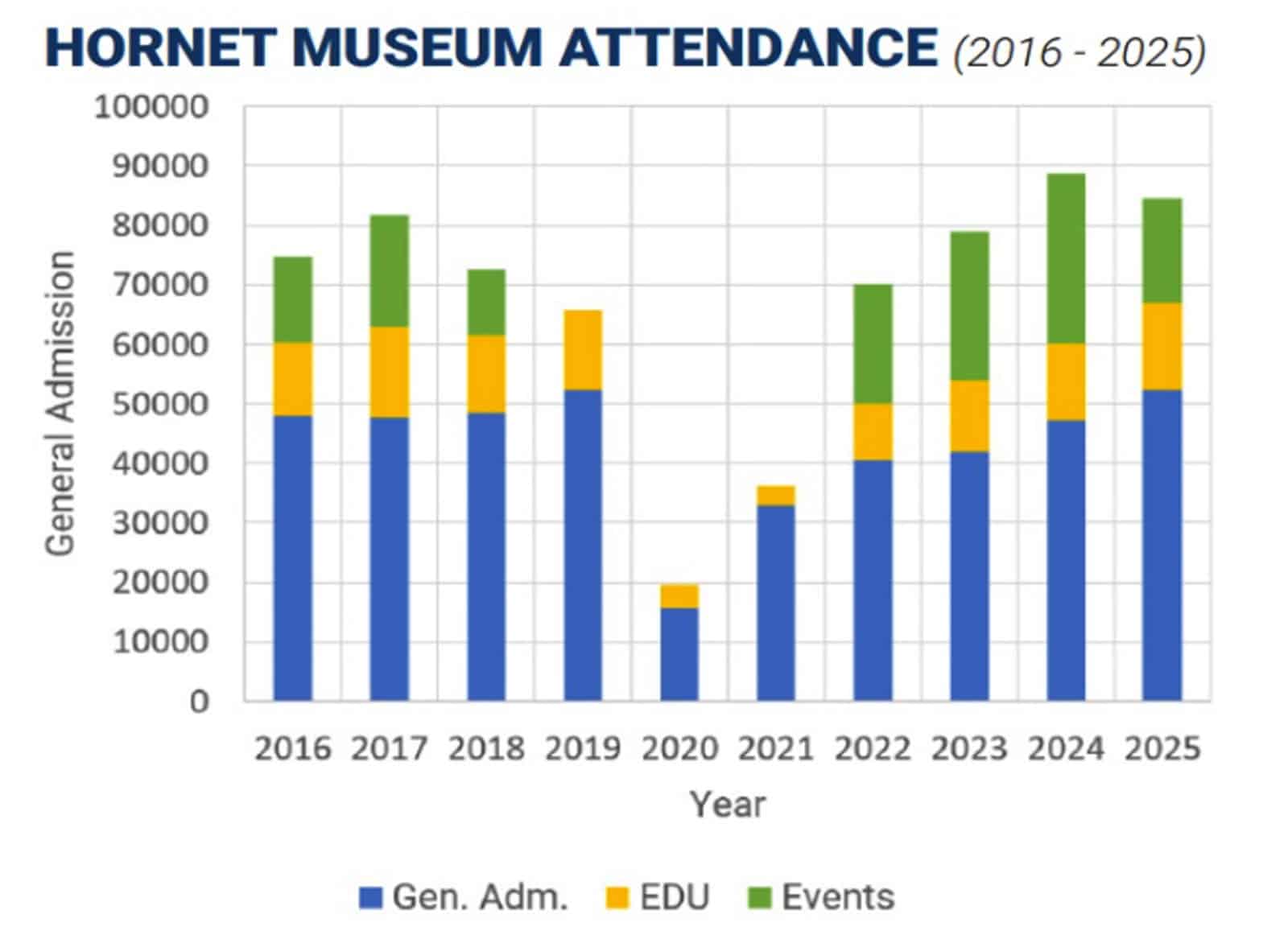
After plunging to less than 20,000 visitors in 2020 at the outset of the pandemic, attendance has “not only returned to pre-pandemic levels, but surpassed them, outpacing the average recovery trend seen across the museum industry nationwide,” the group said in its 2025 annual report.
‘Exploratory’ discussions with Port of San Francisco
While the Hornet’s attendance is approaching 100,000 a year, a move to a more accessible site like the Port of San Francisco could provide an even bigger boost. When the City of San Francisco partnered with a nonprofit in a bid to bring the battleship USS Missouri to San Francisco in the 1990s, a consultant estimated it would draw 450,000 to 520,000 visitors a year.
But while San Francisco’s Pier 45 is home to the World War II submarine USS Pampanito and the Liberty Ship SS Jeremiah O’Brian, plans to bring the decommissioned battleship Missouri and then the USS Iowa to San Francisco proved controversial. The Iowa ended up in Los Angeles and the Missouri is a popular destination at its berth in Pearl Harbor, having attracted more than 10 million visitors to date.
“We have been approached to discuss relocation of the USS Hornet, but these discussions have been general and exploratory,” Port of San Francisco spokesperson Eric Young confirmed to the Post. ” Before any relocation plan is put in place we would bring the proposal to the Port Commission and the community for feedback, and we have no plans to do so at this time.”
The Port of San Francisco’s Historic Vessel Policy requires that backers of prospective museum ships fund a demand and feasibility study by an independent party “detailing expected attendance, expenses, and revenues,” and also pay for all costs related to planning, design, regulatory approvals, development of berthing facilities, and ship restoration.
“It’s a costly endeavor to batten the hatches and get some tugs and pull us to wherever we need to go, and then make sure that sewer, water, electric, everything is ready on the far side wherever we go,” Lamonica acknowledged. “We would have to do some really significant fundraising in order to make that happen.”
The Port of San Francisco also wants any additional historic vessels to have a connection or historical relationship to San Francisco, San Francisco Bay, or Northern California. The Hornet—which fought in one of World War II’s most famous battles and later recovered astronauts from the Apollo 11 and Apollo 12 moon missions—was in dry dock several times over the years for overhauls and modernization at the Hunters Point Naval Shipyard in San Francisco.
But Naval Air Station Alameda will forever be associated with aircraft carriers, providing berths and aircraft maintenance for ships during World War II, the Korean War and Vietnam up until its closure in 1997. Pier 3, where the Hornet Museum is now docked, once served as the home port for several nuclear aircraft carriers. In 1942, the museum ship’s predecessor, USS Hornet CV-8 was loaded up at Pier 2 in Alameda with 16 B-25 bombers in 1942 for Lt. Col. Jimmy Doolittle’s Tokyo raid.

City maintains Alameda Point piers
As the current owner of the three piers at Alameda Point, the City has budgeted $3 million for their rehabilitation and maintenance—a project that’s likely to cost even more in the future. Until recently, all three piers were used by the U.S. Department of Transportation’s Maritime Administration (MARAD) to dock ships in the Ready Reserve Force to support deployment of U.S. military forces worldwide. The eight Ready Reserve ships once berthed in Alameda were gradually moved to Oakland, San Francisco, and Benicia when Congress stopped providing money to dredge the shipping channels required for large ships to access the piers, according to Alameda Post Historian Dennis Evanosky.
While the City of Alameda leases Pier 3 to the Hornet Museum and Pier 1 to Power Engineering Construction—a contractor that performs heavy-civil construction and restoration projects—Pier 2 can no longer be used to berth large ships “due to deterioration in its pilings and systems from an accumulation of debris and deferred maintenance,” according to City staff.
“Pier 3, which is the Hornet pier, is actually in astoundingly good condition for its age, as is Pier 1, where Power Engineering is,” Thorne-Lyman said. She added that she’s working on a federal grant application (due in June) to help pay for repairs to Pier 2 that could allow for some commercial berthing use by smaller ships, as well as restoration work that may be identified as necessary for Piers 1 and 3.
Under the terms of a 2009 lease, the Hornet Foundation pays the City $36,000 a year in base rent. At the time the lease was signed, the museum owed $555,335 in back rent, a debt that the City agreed to write down to $277,668 to be paid off over the following five years. Knowing that the foundation might decide to relocate the Hornet to another location, the City has allowed it to continue renting Pier 3 on a month-to-month basis, Thorne-Lyman said.
Before setting sail from Alameda, the Hornet Museum would want to give City Council an opportunity to accommodate its needs for a solid pier and the ability to hold large events, Lamonica said. He noted that his successor as chair of the Hornet Foundation, Maureen Whalen Vavra, has had “a couple of face-to-face meetings with some City Council members and some of the City government [staff]. We’re always open to have conversations with them.”
While Thorne-Lyman said the Hornet Foundation hasn’t provided the City with anything like a “wish list,” she also said the nonprofit has been very clear that “in order to thrive, they need more foot traffic, they need more visitors, and their special events play a critical role in their finances. Unfortunately, from a fire/life safety perspective, we had to reduce the capacity of the boat, which is obviously not helpful to that need. I know they need to have these large events in order to balance their budget, and I know that they’re sitting on an aging aircraft carrier that has needs. I mean, I’m sitting on Alameda Point, so I am more than empathetic about the needs of historic facilities.”
Matt Carter is a contributing writer for the Alameda Post. Contact him via [email protected]. His writing is collected at AlamedaPost.com/Matt-Carter.

