On October 21, City Council received a comprehensive fiscal sustainability update, which reported that Alameda’s financial position is stable but stretched. Council provided feedback on potential new revenue measures, a proposal to enforce revenue collections, and a proposed budget and financial accountability policy.
Council also unanimously approved a Sidewalk Vending Permit Program to regulate non-motorized sidewalk vendors, aiming to balance economic opportunity with health, safety, and business concerns.

Fiscal sustainability update
City staff, led by Communications and Legislative Affairs Officer Sarah Henry, Finance Director Ross McCarthy, and Budget Manager Ecaterina Burton, presented a fiscal sustainability update, focusing on:
- Current financial condition.
- Potential revenue measures.
- Improving revenue collections.
- A Budget and Financial Accountability Policy.
Financial condition
McCarthy reported that Alameda’s financial position remains stable but stretched. The Fiscal Year 2025-2027 Biennial Budget remains balanced, with revenues covering 96.5% of ongoing expenses. The shortfall is offset by the residual fund balance.
Reserves increased slightly due to stronger than expected one-time revenues:
- Transfer taxes exceeded projections by $2.7 million, attributed to higher than anticipated property transactions.
- Interest income rose $3.3 million, reflecting higher interest rates and strong cash balances.
- Property tax revenues were up by $1 million, signaling modest but positive growth.
However, sales tax revenue declined by $1.6 million (14.5%), primarily due to the departure of an unnamed major taxpayer and a slowdown in regional consumer spending. McCarthy cautioned that while one-time revenues had boosted the balance, they should not be used for ongoing expenses. He noted potential risks from federal funding uncertainties amid recent government shutdowns. Still, he did not recommend budget amendments but committed to continuing close monitoring.
Revenue measures and community engagement
Henry reported that Alameda faces an estimated $800 million infrastructure gap, driven by deferred maintenance and needed disaster preparedness, sea-level rise protection, and other capital improvements. She outlined the City’s strategy to ensure long-term fiscal resilience by exploring potential new revenue sources.
Over the summer, the City launched a “Stronger Together” campaign, inviting public input on infrastructure and public safety needs via a series of ongoing workshops. Workshops have been held on streets and traffic safety and civic and fire facilities. Upcoming workshops will discuss:
- Libraries and Recreation and Parks: November 4.
- Flood Protection, Groundwater Rise, and Disaster Preparedness: December 2
The City plans to follow these sessions with a public poll to measure support for different funding approaches. Staff are considering a $150 million infrastructure bond (estimated at $29 per $100,000 of assessed property value) and a public safety tax, modeled after similar measures in neighboring jurisdictions.
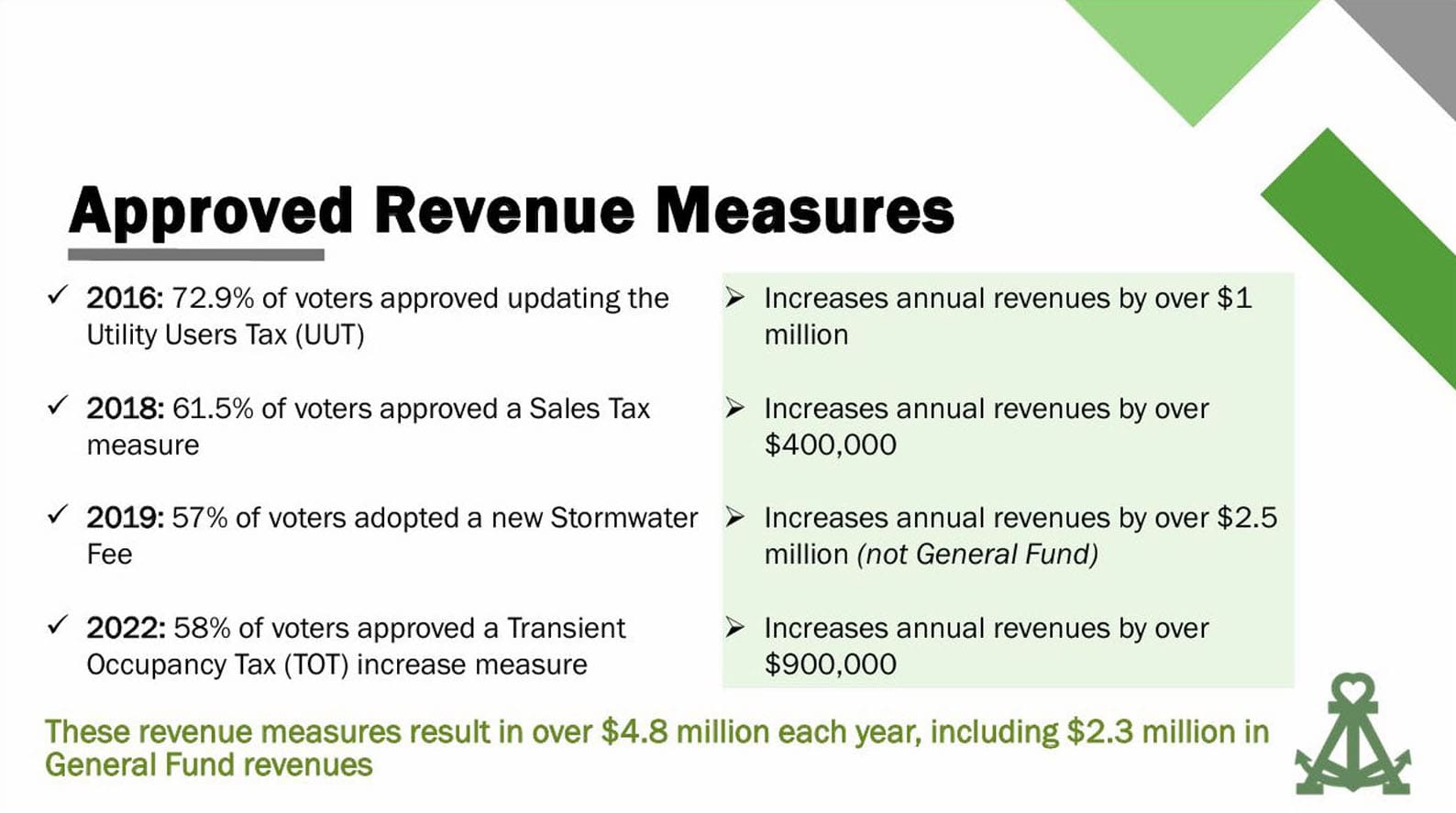
Henry noted that Alameda voters have consistently supported local funding, approving four significant measures since 2016—an updated Utility Users Tax, a half-cent sales tax increase, a stormwater fee, and a higher Transient Occupancy Tax—together generating $4.8 million annually, including $2.3 million for the General Fund. She argued that the success of these measures demonstrates community willingness to invest locally when the benefits are clear and transparent.
Improving revenue collection
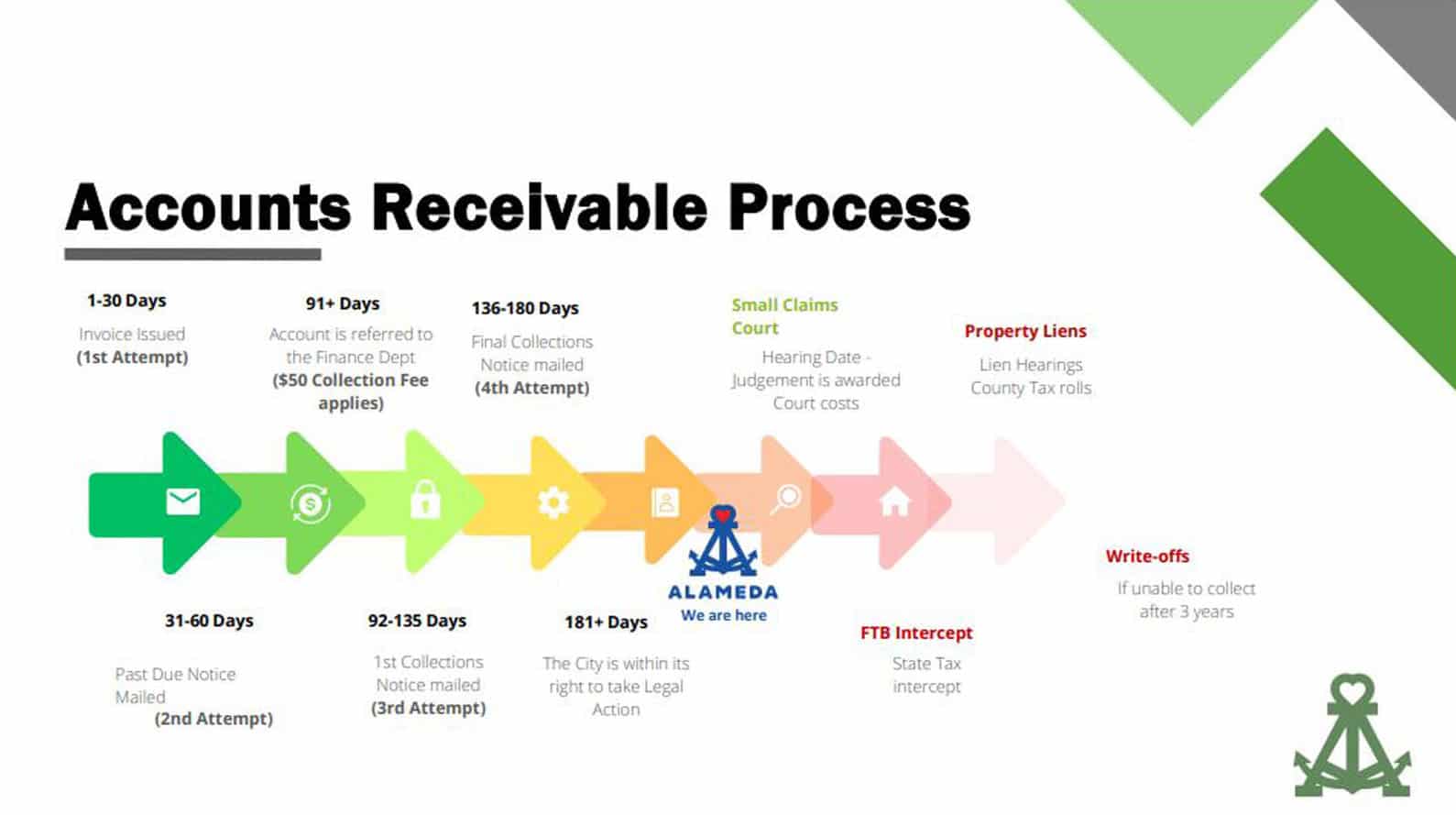
McCarthy discussed the City’s uncollected revenues, totaling approximately $1.4 million, including uncollected fire inspection fees, police fines, traffic mitigation fees, business license taxes, and other program-related charges. Many of these debts are unsecured, meaning they lack real property collateral.
He explained that delayed or missing collections reduce the City’s ability to maintain essential services and put additional pressure on general and special funds. He proposed implementing a formal collections policy aligned with Bay Area best practices. Key tools could include property tax liens for secured debts, the State Franchise Tax Board’s intercept program (which allows the state to recover unpaid amounts from tax refunds), and third-party collection agencies.
The proposed approach offers debtors multiple notifications and at least six months to pay or arrange payment plans before stronger enforcement measures are taken. McCarthy emphasized that the goal is to ensure equitable compliance, discourage chronic nonpayment, and reinforce fiscal responsibility.
Draft Budget and Financial Accountability Policy
Burton introduced a draft Budget and Financial Accountability Policy (link downloads document), establishing best practices for balanced budgeting, reserve management, and long-term financial planning. It commits the City to ensuring ongoing costs are supported by stable funding sources, using one-time revenues only for one-time expenses, and to maintaining adequate reserves.
Burton explained that the policy reinforces a “culture of fiscal prudence,” providing accountability internally and to the public. The draft policy will return to Council for formal adoption after feedback and revisions.

Henry concluded by highlighting Alameda’s agility in navigating shifting funding environments. She cited an example in which federal grant rules changed after the City had been approved for $15 million under the Water Resources Development Act program. When the funds could no longer be used for coastal resilience, the City swiftly repurposed them for stormwater infrastructure improvements in the Main Street neighborhood at Alameda Point, ensuring no funds were lost.
Council feedback
Mayor Marilyn Ezzy Ashcraft strongly supported comprehensive polling to determine what residents would support for any future tax or bond measure. She cautioned against assuming voters’ past generosity will continue amid current economic pressures, including inflation, the high cost of living, and potential competing regional measures in 2026, such as the Bay Area Transit Stabilization Initiative (Proposition 63).
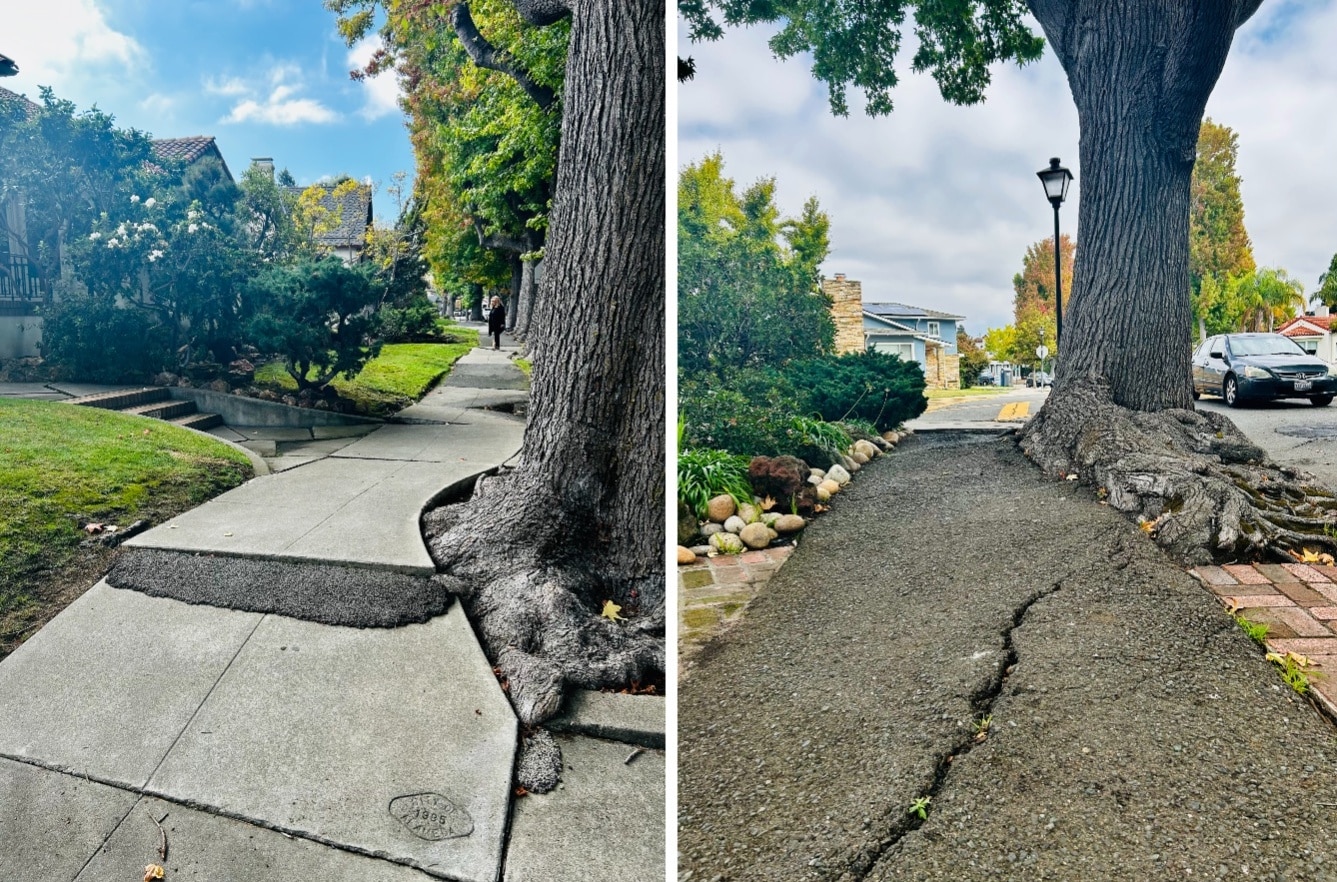
Ashcraft also highlighted the need to curb unnecessary expenditures, especially avoidable costs from potential lawsuits. She cited the broken sidewalks on Gibbons Drive as an example: “If we get hit with a lawsuit because someone tripped and fell and injured themselves badly, that was avoidable.”
Vice Mayor Michele Pryor endorsed moving forward with a bond or parcel tax before infrastructure deterioration worsens and costs escalate. Councilmember Tracy Jensen also endorsed an infrastructure bond as essential for long-term financial stability, saying, “We’re not going to be able to get enough funds from outside Alameda, from the state, federal government, the county, or elsewhere to meet our needs.” She proposed including a citizens’ oversight committee to ensure transparency.
Regarding community polling, Councilmember Greg Boller cautioned against being overly prescriptive in describing how potential revenues would be used, arguing that the City must retain the flexibility to make the best public policy decisions when funding becomes available. Councilmember Tony Daysog emphasized the need for statistically valid polling that equally represents renters and homeowners.
Council unanimously voted to include both infrastructure and public safety tax options in upcoming polling and directed staff to proceed with developing enhanced collection processes and a formal budget accountability policy.
Sidewalk vendor ordinance
Assistant City Manager Amy Wooldridge presented an ordinance to regulate sidewalk vending. The proposal aims to balance economic opportunity for low-income and immigrant vendors, as supported by the state’s Safe Sidewalk Vending Act, with health, safety, and business concerns.
Wooldridge noted a rise in sidewalk vendors across Alameda, particularly during major events such as Winter Lights, the Park Street Art and Wine Fair, Halloween, and Christmas Tree Lane. Thompson Avenue (Christmas Tree Lane) neighbors strongly supported the ordinance, as did local business leaders, including Alameda Chamber CEO Madlen Saddik and Downtown Alameda Business Association Executive Director Kathy Weber, both of whom endorsed the measure due to issues with unregulated vendors at the Park Street Art and Wine Fair and disruptions of brick-and-mortar stores.
Key provisions include:
- Stationary vendors (non-motorized sellers in a fixed spot) are prohibited in residential zones but allowed in commercial areas and parks.
- Roaming vendors (e.g., ice cream carts) may operate in both residential and commercial areas.
- Hours of operation: 7 a.m.–10 p.m. in commercial zones and sunrise to sunset (or 8 a.m.–8 p.m.) in residential areas.
- A special restriction on Thompson Avenue during December will prohibit vending in public areas between 4 p.m. and 9 a.m.
- Vendor requirements include maintaining ADA clearance, avoiding blocking bike lanes and school drop-off areas, and complying with health and safety rules.
- Permits will require insurance, business and health permits, and seller’s licenses.
- Fees: $50 annual permit fee and a $119 minimum business license fee.
- Enforcement will be primarily complaint-based, with code officers patrolling daily for the first two weeks of Christmas Tree Lane to establish compliance.
Councilmember Daysog asked how the ordinance would apply to students selling food, for instance for school project fundraising. Wooldridge responded that the ordinance applies to everyone selling in public areas, even students. However, she noted that the ordinance does not apply to selling on private property, such as a lemonade stand in a driveway or a bake sale on school property.
Wooldridge emphasized that the ordinance seeks to support fairness, protect neighborhoods, and ensure safety, while keeping the permit process accessible and educational through multilingual materials and outreach.
The Post reached out to Wooldridge to clarify how the ordinance may affect Girl Scout cookie sales. Wooldridge replied that, “Sidewalk vending permits are not required for Girl Scouts or any other organization selling on private property, such as in front of a grocery store in a shopping center. However, (anyone) selling in the public right-of-way, such as a public sidewalk, would require a permit and require not blocking access.”
Council unanimously approved the ordinance.
Contributing writer Karin K. Jensen covers boards and commissions for the Alameda Post. Contact her via [email protected]. Her writing is collected at https://linktr.ee/karinkjensen and https://alamedapost.com/Karin-K-Jensen.

