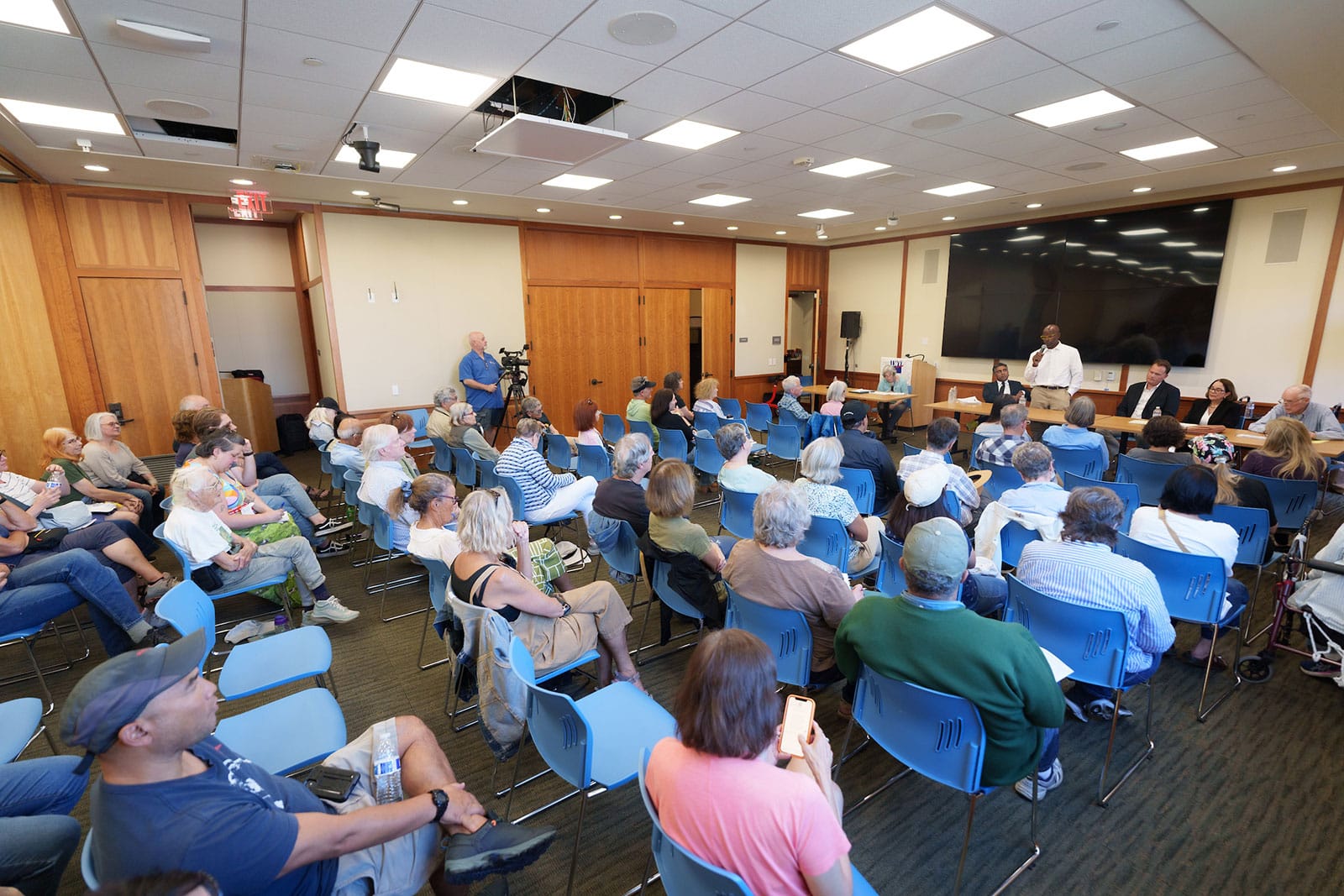
Alameda’s candidates for City Council differentiated themselves on the hot topics of the upcoming general election—climate change, developer partnerships, city infrastructure, and affordable housing—during a public forum on September 5.
 [1]
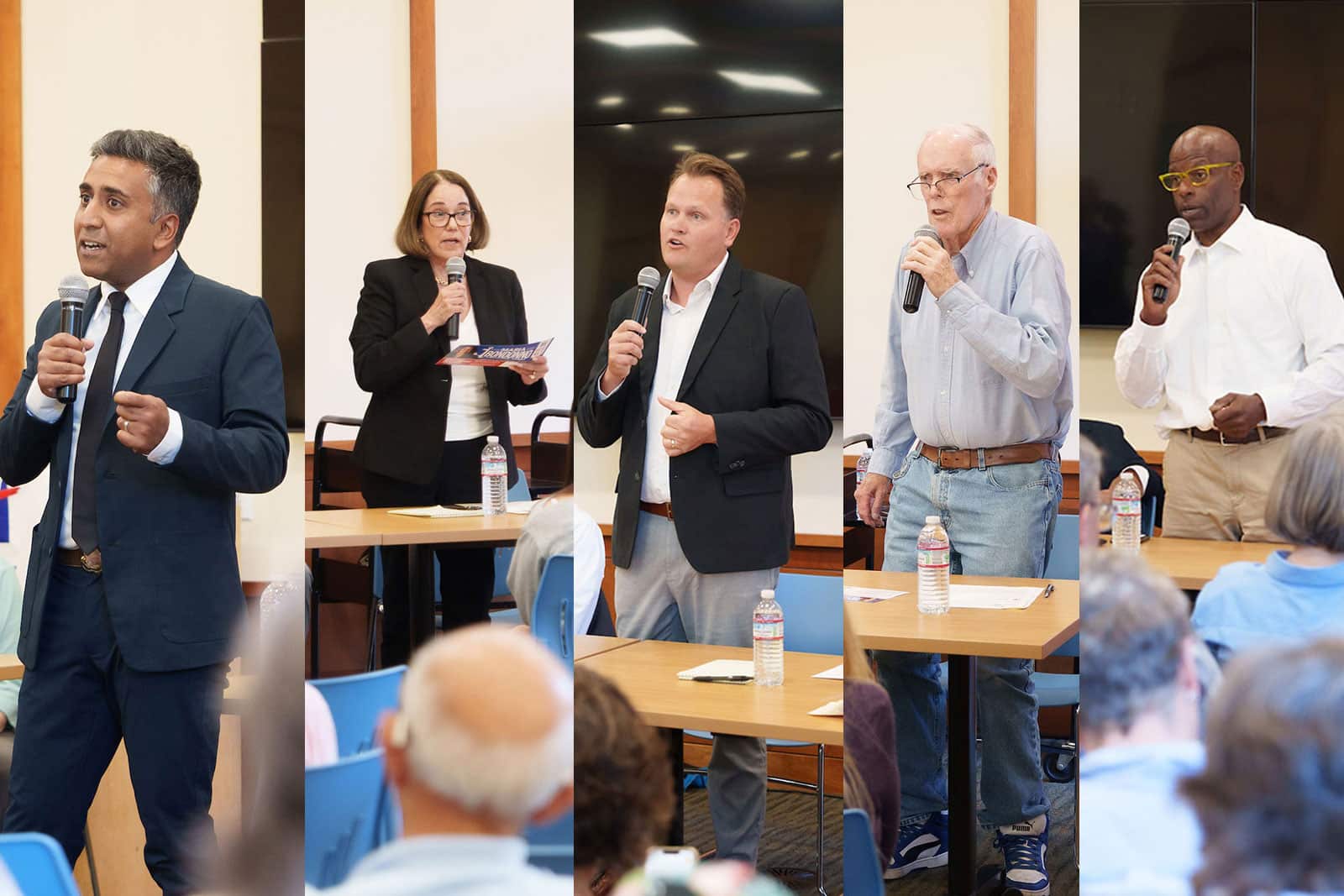
[1]Tyler Savage, Thushan Amarasiriwardena, Steve Slauson, Amos White, and Maria L. Bondonno took part in the forum, which was hosted by the League of Women Voters of Alameda (LWVA) at the Alameda Library main branch. Marcie Johnson did not attend due to a family obligation, according to forum moderator Anna Crane.
The forum took place directly after a forum for City mayoral candidates [2], also held by the LWVA.
Alameda’s biggest challenges
White said that the top issue Alamedans face is the “long-term emergency” of climate change. He said he doesn’t think Measure L is a complete solution, but that it’s “looking forward in the right direction.” He plans to focus on environmental sustainability, public safety and privacy, and housing.
Slauson responded that he does not support the bond measure, and that he’s concerned about the amount the City would pay to developers for new housing. He added that he doesn’t believe in sea level rise, and that it doesn’t represent an existential threat to the city. “This island is going to stay right where it is,” he said.
Bondonno maintained that bringing more mixed-use housing to the island would promote more economic development while creating affordable homes. She also said the City must invest more into services for the homeless. She expressed support for Measure L, but said she also wants to seek state or federal funding for future projects, rather than taxing Alameda residents.
Amarasiriwardena said the island’s biggest challenge is the availability of affordable housing, as rising costs displace more Alameda residents. He said City government should follow the state housing mandate and utilize partnerships with housing developers to offset the cost of City projects, such as bike lanes and new seawalls, without relying on tax funds.
Savage said there’s “not enough time and not enough money” to accomplish all of Alameda’s economic and development goals. But he called for the City to focus on its economic “engines” to support projects like Dignity Village [3], and said he would target areas of the island that offer a “large return on investment” to do so.
Spending Measure L funds
Savage said that the City must use the bond funds to address rising sea and ground water levels and prevent street closures due to flooding. He also said the funds should be used to improve residents’ mobility, by fixing sidewalks and ensuring public areas are ADA compliant.
Adapting to sea level rise is “critical,” White said, and stressed the importance of approaching infrastructure with sustainability in mind. He also said he supports the City’s transportation plan, and thinks transit infrastructure, street safety, and emergency response times represent major priorities. “The infrastructure bond would pay for that,” he said.
“I don’t support any projects on that list.” Slauson said. He called the measure a “blank check” due to the absence of a “detailed financial breakdown” of specific projects the bond would fund. Instead of “money for government,” he said Alameda residents deserve “more money in our own back pockets. …We need more money for gas. We need more money for food.”
Bondonno said the bond funds should be invested into creating resilient infrastructure, and that new construction should prioritize “flood protection, storm water and drainage improvements, seismic resilience, and emergency preparedness.” She stated again that the City should seek additional state and federal funding to close its own budget gap for infrastructure projects, while also ensuring resources go to community safety and wraparound support services for homeless individuals.
Amarasiriwardena expressed enthusiastic support for the measure, saying it’s “critical for our island’s future.” He said sea level rise mitigation is his top investment priority, particularly on Bay Farm Island where he said it is affecting environmental conditions and threatening to impact residents’ insurance rates.




Upgrading infrastructure to support housing
 [4]
[4]“When you have more people, you have to help them get on and off the island,” Amarasiriwardena said. He noted that new housing brings new residents, e.g., new taxpayers, which can drive more funding for City projects and increased services. He said he supports expanding infrastructure for buses and ferries, and encouraged attendees to vote for the Bay Area’s regional public transportation funding measure, the Connect Bay Area Transit Initiative [5].
Savage expressed concern about aging utilities beneath the planned development at Alameda Point, and spoke positively about a new business in the area that had invested $300,000 into infrastructural improvements that also support the surrounding community. He said he wants to create more resources within communities so residents can walk or bus to their destinations, without having to get into their cars and “putting any more pressure on the greater part of Alameda.” He also supports a new ferry line to the South Bay.
White said utilities, transportation, and services for mixed-use housing would support the City’s progress on its housing mandate, and that a portion of the bond could fund those goals. But he called Alameda’s limited progress on its state-issued housing mandate “sobering,“ and he shared his disappointment that the current City Council recently voted [6] to lower its affordable housing requirement for new housing construction.
“I’m the only renter here. I’m the only person from the West End here,” White said. “Are we really focused on affordable housing?”
Slauson said the issue of affordable housing is “resolved.” He praised the new housing on Clement and Grand streets, and said the fact that the buildings are nearly filled with residents is a “testament to the quality of life in Alameda.” He said developers, rather than taxpayers, should be paying to modernize a building’s utilities.
Bondonno said she agreed that developers should be held responsible for upgrading a building’s utilities once they are on a property, and that the City should be responsible for improvements to public areas “to protect this growth.” She repeated her support of mixed-use housing, to build up local businesses and residential communities at the same time.
Economic development at Alameda Point
After investing $395 million dollars into the project, the Trump administration canceled a veteran’s center at Alameda Point [7] last year. The center would have brought a VA health facility and a military columbarium to the island. Slauson said he believes the idea is still a “winner,” and said the center would come with “peripheral businesses” like restaurants and stores in the area.
“Again, I go back to this idea of mixed-use housing and below market rate units in these new developments” at Alameda Point, Bondonna said. She emphasized the potential to attract small businesses rather than large chain stores to the commercial spaces, while building communities around them of people who “actually live there.”
Amarasiriwardena mourned that many of the existing structures at the Point had been in decline since the City took over the land 30 years ago. But he said the City could make improvements to properties in order to “flip” them for sale, and he thinks his background as a start-up co-founder would help make that happen. “There are many things that I think government should be doing. Maybe being a landlord isn’t the best,” he said.
“Time is short, right? There are companies who have lots of dollars lingering,” Savage said. “If they don’t lock up a lease or they can’t buy and they can’t make investments, they will look elsewhere.” He said the area’s future development has potential to draw visitors from San Francisco through the nearby ferry route, with the correct marketing.
White said his vision for the West End’s development is “currently in action” through the City’s support for the West Alameda Business Association, as well as his recent acquisition of a grant to plant 1,000 trees in the area through his nonprofit. He said these efforts can be coordinated with development at the base through “intentional conversation” and focused economic development.
Watch the candidates forum on YouTube [8].
Staff writer Desmond Bracken is a UC Local News Fellow [9] placed with the Alameda Post through the summer of 2028. Reach him at [email protected] [10]. His writing is collected at AlamedaPost.com/Desmond-Bracken [11].