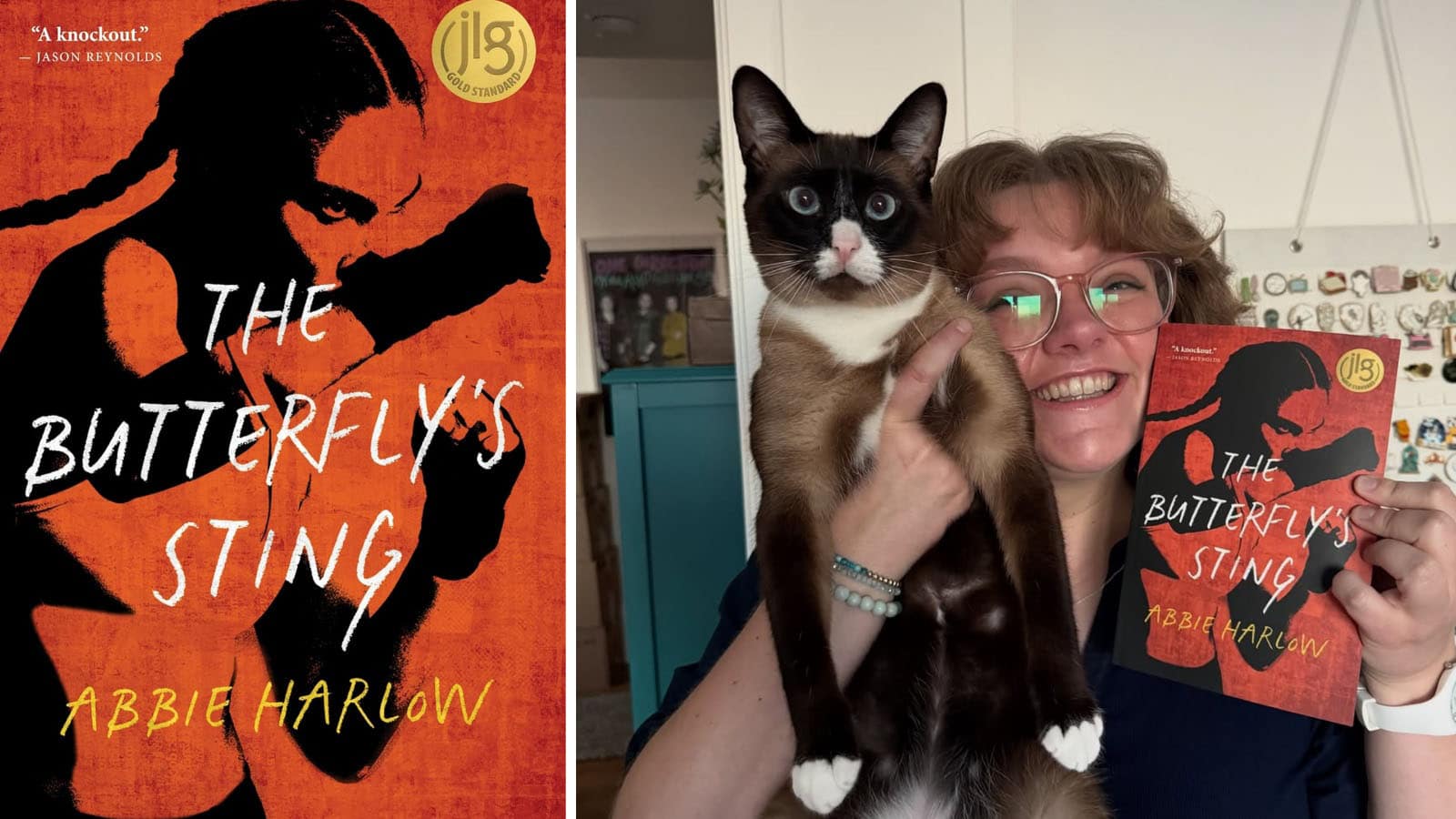
Put off by its inherent brutality, I confess I’ve never watched professional or amateur boxing in my life beyond a few clips of Muhammad Ali and a handful of Olympic athletes. Nonetheless, Alameda author Abbie Harlow’s new young adult novel, The Butterfly’s Sting, published in October 2025, drew me into the adrenaline of the sport, allowing me to understand the appeal of its high-stakes drama, spectacle, intense physicality, and mental toughness. Combine that with the unexpected twist of the protagonist being a teen girl growing up in a town inspired by Alameda, who’s fighting—literally and figuratively—to save herself and her siblings from an abusive home, and you have an intense and compassionate page-turner.
 [1]
[1]“The road’s clogged with cars: parents driving carpools, commuters trying to get to the bridge or the ferry to go off-island for work. In the weak sunlight, the San Francisco Bay gleams blue and green and gray, a mood ring that can’t settle on a color…I won’t miss much when we leave. But I will miss this wind, this view, this smell.”
In The Butterfly’s Sting, the fictional island city of La Salida forms the backdrop for the story of Bo Clark, a high school senior with two younger siblings, living with a physically abusive uncle, Jack, who became their guardian after their father’s death and their mother’s abandonment.
Although La Salida is based on Alameda, it is grittier and foggier, reflecting Bo’s struggles. There’s a secret flight club over a nightclub out at the old Navy base. (Harlow made this sound so plausible, I actually looked up whether such a thing had ever existed at Alameda Point, and no, it hasn’t – that the internet knows of.) When Jack, a former boxer himself, discovers that Bo also has boxing talent, he signs her up to compete in the lightweight division of the fight club tournament, where she is at first underestimated by her male competitors and starts winning matches.
The boxing ring is brutal, and when she isn’t calling in sick to recover, Bo conceals bruises with makeup and clothing so she can attend school without raising suspicion. The opportunity to win the tournament prize keeps her going. Her dream is to win enough to move out of her uncle’s home as soon as she turns 18 and take custody of her siblings. That powerful motivation keeps her going in matches when she might otherwise give up to preserve her health.
The boxing scenes are among the novel’s strongest elements. Vivid and immersive, they place readers directly in the ring, mirroring Bo’s adrenaline, fear, and grit: “Float like a butterfly. I let him move in. Let him throw a jab-uppercut combo that I sidestep and dodge. His fists fly through the air, carried by pure momentum. He’s within arms’ reach, unguarded – Whump. I get him in the jaw. WHUMP. Then in the head.”
Yet the fights are never just about sport—they are extensions of Bo’s inner life, each blow reflecting her desperation and resolve. Her boxing name, “The Butterfly,” is drawn from Muhammad Ali’s famous phrase, “Float like a butterfly, sting like a bee,” which reflects a boxing style combining graceful movement with sharp, unexpected strikes. The name fits a character who must be swift and precise to succeed. It is also a compelling metaphor for her transformation—grace under pressure and power born from pain.
Until I read The Butterfly’s Sting, I never knew about the vital role of cutmen in boxing. Each boxer has a cutman responsible for preventing and treating physical injuries—specifically cuts, swelling, and nosebleeds. They use tools like thrombin-soaked swabs to constrict blood vessels and seal lacerations, and frozen metal “enswells” (cold irons) to prevent swelling. The cutman can make or break the boxer by how well or poorly they treat injuries in the 50- to 60-second window between rounds.




Bo’s cutman, Liam, unexpectedly turns out to be the fight club owner’s son, who is also her classmate, reluctant ally, and eventual romantic interest. This dynamic adds warmth and complexity to the story without overshadowing the central narrative. It underscores one of the book’s key themes: the difficulty—and necessity—of letting others in to help when past survival has meant relying only on oneself.
As the eldest sibling, Bo becomes parentified, willingly sacrificing her body, her budding romance, and her potential for higher education in a single-minded pursuit to do whatever it takes to escape their uncle and provide a safe environment for her siblings. She meticulously plans and calculates, hiding housing and employment leads on her laptop. Her fierce devotion to her siblings transforms what could have been a straightforward sports narrative into something more profound—a meditation on sacrifice, responsibility, and chosen strength.
Yet her younger sister, Kate, likes living in La Salida, where she enjoys activities and friends at school. Since she’s never personally on the receiving end of Jack’s abuse, she doesn’t fully appreciate Bo’s sacrifice, nor does she look forward to being parented by her older sister when she knows that will mean living in poverty and sacrificing friends. Moreover, Jack alternates abuse with charm, such as when he insists on eating breakfast together every morning as a sign that they are a real family, and when he pours on praise when Bo fights well. Such behavior lowers Kate’s defenses.
Meanwhile, Bo’s younger brother, Zach, still in elementary school, portrays the helplessness, stress, and confusion of the very young in an abusive environment. Bo’s heart breaks for him, yet he is most afraid that something bad will happen to her and he will lose his one trusted parental figure.
The story effectively portrays the layered, corrosive effects of abuse, particularly by a family member, and the painful mental gymnastics that result.
The Butterfly’s Sting fuses the intensity of underground boxing in a fictional Alameda setting with a deeply personal story of survival, resilience, and love, combining visceral action with heartfelt storytelling. Fans of gritty young adult fiction and sports-and-competition stories, readers who enjoy strong, complex female protagonists and stories about family and sacrifice, as well as local-setting enthusiasts, will enjoy it. The Butterfly’s Sting is available through Books Inc. on Park Street as well as the Alameda Free Library.
Contributing writer Karin K. Jensen covers boards and commissions for the Alameda Post [3]. Contact her via [email protected] [4]. Her writing is collected at https://linktr.ee/karinkjensen [5] and https://alamedapost.com/Karin-K-Jensen [6].