On October 7, City Council held the second of four workshops to update the public on over $800 million in facility and infrastructure needs. This workshop focused on civic and fire facilities. Input from the workshops will inform the development of a planned voter survey and guide consideration of a potential 2026 revenue measure.
Council also passed a resolution supporting SB 684, the Polluters Pay Act, following strong student testimony. Additionally, it adopted the 2025 California Building Codes, and approved Community Facilities District resolutions to fund new infrastructure for the West Midway Project.
 [1]
[1]
 [2]
[2]Civic and fire facilities infrastructure workshop
The City faces significant challenges related to aging and deteriorating infrastructure, with over $800 million in facility and infrastructure needs identified. City Council is in the process of hosting four workshops to update the public on these needs. The first, on streets and traffic safety [4], was held on September 2.
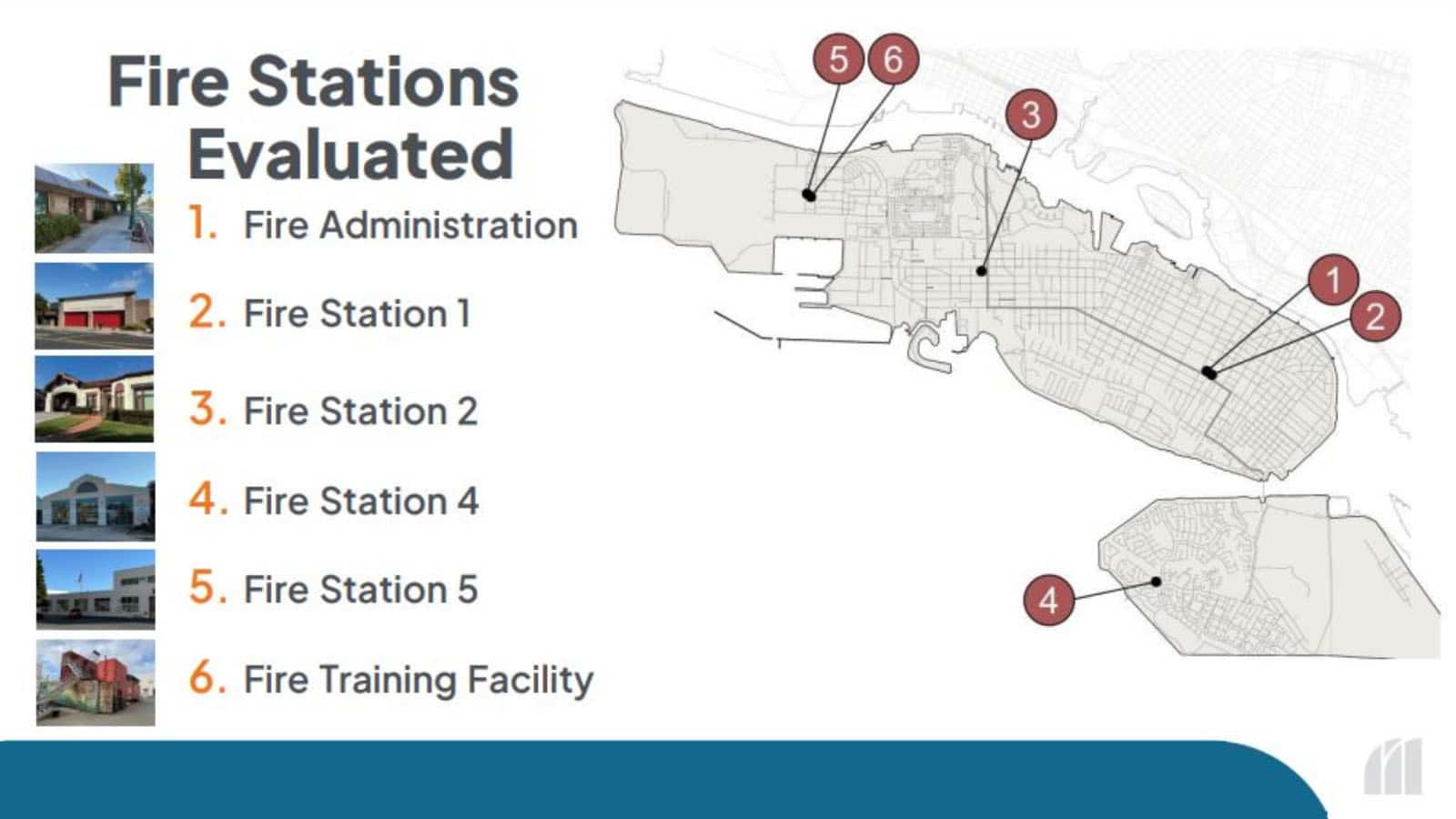
This second workshop focused on civic facilities, including the animal shelter, Fleet Services Garage, Maintenance Service Center (MSC), and the Recreation and Parks Corporation Yard, as well as all fire facilities.
Charles Dellinger, Project Manager for the City’s consultant, RRM Design Group, noted that the civic facilities are undersized, outdated, and inefficient. Among the fire facilities, several are not only outdated, but are seismically vulnerable. Some facilities, such as the MSC, are well-located but require upgrades, while others, like the animal shelter, are poorly situated. The animal shelter is next to housing, so nearby residents are disturbed by barking.
RRM recommended relocating the animal shelter, as well as the Fleet Services Garage, to Alameda Point. Similarly, they recommended that the Recreation and Parks yards be consolidated into a new combined facility, also at Alameda Point, while the MSC be remodeled and expanded to include the adjacent animal shelter and fleet services garage.
Recommendations for the fire facilities include relocating the Fire Administration out of Fire Station 1, possibly to office space or a new Fire Station 5; remodeling and expanding Fire Station 1; remodeling Fire Stations 2 and 4; constructing a new Fire Station 5; and rebuilding the existing Fire Station 5 for fire training.
| Facility | Recommendation | New Location |
| Animal shelter | Relocate | Alameda Point |
| Fleet Services Garage | Relocate | Alameda Point |
| Recreation and Parks yards | Consolidate into new combined facility | Alameda Point |
| Maintenance Service Center (MSC) | Remodel and expand to include adjacent animal shelter and fleet services garage | NA |
| Fire Administration | Relocate out of Fire Station 1 | Office space or new Fire Station 5 |
| Fire Station 1 | Remodel and expand | NA |
| Fire Station 2 | Remodel | NA |
| Fire Station 4 | Remodel | NA |
| Fire Station 5 (new) | Construct | Alameda Point |
| Fire Station 5 (existing) | Rebuild for fire training | NA |
Input from the workshops will inform the development of a voter survey planned for the end of the year and will guide consideration of a potential 2026 revenue measure. The next workshop, scheduled for November 4, will focus on libraries and recreation and parks.
 [5]
[5]Council comment
Council members acknowledged that an $800 million need is daunting, but stressed the importance of community input and creative funding. Mayor Marilyn Ezzy Ashcraft noted, “There’s a cost to deferred maintenance.”
The Mayor added that she would seek grants and supplemental funding, but cautioned, “We are going to need to do more with less, which means you all aren’t going to get everything on your wish list.” Praising the Friends of the Alameda Animal Shelter, she noted, “Their volunteers are amazing and committed, and they raise a lot of money. I’m going to look for a percentage of the revenues to come from (them).”
Councilmember Tracy Jensen inquired about how the upgrades would impact the Emergency Operations Center. Fire Chief Nick Luby explained that seismic improvements would help ensure that firefighters are actually available to respond during a disaster. Further, adding a new Fire Station 5 at Alameda Point would improve coverage, reduce response times, and decrease reliance on mutual aid.
Councilmember Greg Boller emphasized the importance of residents educating themselves on the City’s infrastructure issues and understanding the trade-offs associated with funding different City facilities.
Councilmember Tony Daysog asked about the statistical validity and sample sizes of upcoming community surveys. Communications Director Sarah Henry responded that past polling had 400-600 respondents, resulting in a margin of error of about 5%, with a 95% confidence level. The City will conduct surveys online and by phone in multiple languages, with a focus on reaching diverse demographic subgroups.
Vice Mayor Michele Pryor concluded, “We need to make some bold, hard decisions. We want to be here for decades, and we’ve got to start today.”
Polluters Pay Climate Action resolution
Councilmember Tracy Jensen introduced a resolution at the request of Alameda’s Youthpower Climate Action [6] organization, urging stronger local support for the “Polluters Pay Climate Action Superfund Act of 2025” (SB 684). Jensen stated that companies profiting from carbon emissions “should be responsible for addressing the damage that those chemicals have caused.” She added, “This council can and should demonstrate our support by adopting the resolution.” Other California cities have passed similar resolutions.


Communications Director Henry explained that SB 684 was introduced in February 2025, passed the Senate Environmental Committee in April, but stalled in the Judiciary Committee. It must advance in January 2026 to stay alive.
Henry noted “significant opposition from labor unions, construction trades, and the fossil fuel industry,” who claimed it could raise gas prices. She said supporters, including the National Resources Defense Council and Union of Concerned Scientists, countered that it would “make the polluters pay, not people from their purses.”
The City has already submitted a formal support letter via the state portal. Passing a council resolution would add symbolic weight, but it would still be submitted through the same process.
Student speakers from Alameda High, Encinal Junior/Senior High, and other Alameda schools urged the Council to pass the resolution, arguing that major oil and gas companies should be held accountable for the damages caused by climate change. Students emphasized fairness, saying, “We shouldn’t have to clean up after someone else’s mess,” and stressed that the bill targets large fossil fuel companies, not small producers.
Community advocates, including Community Action for a Sustainable Alameda, echoed student concerns about Alameda’s vulnerability to sea-level rise, urging the Council to validate youth advocacy.
Council response
Council unanimously approved the resolution. Vice Mayor Pryor praised the students’ efforts, and Councilmember Boller added, “This is going to be a legal fight, but it’s one worth taking.” Councilmember Daysog emphasized Alameda’s vulnerability: “Because we are an island, we are uniquely affected by climate change in all parts of Alameda [7], not just along the waterfront.”
Mayor Ashcraft encouraged the youth who were present to stay engaged: “A letter and a resolution from the City isn’t going to move the needle, but it is great practice in advocacy.” She encouraged the students to take their advocacy further by identifying the bill’s opponents and writing to or visiting them, lobbying state legislators and officials, registering to vote as soon as they are eligible and thinking long-term, including pursuing elected office or careers in environmental fields.
Updating building codes
Chief Building Official Oscar Davalos introduced an ordinance to adopt the 2025 California Building Standards Codes, along with local amendments addressing liquefaction, sea-level rise, and seismic risks. For the first time, the City is also adopting the International Property Maintenance Code [8], which specifies requirements for the use and maintenance of residential and nonresidential building elements and systems.
Davalos highlighted recent code enforcement improvements, such as collaboration with the Chamber of Commerce and the Department of Public Works to support compliance and redevelopment of vacant properties.
He also highlighted an example in which the City partnered with the California Department of Tax and Fee Administration to conduct enforcement inspections. Officials seized 43 boxes of merchandise, representing 1,470 violations at a single business. This enforcement was tied to the City’s tobacco retail ordinance, which restricts the sale of unlicensed products.
Davalos credited Councilmember Daysog for pressing the issue, noting that he had urged more vigorous enforcement earlier in the year. Council unanimously approved the ordinance.
Community Facilities Districts at Alameda Point – West Midway Project
Council also considered and unanimously approved the formation of Community Facilities District (CFD) 25-1 for the West Midway Project at Alameda Point and the annexation of the West Midway property into the existing CFD 17-1 (Alameda Point Public Services District).
The West Midway Project, approved by the Planning Board in May 2023 [9], includes 478 housing units and up to 10,000 square feet of nonresidential space on 26 acres. CFDs are financing tools used throughout California for large-scale redevelopment. They ensure that new residents pay for the infrastructure they will directly benefit from, protecting existing residents from those costs. Councilmembers highlighted that CFDs have been commonly used in Alameda for large projects, including Alameda Marina, Alameda Landing, and Bayport.
CFD 25-1 will finance backbone infrastructure, including new roads, sewers, water, utilities, flood control facilities, bike lanes, and public safety improvements. Financing will be obtained through bond issuance, repaid over time by property owners in the new development. CFD 17-1, formed in 2017, will provide public services such as roadway maintenance, utilities, flood control, police, and fire protection.
Contributing writer Karin K. Jensen covers boards and commissions for the Alameda Post [10]. Contact her via [email protected] [11]. Her writing is collected at https://linktr.ee/karinkjensen [12] and https://alamedapost.com/Karin-K-Jensen [13].