On July 7, City Council approved an ordinance to place a $300 million general obligation bond measure on the November 2026 ballot to finance critical infrastructure projects. Council also voted to approve resolutions to place two measures on the November ballot for City Charter amendments and approved construction contracts for the Alameda Aquatic Center, which are detailed in a separate article [1].
 [2]
[2]With at least $800 million in unfunded infrastructure [3] and deferred maintenance needs identified across the city—an amount that continues to grow amid impacts stemming from climate change—City staff have conducted extensive public input [4] in the past year to gather feedback on how to prioritize and fund key needs. Staff also explored the possibility of placing a local bond measure on the ballot that would create a dedicated funding source for key infrastructure projects, rather than pulling from the City’s general fund balance, which, according to Sustainability and Resilience Manager Danielle Mieler, could put other City services and priorities at risk.
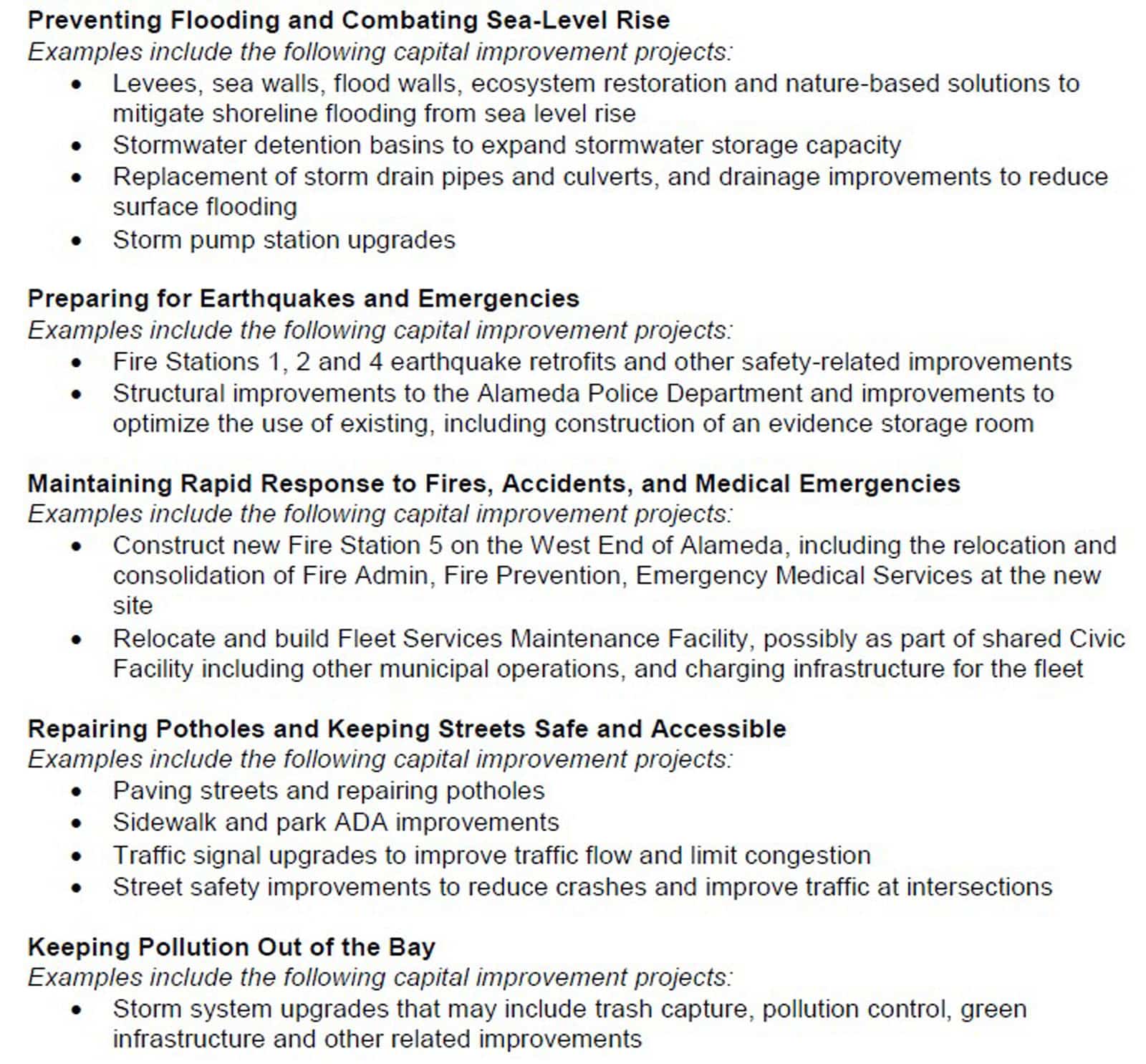
If passed by voters, the measure would require property owners to pay about $49 per year for every $100,000 of assessed value. It would also create a Council-appointed oversight committee to review and report on expenditures for projects that fall under five authorized capital improvement project categories:
- Preventing flooding and combating sea-level rise.
- Preparing for earthquakes and emergencies.
- Maintain rapid response to fires, accidents, and medical emergencies.
- Repairing potholes and keeping streets safe and accessible.
- Keeping pollution out of the Bay.
The City hired Team CivX and FM3 Research—consultants that specialize in election strategy and public opinion research—to gauge public appetite and perspectives for a proposed bond measure. Curtis Below, a partner and Chief Operating Officer at FM3, explained the survey methodology, which involved interviewing 420 residents over the phone or by email over a week in June 2026. They were asked a series of questions, ranging from their opinions about the direction Alameda is heading, approval of city government, thoughts on key issues and priorities, and support for an infrastructure bond.
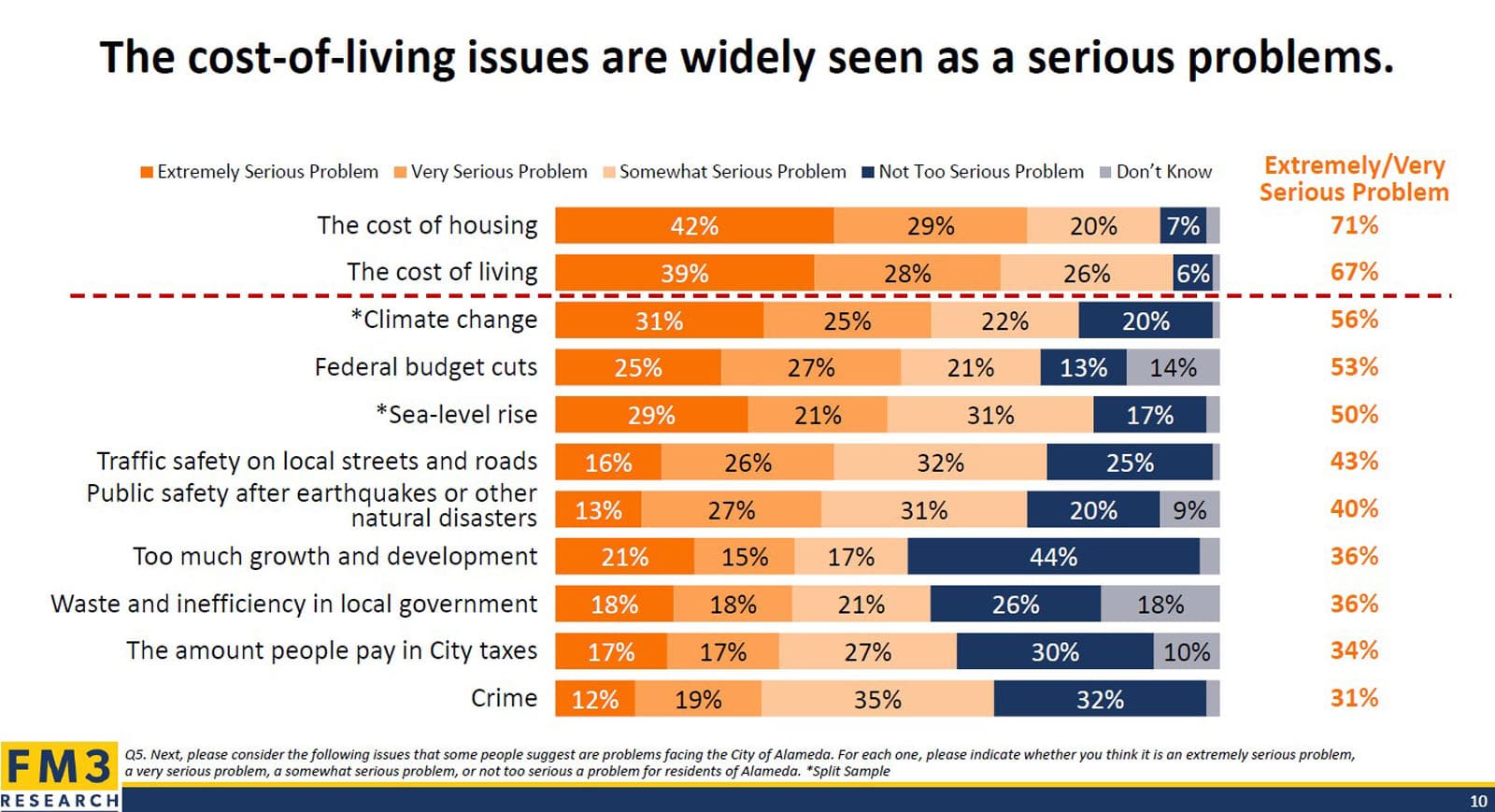
Overall, Alameda voters who responded were generally optimistic about the city’s direction and have generally positive views of city government. The high cost of living and housing, followed by climate change, were identified as the three most significant problems Alameda faces. Crucially, about 62% of those surveyed said they would support a bond measure, but notably, this value falls short of the two-thirds supermajority required for its passage.
 [5]
[5]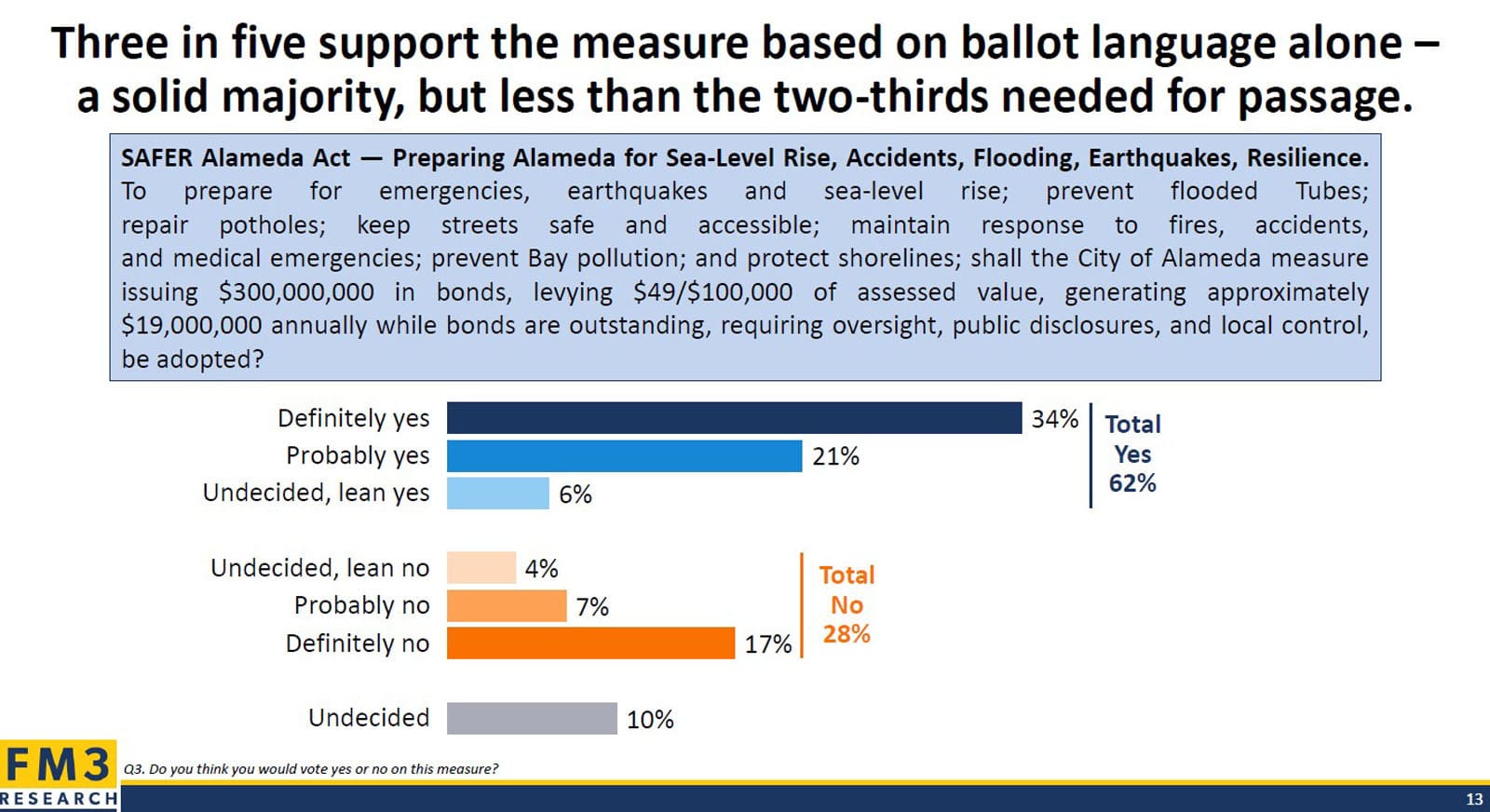 [6]
[6]However, that percentage, as well as the perceived need for additional infrastructure funding, have been trending higher since 2024, leading Team CivX’s Jeremy Hauser to express some surprise given that residents of other cities have soured on similar proposals. With optimism, Hauser indicated that with a robust advocacy campaign and continued outreach and education, the measure has a chance to gain voter approval later this year.
Public comment
About a dozen community leaders and residents largely voiced support for placing the bond on the ballot.
“Tonight’s vote is not about approving the $300 million bond—it’s about whether the people of Alameda should have the opportunity to decide the future of their city,” said Mike DeWitt, a firefighter and president of Alameda Firefighters Local 689. “Our firefighters are serving tomorrow’s city with yesterday’s facilities.”
Meredith, who described herself as an Alameda resident with a young family who wants to create a long-term quality of life here, agreed. “This work needs to get done,” she said. “Every year we delay, projects become more expensive while risks to our community grow exponentially.”
However, a few speakers, like Mitch, voiced opposition to the funding mechanism and argued that bonds funded by parcel tax would “tax more progressively, putting a lighter burden on the least wealthy, and would encourage housing development rather than discouraging it.”
Council discussion
Vice Mayor Michele Pryor expressed support for the bond, suggesting that although the demonstrated need is closer to $800 million, a $300 million bond will be a strong start to chipping away at the backlog.


“The needs that exist today will not go away, and if we don’t get this bond our current needs will become untenable and more needs will arise,” she said. “But the five of us do not decide if there will be a bond—it is up to the voters.”
Councilmember Greg Boller agreed, and expressed gratitude for the public speakers and survey respondents for taking the time to care about the city’s future. Both Boller and Pryor also highlighted what they believed to be a balanced specificity of the ordinance, which describes not just the five different categories of capital improvement projects, but also lists specific project examples.
“Does it have every cost and dollar attached to that and a timeline? Absolutely not. And there would be problems with doing it that way,” said Boller, as he echoed Pryor’s suggestion that being overly specific could place unforeseen restrictions on how funds are spent if additional funding, such as grants, were secured in the future.
Their sentiments were likely made in anticipation of Councilmember Tony Daysog’s opposition, which proved prescient, since Daysog echoed similar opinions about the perceived lack of specificity on projects and funding allocation that he expressed during the discussion over the proposed infrastructure bond measure [7] back in 2024.
“We need to rise to the occasion of presenting to the voters a clear list of what it is that we are expecting them to fund,” said Daysog. “The argument is being made that this is about letting the Alameda voters decide. …In a way, it really isn’t, because it is letting future City Councils decide how to spend the $300 million. Because if it was about letting Alameda voters decide how to spend the $300 million, you would have had a very specific list.”
 [8]
[8]Upon hearing Daysog’s opposition, Councilmember Tracy Jensen acknowledged that the proposed revenue option is not the most equitable and that the project list is not perfect. However, she expressed faith that staff is equipped to make future decisions over project priority, and ultimately expressed support for the ordinance.
With it clear to Mayor Marilyn Ezzy Ashcraft that the required four Council votes had been secured to pass the ordinance, she delivered her concluding remarks. As she spoke, she reiterated the hope that voters would approve the measure in November, but also criticized Daysog’s continued opposition and his refusal to meet with the consultants and pollsters to get his questions answered.
“The voters elected us to make decisions, not to just sit in a chair and kick a can down the road and raise the same, tired objections that we’ve seen over and over again,” Ashcraft declared. “This is about democracy in its most fundamental form. Let the voters decide how the voters want to spend their money.”
In response, Daysog clarified that he saw no need to meet with the consultants since he had sent his questions to staff and received satisfactory responses, both via email and during the evening’s discussion.
Ashcraft closed by thanking City staff for their hard work, and Council voted 4-to-1, with Daysog in opposition, to place the measure on the November ballot.
Ken Der is a contributing writer for the Alameda Post [9]. Contact him via [email protected] [10]. His writing is collected at AlamedaPost.com/Ken-Der [11].