Senator Arreguín shares latest legislative developments
On November 4, City Council held an in-depth workshop on library and parks infrastructure needs, heard a legislative update from State Senator Jesse Arreguín, and approved new City board appointments. The workshop underscored the City’s looming $800 million infrastructure deficit, with staff noting aging recreation facilities operating beyond their intended lifespans.
 [1]
[1]Infrastructure Workshop #3
City staff presented a third infrastructure workshop outlining significant needs for Alameda’s libraries, parks, and recreation facilities. Prior workshops focused on streets and traffic safety [2] and civic and fire facilities [3]. Staff noted that the City faces more than $800 million in deferred maintenance and upgrades.
Communications and Legislative Affairs Director Sarah Henry explained that while Alameda has a well-used park and library system, “our needs are greater than our revenues,” and many facilities are “operating beyond their intended lifespan.”
The City’s 35 parks, 26 playgrounds, recreation centers, and trail systems require significant work, including modernizing aging irrigation systems, repairing buildings, improving accessibility, and upgrading energy efficiency. Planned new parks and expansions—including De-Pave Park [4], future phases of Seaplane Lagoon Park, completion of Jean Sweeney Park, Enterprise Park, and a regional sports complex—represent approximately $216.5 million in capital needs.
Alameda Recreation and Parks Department (ARPD) Director Justin Long emphasized urgency, saying the City is approaching an “infrastructure cliff” and that larger facilities like the Veterans Building, Officers’ Club (O’ Club), and Alameda Point Gym will require “a capital infusion … larger than what we can do on an annual revenue basis.”
Library Director Mike Eitner described parallel challenges in the City’s library system. The Bay Farm Library, opened in 1980, “is in dire need of expansion” and lacks basic space for story times and study rooms.
The Main Library, now nearly 20 years old, needs carpet and furniture replacement, as well as a significant upgrade to its building management system, which controls lighting and HVAC. Eitner noted that while the West End Library is an “architectural gem,” it is a challenge to operate due to its single-room layout and age.
The City also hopes to establish a library presence at Alameda Point and develop a Library of Things (tools, cookware, etc.), but both are currently unfunded. Estimated library-related needs total up to $35 million.
Staff said they will continue community outreach and then conduct public polling as to whether the City should consider a local revenue measure.
 [5]
[5]Public comment
Adrienne Alexander spoke as both a Recreation and Parks Commission member and a Friends of the Parks board member: “Our parks need a lot of work.” She cited the decade-long delay to replace the Krusi Park building as “a disgrace to the city.” Nonetheless, she praised parks crews and urged support for a proposed infrastructure bond, provided it clearly states how money will be spent.
Katie Connell followed, focusing on reviving the historic Carnegie Library [6]. She proposed forming a nonprofit “Carnegie Creativity Center,” describing it as a “vibrant hub for creativity, connection, and community.” The center, she said, could promote “equitable and inclusive access to the arts” through visual, performing, culinary, and cultural programs. Connell envisioned energy-efficient upgrades, food-recovery partnerships, and mental health-supporting art initiatives. She said the project would “restore a landmark building while creating artist opportunities” and could sustain itself via “event rental revenue and small business hubs.” Connell urged City partnership.
Council comment on libraries
Councilmember Tracy Jensen opened by inquiring about the unused Carnegie Library. City Manager Jennifer Ott explained that it is “one of our older and more classic buildings,” that upgrading would require significant expense, and “a lot of staff time” to determine the costs. Any reuse would need to be discussed as a new project, since it is no longer part of the library portfolio.
Discussion turned to a proposed Alameda Point Library, estimated to cost between $500,000 and $20 million, depending on whether the City uses mobile van services or builds a new facility. When Councilmember Greg Boller asked how equity should guide spending, Director Eitner replied, “We would focus on Alameda Point … Many folks who live [there] do not have easy transportation … We need to go to them.”
Brainstorming possible locations, Eitner referenced creative best practices: “Libraries across the country … are on the first floor of a building, and housing is on the second, third, (and) fourth.” He also mentioned how the Davis public library was co-located with an elementary school. Mayor Marilyn Ezzy Ashcraft suggested unused shopping mall space, such as at Alameda Landing; Eitner agreed this was possible.
Eitner noted that expansion at the West End Library is constrained. He floated the idea of relocating Alameda Reads, the adult literacy program, to that site and finding “a different location for a larger, more modern West End library.”

Eitner praised Friends of the Alameda Free Library [7], calling them “ready to engage in a capital campaign.” He noted that they previously “provided all of the furniture for the Main Library” when it opened in 2006.
 [8]
[8]Council comment on recreation and parks
Addressing public concerns about a “backroom deal” related to locating a proposed Surf Park [10] at Enterprise Park, City Manager Ott emphasized that any such project “will come back to the City Council in public session” before an agreement is executed. The City Attorney confirmed that “all real estate transactions have to be approved by the City Council in open session.”
Councilmember Daysog questioned whether Alameda Point projects should “pay for themselves.” Ott replied, “We anticipate that a lot of the new facilities… would be paid for by developer funds.” Director Long added that the sports complex could be phased to avoid incurring the full $65 million cost at once.
Addressing equity concerns, Director Long noted, “We’re building dense communities around Clement, and having really good open space near there would be valuable.” Still, he pointed out that Alameda is very lucky to “have almost the entire community within a 10-minute walk of a park.”
In response to Councilmember Boller asking about the status of ARPD art programs, Long noted a desire to incorporate “rotating art events in all of our rec centers.”
Long praised Friends of the Parks [11] as key partners who “help raise money for playgrounds and assist when we are making improvements.” He noted their successful fundraising events, such as “Bike for the Parks.”
The final infrastructure workshop, on December 2, will focus on flood protection, sea level and groundwater rise, and disaster preparedness.
 [12]
[12]Senator Arreguín’s legislative update
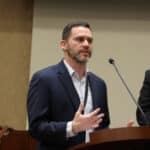
State Senator Jesse Arreguín addressed City Council on his work, leading with strong criticism of recent federal immigration enforcement activities. He said he shared the community’s “disgust and anger over the inhumane actions of the Trump administration to separate families … to literally snatch people off the street.” He thanked Alameda for maintaining its commitment to being a sanctuary city.
He highlighted state actions, including $50 million in emergency funding, noting: “We allocated $25 million to the Attorney General … to file lawsuits against the Trump administration,” and another $25 million to ensure “people that are facing deportation have legal representation.” He underscored laws he sponsored, including SB 81, which prohibits immigration enforcement in schools and hospitals, and SB 627, the “no secret police act,” which prohibits enforcement officers from wearing masks.
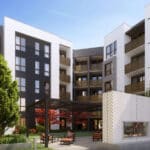
On housing, Arreguín described ongoing state support for affordable and supportive housing, including over $20 million for Alameda’s North Housing Senior Apartments project. Regarding climate resilience, he noted how Alameda is disproportionately affected by sea level rise and pledged to secure the City’s fair share of funding through Proposition 4, the statewide climate and natural resources bond.
As chair of the Senate Public Safety Committee, he highlighted legislation to reduce ghost guns, explaining that “over 70% of guns collected … are ghost guns.” SB 704 closes a loophole by requiring that gun barrels be purchased from licensed dealers.
Arreguín addressed economic hardship caused by federal SNAP (Supplemental Nutrition Assistance Program) freezes, criticizing the politicization of basic needs: “Food and health care should not be bargaining chips.” He noted that the state budget includes $1 million in supplemental support for local food banks and said lawmakers will consider additional funding when the Legislature reconvenes.
On transportation, he noted securing $750 million to prevent transit service cuts, while working on SB 63 for long-term funding. SB 63 would allow the Bay Area to place a regional funding measure before voters to support public transit operations. The bill aims to provide a long-term, stable revenue source for agencies such as BART and local bus systems, which are facing significant budget shortfalls. Arreguín said, “We have to stabilize transit or we will see significant service reductions.”
New commission and board appointees
In other business, the Council unanimously approved resolutions appointing Michelle Knoedler, an architect and ADA-focused designer, to the Commission on Persons with Disabilities and Roberta (Robbie) Kreitz, a lifelong Alameda resident and special education professional, to the Social Service Human Relations Board.
Contributing writer Karin K. Jensen covers boards and commissions for the Alameda Post [14]. Contact her via [email protected] [15]. Her writing is collected at https://linktr.ee/karinkjensen [16] and https://alamedapost.com/Karin-K-Jensen [17].