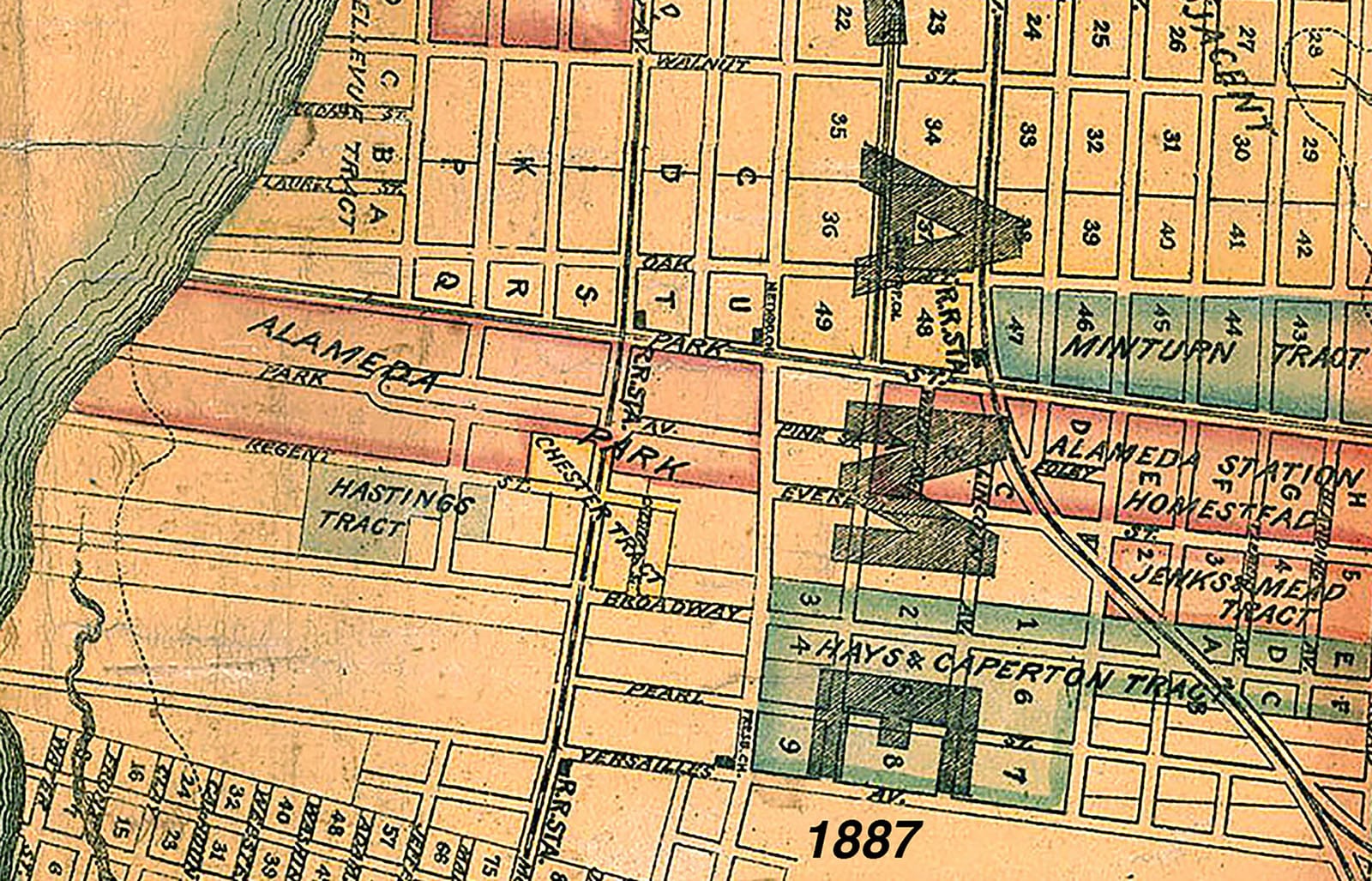
Three towns developed on the Alameda peninsula, called the Bolsa de Encinal, between 1854 and 1864: Alameda, Encinal, and Woodstock. Don Antonio Maria Peralta sold the entire bolsa to William Worthington Chipman and Gideon Aughinbaugh in 1852. The Don was happy to have the $14,000 in gold coin (about $325,000 in 2024 dollars) and be rid of the peninsula that the Spanish thought was shaped like a purse (bolsa) with its large oak (encinal) forest.
 [1]
[1]
Chipman and Aughinbaugh sold a portion of the peninsula to James J. Foley and a larger slice to Dr. James F. Hibberd. The line on the map that defined the boundary between these properties became Park Street. This boundary first became a dirt road that carried horses, wagons, and pedestrian traffic across a slice of marsh toward today’s Foothill Boulevard in Oakland.
In 1864, Alfred A. Cohen’s San Francisco & San Jose Railroad began running through the peninsula. The railroad laid tracks that started near today’s Pacific Avenue and Main Street. The new train ran down Pacific, veered southeast on Marshall Way onto today’s Lincoln Avenue. The locomotive Edwin Mastick pulled cars with freight and passengers east on the way to San Francisco & Alameda Railroad’s first end station near today’s High Street and Coliseum Way in Oakland.
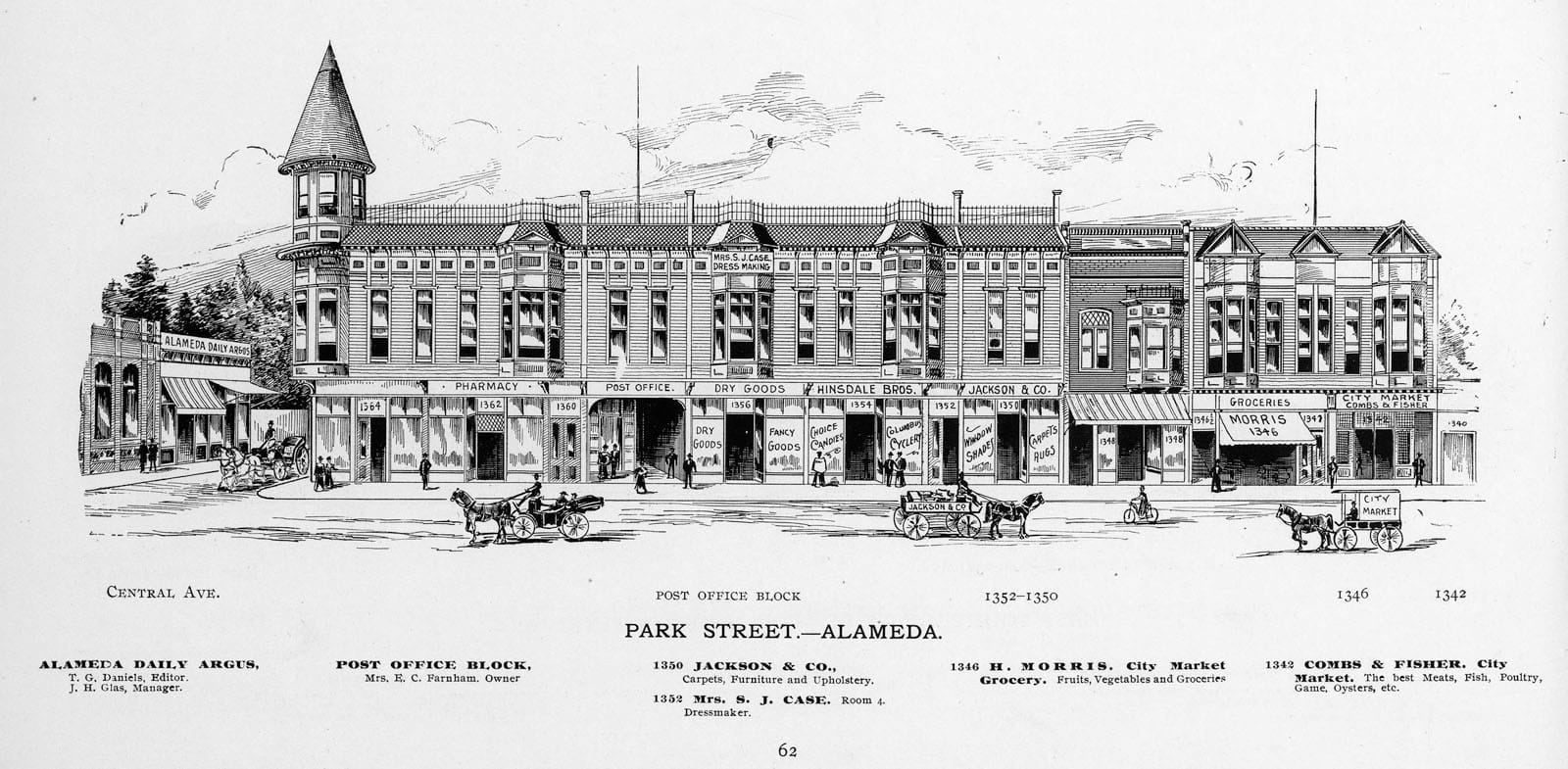
Cohen decided to build a station at Park Street. He also purchased property on the east side of the street, built a hotel, and created a park that he was sure would attract wealthy residents. This railroad station made Park Street a focus, and gradually it became the epicenter of business. Residents moved from the Town of Alameda to be closer to this long sought-after transportation. Some felt that Cohen had snubbed the town.
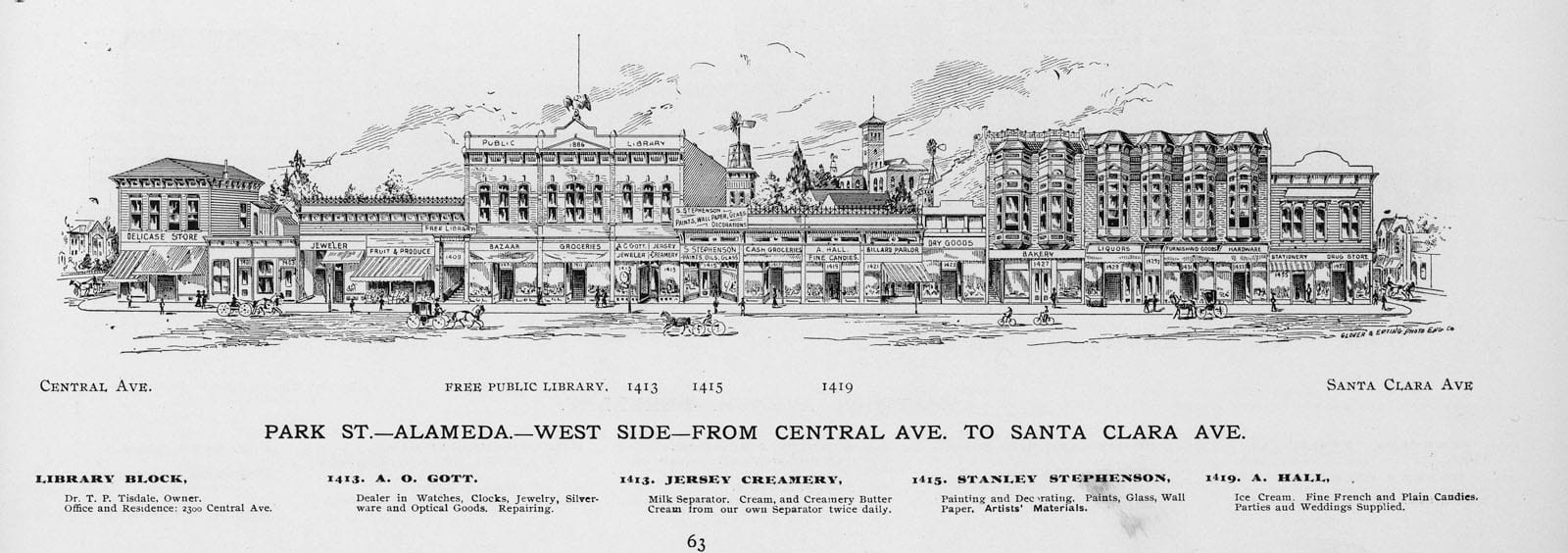
The Methodists decided to move their entire church building from Court and Jackson streets to the southwest corner of Central Avenue and Park Street. Thomas A. Smith moved his office from Alameda and nestled it next to the San Francisco & Alameda Railroad tracks. He offered his office to residents who wanted to create a library. Businesses, shops, and saloons joined Smith and clustered around “Alameda Station,” as their addresses read. This took the focus away from the Town of Alameda.


 [2]
[2]
 [3]
[3]Charles Minturn owned property on the western side of Park Street, an interesting addition. Minturn was the scion of a wealthy shipping family in New York. The family sent Charles around the Horn with a small ferry called Union in its hold—it is no accident that Alameda has a pair of streets named Minturn and Union. Minturn was responsible for Hibberd’s Wharf in the Town of Encinal. He also founded the San Francisco & Alameda Railroad with A. A. Cohen and Edwin Mastick.
The Central Pacific Railroad arrived in 1869 and opened Park Street to a wider world. The Alameda Oakland & Piedmont Railroad was not that far behind. Its horse cars began running from Alameda Station in 1875. The line ran south on Park Street to Central Avenue, east on Central to High Street, and north on High Street to Santa Clara Avenue. To add flourish to Park Street, a second railroad arrived in 1878. The South Pacific Coast Railroad chose Park Street as the site of its hotel. In 1879, all was tied nicely together when the Alameda Oakland & Piedmont Railroad extended its Santa Clara Avenue line from Union Street to Park Street. Passengers could board a streetcar on Park Street and ride west to Webster Street and north into Oakland.
This rail system played an extremely important role by allowing the organized and scheduled movement of both goods and people. Merchants and fraternal organizations responded. The Odd Fellows added an attractive Queen Anne-style building on the northwest corner of Park Street and Santa Clara Avenue.
The Masons hired prominent Oakland architect Charles Mau to build its temple at Alameda Avenue. They would later expand with a new temple along Alameda Avenue, home not only to the temple but to the Alameda Museum. R. R. Thompson chose Park Street as the headquarters for his Artesian Water Works. He commissioned architect William Patton to build a bank at Park Street and Central Avenue. This building expanded as it met more modern banking needs. The opulence still surrounds those enjoying pizza in the restaurant located in the building today.
Dennis Evanosky is the award-winning Historian of the Alameda Post [4]. Reach him at [email protected] [5]. His writing is collected at AlamedaPost.com/Dennis-Evanosky [6].