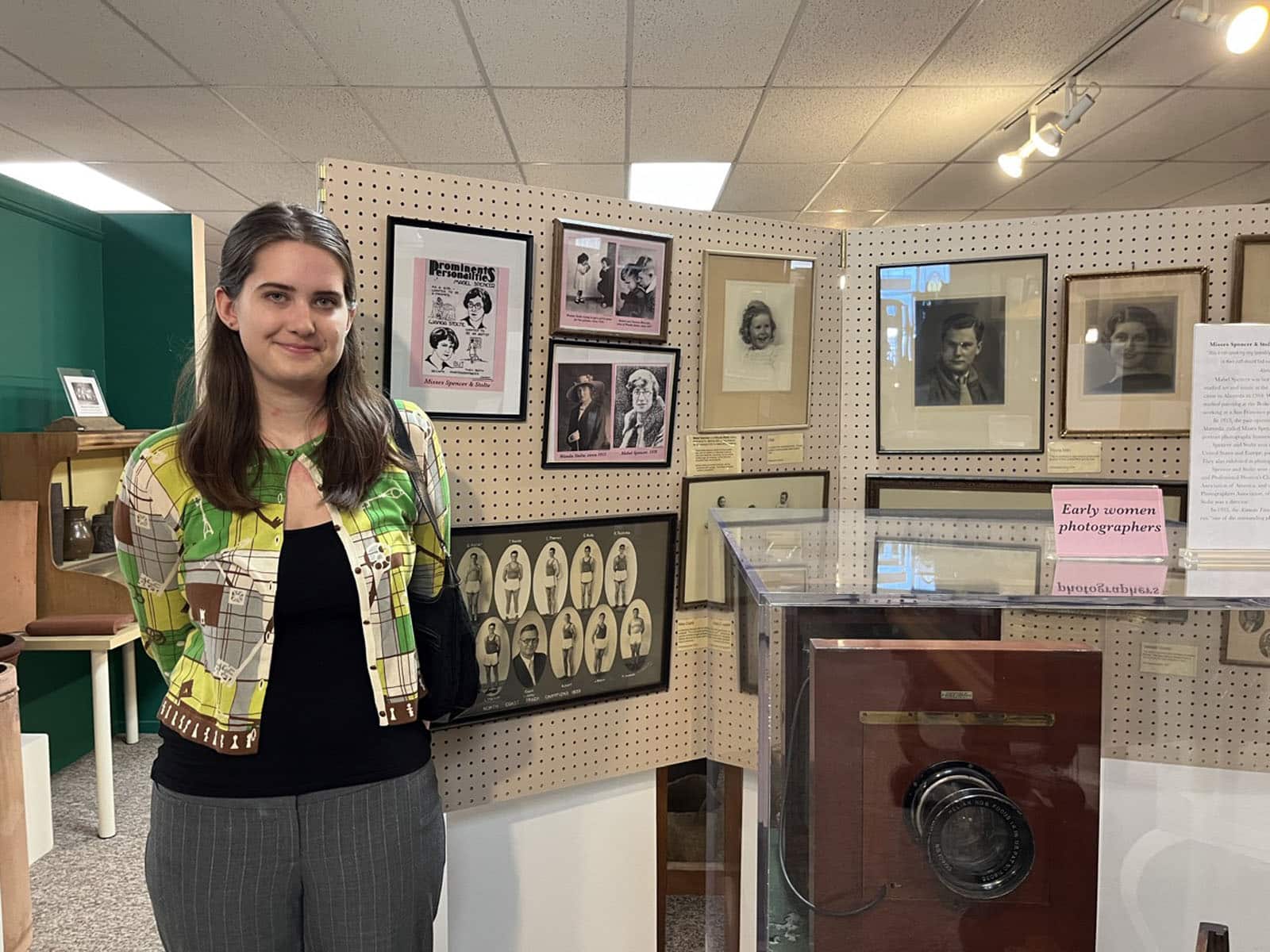
To celebrate Women’s History Month, the Alameda Museum is currently highlighting the lives of notable women of Alameda who made contributions to our island from the late 1800s to the 1990s. The show, Women of Alameda’s History, was curated and researched by Gemma Jackson and runs through April 19.
 [1]
[1]“Even though [Alameda] is kind of a small town and it’s not like a big city, there’s a lot of women that shaped the town and did really interesting things,” Jackson told the Alameda Post.
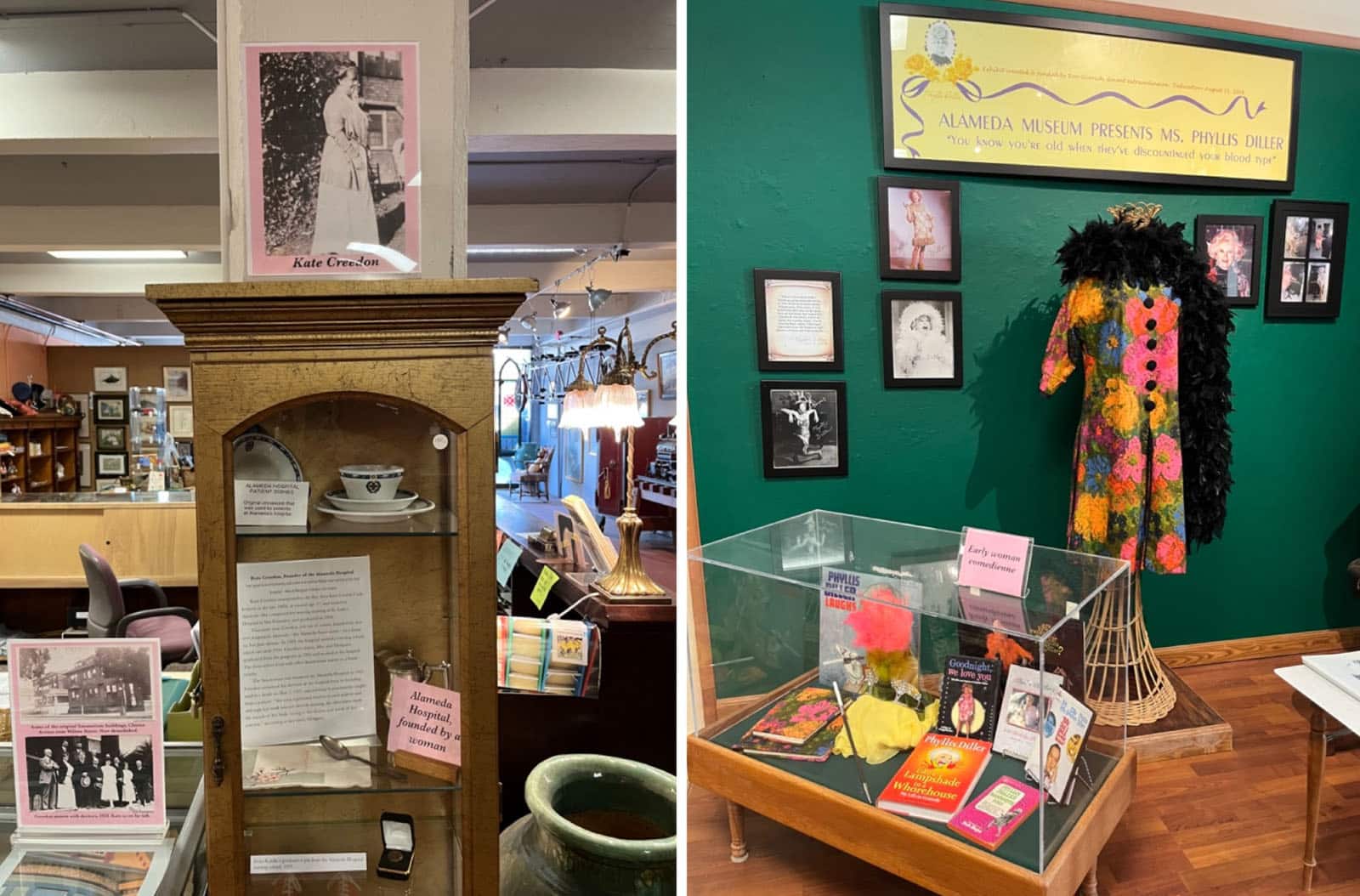
Jackson has put together an informative exhibit which features Elector Littlejohn, a community activist who passed away in 1992 and for whom Littlejohn Park is named, as well as Kate Creedon, who founded the Alameda Hospital (originally named the Alameda Sanitorium) in 1894.
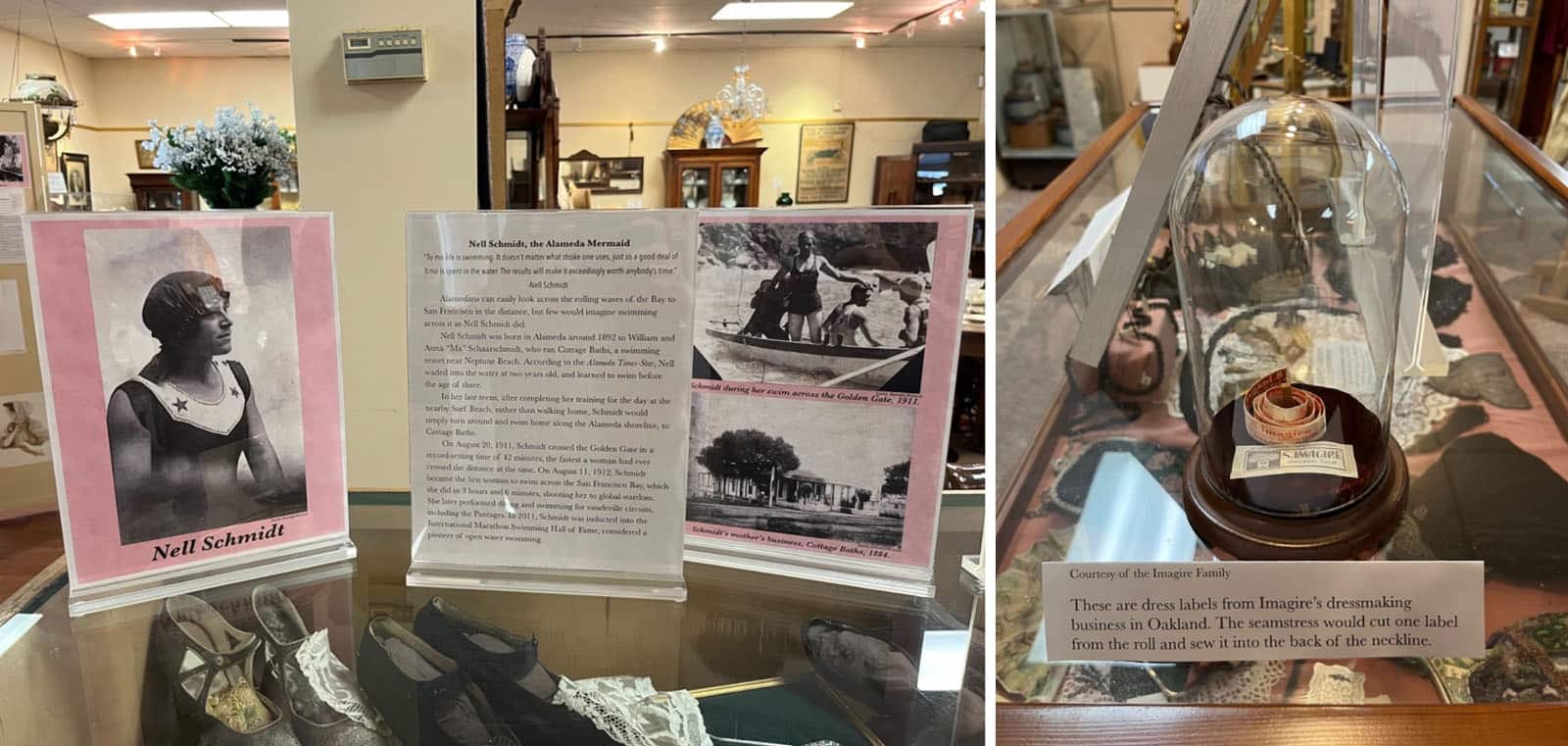
Also featured are the Bruton sisters [2], modern artists born in the 1890s who created a number of murals and public art in the Bay Area at the San Francisco Zoo and UC Berkeley, as well as Shizuko “Shizu” Imagire, a businesswoman and dressmaker who opened a sewing school in Alameda in 1922 and fled from Japanese internment camps.
Nell Schmidt, “The Alameda Mermaid” who was the first woman to swim across the Bay, Ruth Hackett Lasartemay, who cofounded the African American Museum and Library in Oakland, and Ruby Yoshino, a singer and civil rights activist, also are included in the show.
 [3]
[3]Jackson researched the lives of the women by reaching out to the Alameda Japanese American History Project [4] and the African American Museum and Library at Oakland [5]. She also reviewed past articles from the Alameda Post and accessed newspaper archives from the Alameda Free Library [6].
Jackson was also able to connect with a relative of Shizuko Imagire and find out more information about her. “It was gratifying to connect with her family and I think she’s really inspiring,” Jackson told the Post.


Jackson, who is an archives volunteer, was inspired to work with the Alameda Museum when she visited the Meyers House [7] last summer. The historical home, which has been restored to its original 1890s charm, is open to the public for tours. Jackson was intrigued by the fact that Henry Meyers, the owner of the house who designed the Posey Tube portals and other Alameda structures, had three daughters who never married and had successful careers.
“One of them was an architect… and one of them was a physician. And this was in the 1930s,” Jackson explained to the Post. After the tour, the Alameda Museum, which owns and operates the Meyers House, told Jackson that they needed archive volunteers and she signed up.
 [8]
[8]In addition to the Women of Alameda’s History exhibit, the Alameda Museum’s permanent collection features an exhibit on legendary and iconic comedienne Phyllis Diller, porcelain art by women in the early 1900s, and photography by Mabel Spencer and Wanda Stolte, who started a photography studio in 1913. Diller lived in Alameda while her husband was working at the Naval Air Station Alameda. She reportedly got her start in stand-up comedy by telling jokes to her fellow PTA moms at Edison Elementary School in the 1950s.
“In school, I feel like we learn about white men,” Jackson said, “but that doesn’t mean that there’s not stories of other groups… Those stories are there, you just have to look harder for them because they haven’t been considered important for a long time.”
The Alameda Museum [9] is located at 2324 Alameda Avenue and is open Friday 1 p.m. to 4 p.m., Saturday 11 a.m. to 4 p.m., and Sunday 1 p.m. to 4 p.m. “Women of Alameda’s History” runs through April 19.
Jean Chen is a contributing writer for the Alameda Post [10]. Contact her via [email protected] [11]. Her writing is collected at AlamedaPost.com/Jean-Chen [12].