Citywide accessibility transition plan approved; natural gas ban repealed
On June 18, City Council [1] unanimously directed staff to continue work toward a new branch library at Alameda Point [2] by pursuing funding opportunities, soliciting community feedback on programming and design, and updating cost estimates. It approved the conceptual design for Phase 2 of Estuary Park [3] and a plan describing planned citywide accessibility improvements. It also repealed a ban on using natural gas in new construction, major remodels, and additions.

Branch library at Alameda Point
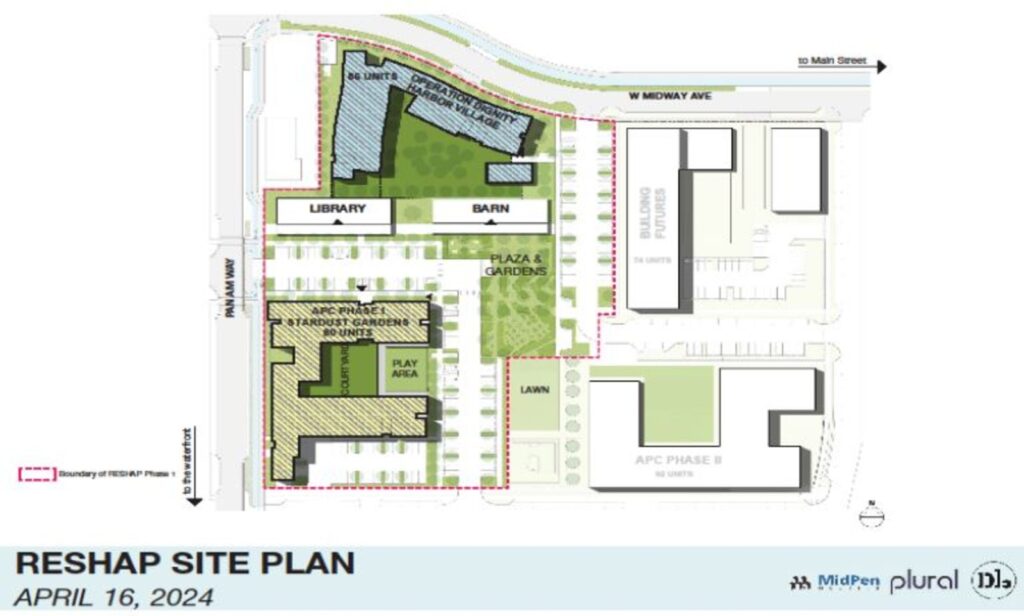
Since Fall 2023, the City [4] has discussed with Alameda Point Collaborative [5] (APC) and MidPen Housing [6] (MidPen) the feasibility of a branch library in the RESHAP (Rebuilding Existing Supportive Housing at Alameda Point) development [7] at Pan Am Way near West Midway Avenue.
RESHAP [8] is a housing project that will develop approximately eight acres of City land at Alameda Point into a trauma-informed campus to serve those most in need. APC, Building Futures [9], and Operation Dignity [10] lead the project in partnership with MidPen and the City. When completed, the campus will have 332 affordable housing units, including 201 replacement units for existing residents and 131 new units. In addition to housing, the project will offer community and economic development initiatives, including afterschool and youth programs, a central plaza, and a one-stop workforce development center.
This month, RESHAP developer Catellus starts work on the first phase, including the branch library site. Site preparation is expected to conclude in September 2025, with construction of the first phase of affordable housing scheduled to begin in March 2026 and conclude in March 2028. Consequently, the City has a couple of years to identify and secure funding for the library and obtain final Council approval.
Preliminary plans include a public events space, study rooms, tool lending, a computer lab, and library materials in various formats. Library Director Michael Eitner [11] said, “Many libraries across the country, including Chicago Public Library, have co-located libraries and housing developments to great success.” Eitner estimated the cost of building and stocking the library of $4 million with an annual cost of $400,000.
Public comment
Public comment was unanimously in support. Liz Varela, Executive Director for Building Futures, said that when her agency discussed the possibility of a library with their clients, “You could see hope in their faces. You could see awe. This is not something they thought could happen in their future.”
Laura Ross, Director of Development at Operation Dignity, read from a client’s letter of support: “I’ve been in tough spots in my life… Books were a big part in helping me through the storms. The ability of a good book to transport me out of my reality probably saved my life and certainly saved my mind.”
Sarah McIntire, Senior Project Manager for MidPen, lauded planning for the library now, saying this would allow the branch library to be an essential, well-used part of the community from the beginning. Co-locating the library next to the workforce development facility would allow for complimentary shared spaces, she noted.
Karen Butter, President of Friends of the Alameda Free Library [12] (FAL), said the Alameda Point community deserves a library. She promised FAL would fundraise for the new branch as they did for the main library.
Council discussion and next steps
Councilmembers unanimously supported proceeding with the project. However, Mayor Marilyn Ezzy Ashcraft and Councilmember Malia Vella [13] expressed skepticism about the estimated cost, believing it was drastically underestimated. Mayor Ashcraft said to Director Eitner, “I implore you to get other estimates so we go in with eyes wide open.”
Councilmember Tracy Jensen [14] praised libraries as safe places to receive resources, socialize through community programs, and work remotely. She disagreed with those who claim they are becoming obsolete because of the decline in reading physical books. Director Eitner agreed, noting that only 18% of Alameda Library usage is digital. He said children especially prefer paper books.
Councilmember Trish Herrera Spencer [15] encouraged the library to provide homework help and resources to bridge the digital divide, such as lending Chromebooks and providing hotspots. Director Eitner agreed, saying, “Access is at the heart of the library and what the library believes in.”
Staff will now reach out to the broader community for feedback and explore funding opportunities, such as grants, Housing and Economic Assistance for Development (AHEAD) funds, a City infrastructure bond, the General Fund, and FAL fundraising.


Estuary Park Phase 2
Estuary Park at 201 Mosley Avenue is the primary neighborhood park for Admiral’s Cove and Alameda Landing. It will also serve Alameda Point residents, including those at APC and RESHAP. The first phase opened in January 2019, including two athletic fields.
Alameda Recreation and Parks Director Justin Long presented the concept design for Phase 2, which will include neighborhood park amenities such as restrooms, picnic areas, benches, drinking fountains with a bottle filling station, a lawn, an inclusive playground to provide experiences for children of all abilities, pickleball courts, a basketball court, two dog parks (for big and small dogs), a Bankshot basketball system [16], walkways, bike racks, and a parking lot with electric vehicle chargers. Director Long noted that ARPD is trying to accommodate as much vegetation as possible to support the City’s urban forest plan [17], and there will be locations throughout the park where those who choose to may donate a bench.

Funding for Phase 2 is secured through a $2.5 million grant from the federal Land and Water Conservation Fund with matching funds available from the City’s Capital Improvement budget. Construction is expected to start in June 2025, with the park opening in Spring 2026. Council praised and unanimously approved the concept design.
Improving citywide accessibility
Before discussing the City’s plan to improve accessibility at City properties, Public Works Director Erin Smith discussed why accessibility matters, saying the City believes accessibility is not just a civil right but a social responsibility. Recent census data notes that one in four adults identifies as having a disability, yet inaccessible programs and services limit participation in civic life for those with disabilities. Smith concluded, “Disability is an equal opportunist. At any time, any of us could temporarily, situationally, or permanently become disabled. This plan benefits all of us.”
The Americans with Disabilities Act (ADA) requires local governments to assess their services, policies, and practices, modify them as needed to prevent discrimination, and develop a Transition Plan identifying needed facility changes. To develop its plan, the City participated in extensive public engagement, such as holding community meetings, and evaluated City buildings, parks, parking lots, curb ramps, signalized intersections, pathways, and sidewalks, as well as reviewing City programs and services.

Since it is impossible to address all accessibility barriers simultaneously, the City’s Transition Plan [18] aims to ensure that City programs and services are accessible regardless of ability, yet provide a realistic implementation plan. The Public Works Department is transforming a vacant position to a new ADA Coordinator job to oversee its implementation.
The Transition Plan organizes barrier removal into five phases, each to be considered by Council during its budget process. The plan prioritizes high-demand public amenities such as sidewalks on main streets and around City sites and parks, curb ramps citywide, and missing pedestrian crossing push buttons. However, requests from persons with disabilities experiencing a barrier will always be prioritized.
Council unanimously passed the proposed Transition Plan. Vice Mayor Tony Daysog [19] directed the public to review Appendix I [20] for a detailed list of planned improvements.
Repealing the ban on natural gas
In 2021, City Council adopted amendments to the California Energy Code that required all new construction citywide to be electric with no gas hookups. The ordinance essentially banned natural gas in new building construction, consistent with City strategies to reduce greenhouse gas emissions [21]. In 2022, Council expanded the requirement to major additions or remodels of existing buildings.
In January 2024, the U.S. Court of Appeals for the Ninth Circuit found local ordinances banning the use of natural gas in buildings unlawful in California Restaurant Association v. City of Berkeley. The Court held that the City of Berkeley’s ban on natural gas infrastructure in new buildings was preempted by the federal Energy Policy and Conservation Act (EPCA), which sets national energy policy. The City of Alameda immediately stopped enforcing its ordinance, except on City-owned properties.
At its June 18 meeting, Council unanimously voted to repeal the Alameda Municipal Code banning natural gas in new construction, major remodels, and additions to comply with the Ninth Circuit decision. Staff will continue to work on identifying incentives to encourage developers to choose electricity over natural gas in new and substantially renovated buildings. Staff anticipates including this work in the Climate Action Resiliency Plan (CARP) [22] update to be presented toward the end of the year. Councilmember Jensen encouraged residents to register for the Climate Action, Resilience and Zero Waste Workshop [23] on June 25 to provide input on the plan.
Contributing writer Karin K. Jensen covers boards and commissions for the Alameda Post [24]. Contact her via [email protected] [25]. Her writing is collected at https://linktr.ee/karinkjensen [26] and https://alamedapost.com/Karin-K-Jensen [27].