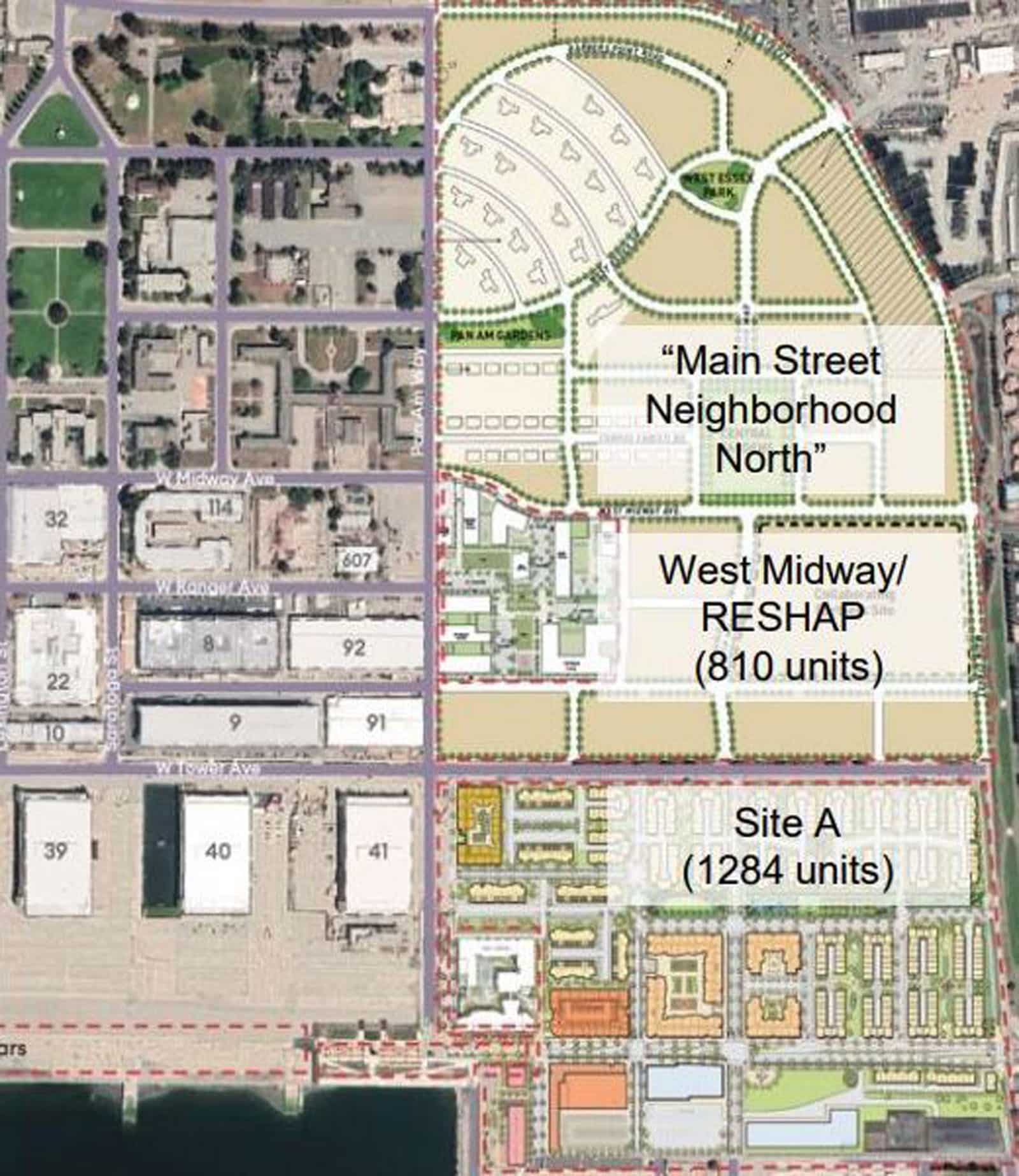
On June 8, the Planning Board held a study session on the future of Main Street Neighborhood North at Alameda Point. The City is revisiting its nearly decade-old redevelopment plan [1] (link downloads document) to ensure its priorities still reflect current community goals and to identify which elements are essential and where flexibility is possible to make the plan financially feasible. A preliminary study concluded that redevelopment is viable if the City can secure approximately $164 to $240 million in infrastructure.
 [2]
[2]Preliminary feasibility study
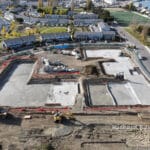
Main Street Neighborhood North is a roughly 31-acre site, bounded by Main Street to the north and east, West Midway Avenue to the south, and Pan Am Way to the west. It includes historic residential neighborhoods, the Officers’ Club, a chapel, a theater, and nearby properties owned by the Alameda Unified School District.
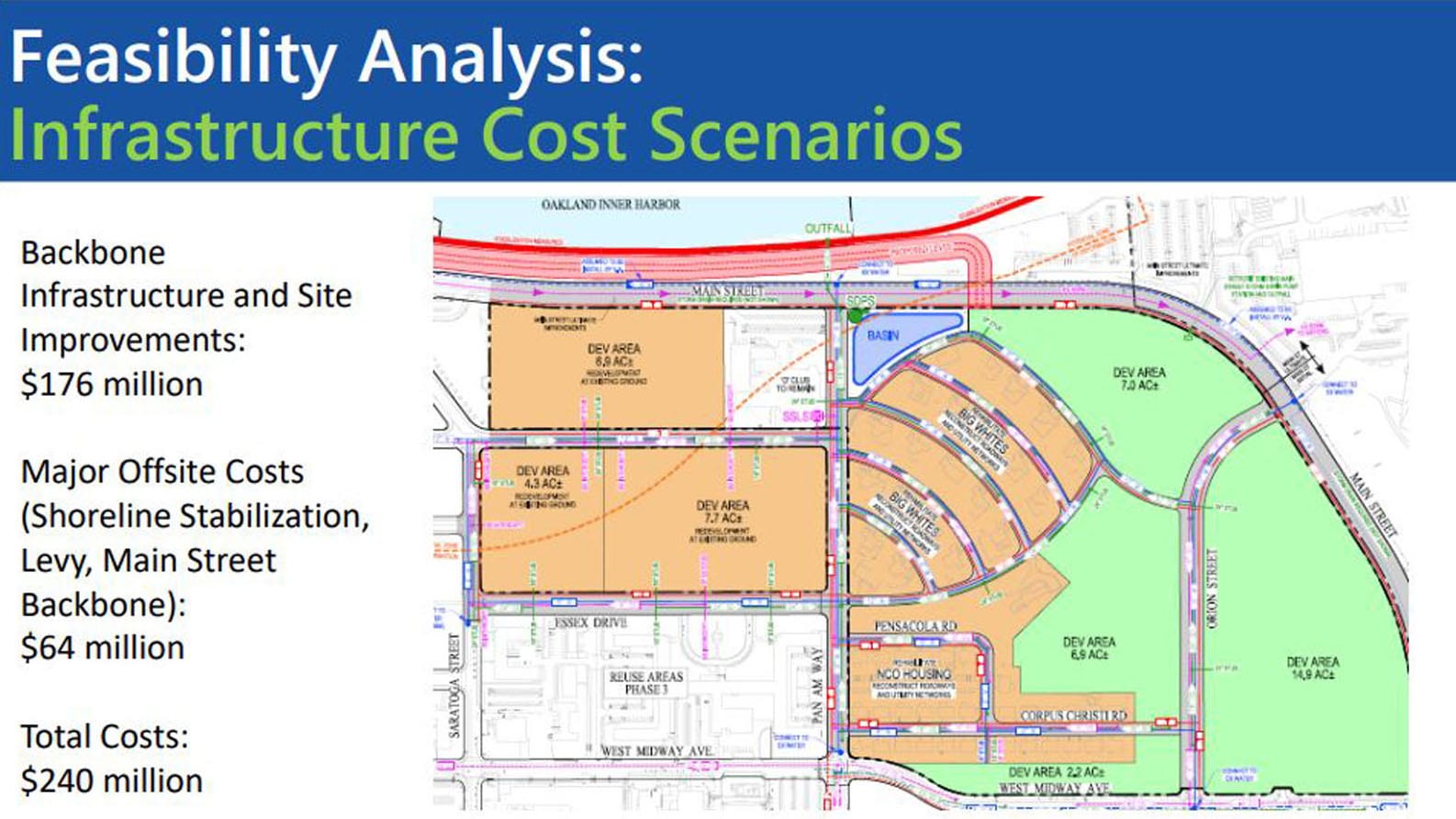
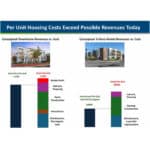
Base Reuse Manager Nicole Franklin reported that long-planned residential redevelopment in the district may be viable if the City can secure approximately $176 million for backbone infrastructure and site improvements, plus an additional $64 million for Main Street infrastructure, shoreline stabilization, and levee construction. Costs could be reduced by up to $75 million through partial rehabilitation rather than complete infrastructure replacement, constructing levees and stabilizing the shoreline only next to residential developments, and securing grants.
The project is more complex than previous Alameda Point developments, reflecting higher infrastructure costs, park requirements, historic preservation, and affordable housing mandates. Future developers may seek modifications, such as to the large central park originally envisioned to improve project economics.
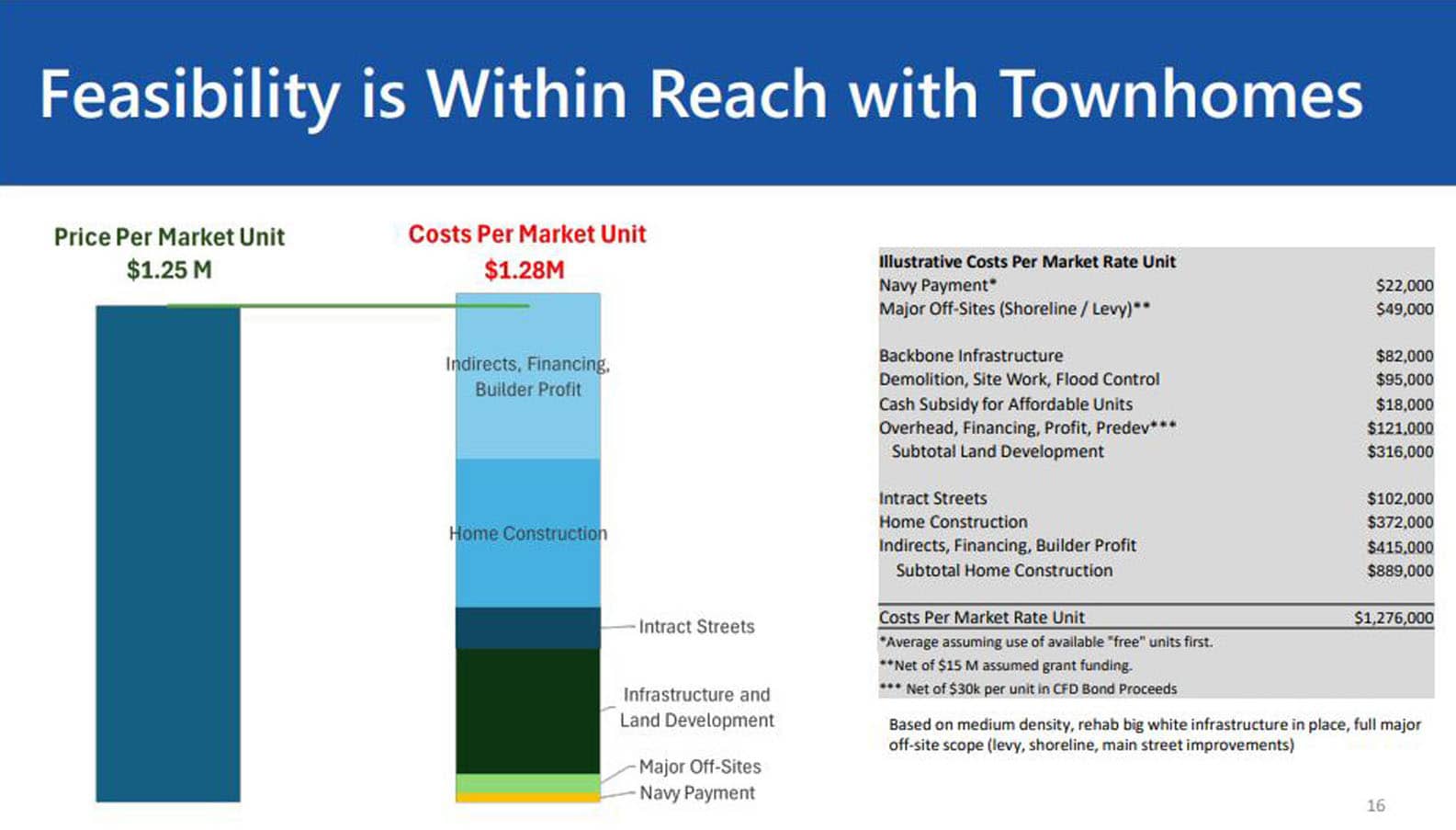
Despite these challenges, consultant David Doezema of Keyser Marston Associates said feasibility appears achievable under both a roughly 600-unit lower-density scenario and a 1,000-unit medium-density scenario. The lower-density option performs better financially because additional market-rate housing triggers higher affordable housing obligations and Navy conveyance payments.
Navy conveyance payments stem from an Economic Development Conveyance agreement under which the Navy transferred the property to the City. The payments apply once Alameda Point exceeds 2,011 market-rate housing units. Currently, approximately 250 additional market-rate units may be built before the payment threshold is reached. Recent negotiations reduced the fee from roughly $100,000 per unit to about $34,000. These fees, along with affordable housing requirements and infrastructure costs, are significant factors affecting project feasibility.
Franklin sought Board feedback on whether to allow greater building heights and residential density, particularly near the Main Street Ferry Terminal, whether to rezone portions of the historic district for housing, and whether to revisit Alameda Point’s affordable housing requirements. The current rules require 25% affordable housing, compared with 15% elsewhere in Alameda, plus an additional workforce housing component for moderate-income households.
 [3]
[3]
 [4]
[4]Council feedback
Planning Boardmembers broadly supported giving future developers greater flexibility to reshape the neighborhood, arguing that rigid adherence to a decade-old plan could make redevelopment infeasible, while flexibility could help unlock a project facing substantial infrastructure, flood protection, and preservation costs.

A major discussion theme was the opportunity to better connect the neighborhood to the Main Street Ferry Terminal. Boardmember Asheshh Saheba suggested rethinking the street network to create a more welcoming arrival experience that leverages ferry service as a unique asset. Referencing the San Francisco Ferry Building, he argued that the area should function as a destination rather than simply a residential neighborhood: “If we move a park anywhere, it should be at the arrival point… where something can receive you into the neighborhood.” Staff noted that upgrades to the historic Officers’ Club could also help serve as a focal point for community activity and commercial uses.
Boardmembers generally expressed openness to increased height and density, particularly along Main Street and near the ferry terminal, with Boardmember Diana Ariza favoring incentivizing alternative site plans and housing types besides three-story townhomes. “There are so many other ways of doing housing,” she said.
Similarly, Boardmember Andy Wang encouraged a process that invites competing concepts from multiple developers, allowing the City to compare different visions before selecting a partner: “I wonder about having a little bit longer of a dating process where we are not exclusive yet, so that we can kind of play the field.”
While the Board supported preserving the landmark “Big White” homes and the district’s overall historic character, Boardmember Hanson Hom suggested remaining open to creative solutions, such as relocating structures.
Boardmember Sunny Tsou questioned whether the plan’s additional requirement for housing serving households earning 120% to 180% of the area median income remains appropriate, noting that Alameda Point already carries a 25% affordable housing obligation and expressing concern that layering additional requirements onto a project with extraordinary infrastructure costs could further undermine feasibility. Boardmembers Tsou and Ariza both suggested encouraging housing diversity and middle-income housing through incentives rather than mandates.
What’s next
The City plans additional outreach to advisory boards, the community, and City Council to clarify neighborhood priorities before issuing a request for qualifications to select a developer. Staff emphasized that Main Street Neighborhood North is unlikely to contribute to the current Housing Element cycle (2023 – 2031) because development is not expected before 2030, but it could become important for meeting future housing requirements.
Contributing writer Karin K. Jensen covers boards and commissions for the Alameda Post [6]. Contact her via [email protected] [7]. Her writing is collected at https://linktr.ee/karinkjensen [8] and https://alamedapost.com/Karin-K-Jensen [9].