Editor’s note: This is the second of two Alameda Post articles by this author about birds that nest at Crab Cove during spring. To learn more, including how to help birds nest, see last spring’s article [1].
During the cooler months, you may notice thousands of birds at a time, eating or resting on Alameda’s shoreline or in the nearby waters. Most of these wintering birds migrate north in springtime to nest, but some species nest along protected areas of Alameda’s shoreline, and numerous others nest here on land. Crab Cove is a birding “hotspot” for both wintering and nesting birds.
Wherever you live on this island, there are birds nesting nearby. Listen to their songs as they establish nesting territories. Watch where they fly and you may find their secret nesting spot in a tree, shrub, building, or on the ground.
Cooper’s hawk
People often think red-tailed hawks are the most common hawk in Alameda, but the smaller Cooper’s hawk, which is about the size of a crow, is actually more common here. They hunt birds, which they often catch in the air, as well as ground-dwelling animals. Originally adapted to hunting in forests with their agile flight capabilities around trees, Cooper’s hawks also can maneuver around buildings and other human structures. The male does most of the work building nests out of sticks up in trees, and the female then does most of the incubating and nest-tending while the male hunts for food. Once the babies fledge (leave the nest), both parents provide food and teach them to hunt.
 [2]
[2]Northern mockingbird
If you hear an almost continuous song from a bird, copying a variety of other bird songs or even some human-made sounds like car alarms, it is likely the song of the northern mockingbird. Both males and females sing, but when a northern mockingbird sings all night it is usually a male without a mate. Like most birds, they don’t usually sing close to their nest, which you can find hidden in bushes and trees, usually three to 10 feet off the ground. Both parents share responsibility for raising their young, and they often have more than one brood, lasting well into the spring or even summer.
 [3]
[3]Oak titmouse
Sometimes called the “heart and soul” of the oak forest, you’ll often hear the persistent and loud “peter-peter-peter” song of the oak titmouse near the trees. Acorns are a significant part of their diet, but they also will eat other seeds as well as plenty of invertebrates. Alameda used to be mostly a mature oak woodland, unlike Oakland where woodland mostly occurred just in the downtown and West Oakland areas. There are now plenty of younger oaks in Alameda to support a healthy population of oak titmice.
 [4]
[4]Mourning dove
These medium-sized doves will sometimes nest in clear view of us humans, even on eaves near porches. They will often “freeze” on their nest when we or other potential predators are near, hoping to protect their nestlings through camouflage. When they do start flying, their wings make a sharp whistling sound that can be startling. Their sad but peaceful-sounding song, which people sometimes confuse with owls, inspired the name mourning doves (not morning doves). Parents feed their newly hatched chicks “crop milk,” a nutrient-rich liquid produced in their crop from the food they have eaten, allowing their chicks to grow so fast they sometimes leave the nest within two weeks.
 [5]
[5] [6]
[6]California towhee
These relatively common birds spend most of their time looking for food on the ground, and they usually nest on or close to the ground in thick bushes or brush piles. If towhees make constant warning calls when you get into an area, please step away to observe them. If they feel safe—that is, you are far enough away—you might get to see them enter their nest area. Females and males look alike, both provide parental care, and they usually mate for life.
 [7]
[7]American robin
A classic springtime bird, the widespread American robin can often be found in open spaces, hunting invertebrates in the ground. In late summer and fall at Crab Cove, you can find them feeding on berries. The female makes a bowl-shaped nest from sticks, grass, and mud, which is placed in trees or on buildings. They sometimes have multiple broods in one year. Although the job each parent plays changes as the babies grow up, parental care overall is equal.

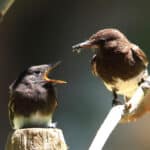

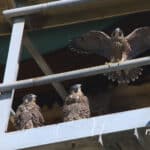
 [8]
[8]House finch
House finches do live in a diversity of habitats far away from humans and their houses, but they also thrive in urban areas like Alameda. The female constructs the nest on buildings or on vegetation, and she exclusively incubates the eggs. The male feeds both her and the chicks. When the youngsters fledge, it’s often the male that continues to feed them while the female prepares a new nest. Their short, thick beak makes them adapted to eating seeds and other plant material, making them almost true herbivores—most other birds that primarily eat plants eat more insects than the house finch.
 [9]
[9]California scrub jay
Like other corvids such as crows and ravens, California scrub jays are smart birds from our human perspective. Often noisy, they will sometimes watch in silence as we humans dig around in or water a landscape, waiting for us to flush out moths or other tasty treats. As true omnivores, be prepared to watch them hunt baby birds as well as eat berries, seeds, and fruit from our gardens. If you call them blue jays, which actually is the name of an eastern U.S. species of jay, the question might be which species? Steller’s jays are the only other jay in our area, and they are mostly forest birds. California scrub jays are birds of chaparral and scrubland (low- to medium-size bushes), oak woodland, grasslands, and suburban areas. They have sturdy bowl-shaped nests made of sticks and other vegetation, which are hidden about five to 15 feet high in dense shrubs or trees. Although they have different roles during the child-raising period, the male and female overall provide equal parental care.
 [10]
[10]Wilson’s warbler
A few different kinds of warblers nest at Crab Cove, but one of the most heard and seen is the bright yellow and sometimes greenish Wilson’s warbler. The female builds the cup-shaped nest, hidden amongst short shrubs, and incubates the eggs but both parents feed the babies. You can see this small, very active warbler gleaning insects amongst trees.
 [11]
[11]Chestnut-backed chickadee
It’s entertaining to watch these small birds as they flit amongst trees and shrubs looking for invertebrates and seeds to eat. Females do most of the nest excavation and placement of vegetation and fur inside a nest cavity, sometimes excavating holes in the wood with her beak, and often using old woodpecker holes and nest boxes. She will incubate the eggs and brood the young while the male brings food to her. Both parents feed the young once they become older.
 [12]
[12]Swallows
There are probably five species of swallows nesting in Alameda—violet-green, tree, cliff, barn, and northern rough-winged. The two that we know for sure are currently nesting at Crab Cove are violet-green and tree swallows, both of which use nest boxes installed by Crown Beach rangers. All swallows are amazing to watch as they acrobatically fly, catching insects in the air.
 [13]
[13] [14]
[14]Other birds
Along with the many native species of birds nesting at Crab Cove and in our neighborhoods, there are at least four common non-native species nesting—rock doves (what we call pigeons), Eurasian collared doves, house sparrows, and starlings. If your goal is to help birds around your home, please try to focus on helping native species.
 [15]
[15] [16]
[16]The birds described above and in the first article of this series make up many, but certainly not all, of the bird species nesting around Crab Cove. We encourage you to visit Crab Cove, other East Bay Regional Parks, and certainly your neighborhood green spaces to watch birds, while hopefully observing their nesting behavior.
Michael Charnofsky is a Naturalist with the East Bay Regional Park District, based at the Doug Siden Visitor Center at Crab Cove, Crown Memorial State Beach in Alameda.
This article is part of a series from the Friends of the Alameda Wildlife Reserve [17] (FAWR), a Conservation Committee of the Golden Gate Bird Alliance [18] (GGBA, formerly Audubon).