As readers of this series know, I take photographs of astronomical objects from Alameda which often include gaseous regions of outer space called Nebula. This fascinating video [1] from NASA explains how we (the solar system in its entirety) very likely formed from a massive nebula similar to the ones I photograph. The catalyst that changed our cosmic building blocks from nebulous Legos into people (who then invented actual Legos) was likely an exploding star whose shock wave pushed the gas and dust together. You can see something similar happening in this photo I took [2] from Alameda in 2025. My Alameda Post article, “One Star Review [3],” detailed that and other star interactions.
 [2]
[2]
The Crescent Nebula (NGC 6888), located in the constellation Cygnus, shows superheated emissions interacting. Photo by Evan Gomez-Shwartz.
A friend of mine has a serious phobia of outer space. To be fair, attempting to comprehend what’s out there, how we fit into it, and the bookends of its lifespan is a lot to grapple with. When I look at my own astronomical photos [4], I often think about how the streams of light and the patches of dust that cast shadows [5] are born in places that are violent [6], radioactive [7], and hostile to life [8]. Yet with enough time and space between us, the danger is long gone, and what arrives on Earth is something calm and luminous. It’s kind of like how our Sun is practically composed of nuclear bombs going off [9] simultaneously, but here on Earth, that’s perfect weather for a stroll at Crown Beach.
Outer Space’s imposing feeling, whether it’s fear or awe, is often motivated by a great sense of externality. It’s all so far beyond us and everything we know. But maybe if we look inward to learn the things we have in common with celestial objects, that gap will feel less overwhelming. The notion that we’re all “made of stardust” is both true and cliché, but it gets a lot more interesting when we explore that idea in detail.
You may have read another article from this series, originally published in the Post in June 2025 [10] about color and ionization. In short, the radiant colors of nebulae depend on their chemical compounds. Don’t worry, I’m not saying there’s a rainbow of glowing nebulae hiding inside us. The kinds of colors we see in space come from radiation so intense it strips electrons from atoms [11], and if that were to happen inside you then… you wouldn’t be around to enjoy the view!
 [12]
[12]Hydrogen is the lightest and most abundant element in the universe [13], making up roughly three-quarters of all ordinary matter. Stars, including our Sun, are powered by vast amounts of hydrogen in an energized, plasma state. On Earth, hydrogen appears in gentler forms like water and the organic molecules that make up living things, including our own bodies.


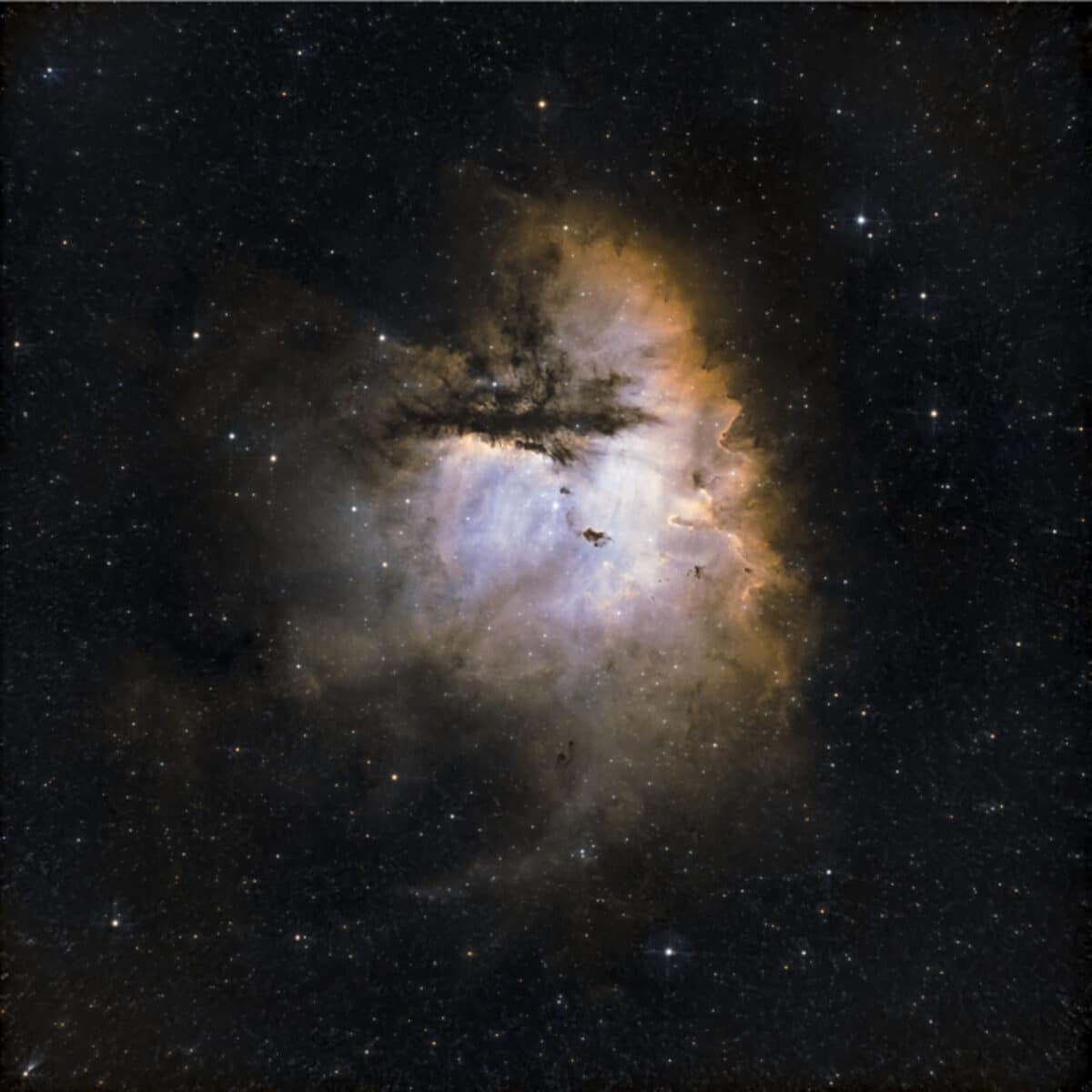
In regions like the Pacman Nebula [14] (pictured above), hydrogen isn’t just sitting quietly in space. Intense ultraviolet light from newly formed stars floods the surrounding gas [15] and strips its electrons. Then, as the electrons drift back and reattach, the atoms shed their excess energy as light, filling the nebula with a deep glow. What we see in these images is not a different substance from the hydrogen on Earth, but the same element caught in a more extreme moment. The light marks a temporary state, a visible phase in an ongoing cycle [16], before the gas cools, recombines, and may eventually become raw material for the next generation of stars, planets, and chemistry.
We will likely never know if the Pacman Nebula, or any other, will become something more tangible like a solar system or life. Other discoveries can be made inside these nebulae, however.
Using NASA’s James Webb Space Telescope, scientists recently discovered a new carbon-based molecule [17]. While this experiment wasn’t conducted on the Pacman nebula, it is very similar to the studied Orion Nebula. The molecule, called methyl cation, is made of carbon and hydrogen and is especially important because it acts as a building block for more complex carbon-based molecules. Those more complex molecules are the same kinds of chemical ingredients that make up life on Earth [18]. While this discovery was made in a planet-forming disk within the Orion Nebula [19], astronomers expect similar chemistry to be happening in other star-forming regions, including the Pacman Nebula.
It’s a reminder that what looks like an ending may look very different after enough time and space.
While on vacation at Timber Cove in 2020, Evan Gomez-Shwartz accidentally photographed the Milky Way with his phone. Since then, he’s been taking photos of outer space at every opportunity possible, now with better equipment. The Alameda-based astrophotographer’s favorite subjects to photograph are nebulae and galaxies. Reach him via [email protected]. [20]