There is a tree that can be found in yards throughout Alameda and the surrounding Bay Area. It tends to produce fruit in abundance; so much so, that it’s often shared with friends and neighbors lest it ripen and fall to the ground to become fertilizer, having given its life and nutrients to nourish the soil below. It’s L_____ season.
What did you fill in the blank with?
 [1]
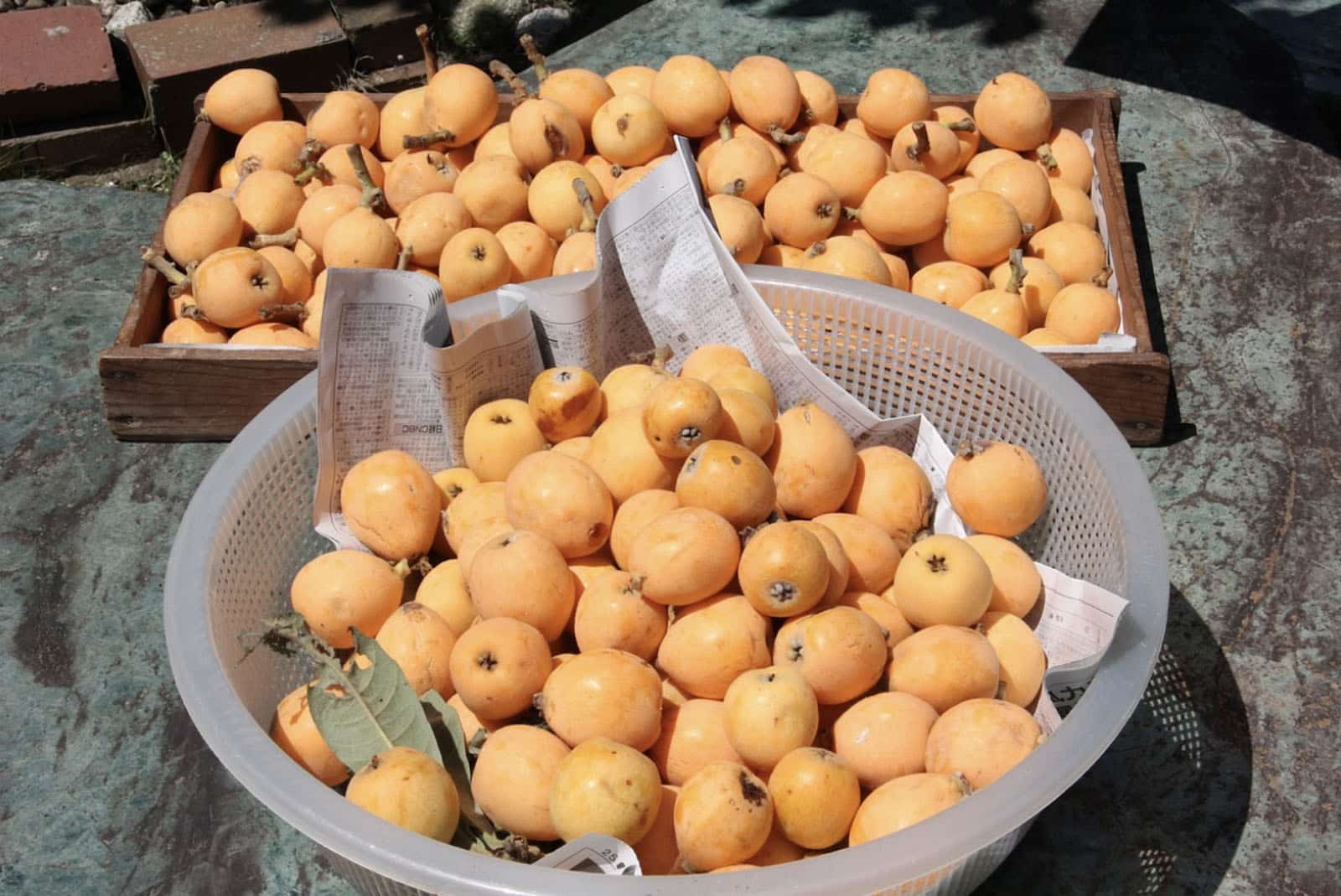
[1]If you were thinking “lemon,” that would fit the clues, but I meant “loquat.” In China, the fruit are more commonly known by their informal name, pipa, after the instrument which their shape, with stem, resembles. Pyriform, or round, these small orange-hued fruit are native to the cooler regions of south-central China; which would explain why the loquat trees grow so well in Alameda. Commercially grown as a tree or shrub, the leaves are often used for herbal teas.
The fruit is sweet with floral overtones, which is probably because the tree is in the same family as the rose. The skin is like that of a ripe peach. It can be peeled back to reveal flesh which is the consistency something between a pear and apricot. Inside you will find large, smooth brown seeds, which, although they cannot be consumed in their whole, raw form, are thought to have cancer-fighting properties. With deep green leaves and clusters of milky orange fruit, both parts of this evergreen plant are often used for ornamental purposes.
 [2]
[2]And they’re not just good to eat and pretty to look at—loquats have many health benefits. They are high in antioxidants, particularly carotenoid antioxidants, which boost the immune system, promote cellular growth, and reduce inflammation. Loquats are low-calorie fruits, packed with vitamins. A 100-gram serving has only 47 calories and is loaded with an abundance of nutrients too plentiful to list, so check it out for yourself here: loquat nutrition data from the USDA [3].
The seeds are particularly high in amygdalin, which many believe is a natural treatment for cancer. Although research in animals has shown loquat can suppress and kill cancer cells, there is little scientific evidence to confirm that it can do so in comparable levels in humans.


 [4]
[4]
For thousands of years, loquat leaves and fruit have been valued in China for their medicinal properties where it is used to treat diabetes, cancer, diseases caused by inflammation such as asthma and bronchitis, and more. Since my childhood, the go-to medication in the homes of both sets of grandparents, at the first sign of cough, is Pei Pa Koa syrup; honey to soothe the throat and loquat to treat the cough.
As noted in a review [5] published in the International Journal of Molecular Science, “Research shows that loquat extracts contain many antioxidants, and different extracts exhibit bioactivity capable of counteracting inflammation, diabetes, cancer, bacterial infection, aging, pain, allergy and other health issues.” In that same publication, one study showed “Among 56 selected Chinese medicinal plants, loquat leaf showed higher antioxidant capacities than 54 other medicinal plants…”
 [6]
[6]
The fruit of this tiny gem is often used for jams and jellies, and those in the know will use it in pies and pastries. It can be fermented to create a fruit wine, and the liquor Nespolino, which is reminiscent of amaretto, is made from the seed. Loquat’s juice is added to other fruit juices to enhance their flavor and the fruity floral scent can be found in perfumes and candles.
What is it not? It is not around for long, as the season began in late May and ends in July. If you’ve never given loquat fruit a try, you have plenty of beneficial reasons to do so and now is the time, while they are at their best. Enjoy!
Contributing writer Denise Lum is a Health and Fitness Coach raising her family in Alameda. Contact her via [email protected] [7] or FitnessByDsign.com [8]. Her writing is collected at AlamedaPost.com/Denise-Lum [9].