Women’s lives in history are often defined by constraints — cultural, economic, and political. I think of my mother, who stayed in an unhappy marriage for 16 years, until 1962, because divorce was considered such a disgrace as would lead to her social isolation, or so she believed. When she did summon the courage and means to leave, much of what she feared came to pass and yet, in the end, she was still standing, and her life did improve.
 [1]
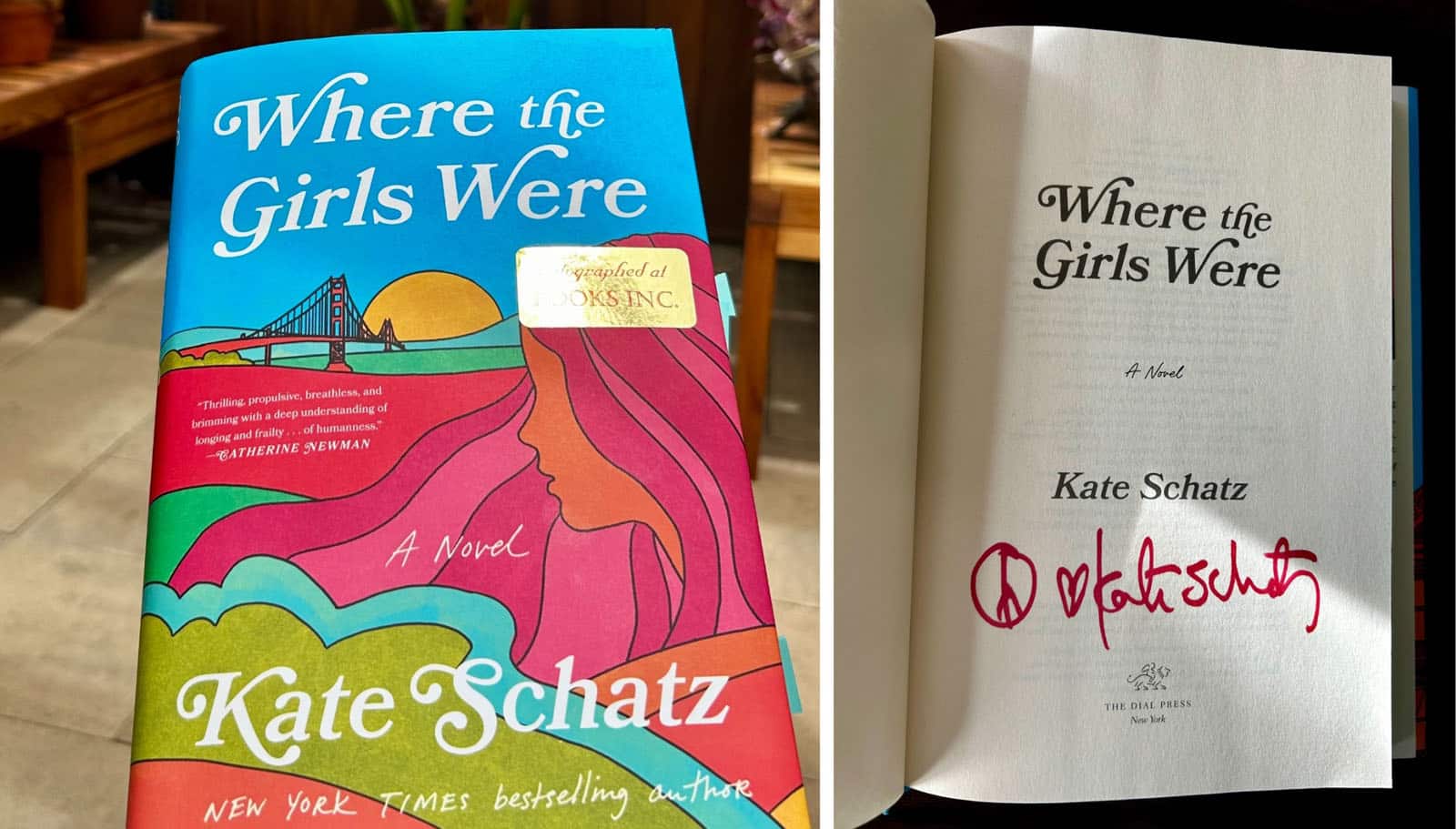
[1]Alameda author Kate Schatz’s debut novel, Where the Girls Were, arrives at a moment when debates over the historical treatment of women feel newly urgent because many rights and assumptions that once appeared settled, such as the right to an abortion, are again contested.
Set in San Francisco in 1968, the novel follows Elizabeth “Baker” Phillips, a high-achieving teenager whose carefully ordered future collapses after an unexpected pregnancy. What begins as a coming-of-age story widens into a broader meditation on shame, silence, institutional control, and female solidarity in pre-Roe v. Wade America.
Baker initially appears to embody the idealized “good girl” of the late 1960s — academically gifted, disciplined, headed to Stanford, and eager to fulfill her parents’ expectations. Schatz establishes how tightly Baker’s identity is bound to achievement and approval: “The pit that has been hovering somewhere in Baker’s abdomen drops hard and fast. It’s a familiar feeling: the weight of expectation.”
When she meets Wiley, a young man tied to San Francisco’s counterculture, she experiences a sudden loosening of the rigid structures that have defined her life. Schatz beautifully contrasts suburban respectability and the liberating energy of Haight-Ashbury: “That first night with Wiley unspools in her mind. The music, the smoke, the cool midnight air. How free she felt, how unleashed and unmoored and dizzy and real…They weren’t in love; that’s not what this was…It was something bigger than love, she thinks. It was freedom.”
Schatz uses this cultural divide not merely as a colorful historical backdrop, but as a way to expose the era’s contradictions. The so-called sexual revolution promised freedom, yet the consequences of that freedom fell disproportionately on young women.
The novel’s emotional core emerges after Baker becomes pregnant and is sent away to a home for unwed mothers to “preserve her dignity.” There, Schatz shifts into something more intimate and unsettling. The maternity home is not overtly monstrous, but quietly coercive, a system built on secrecy, obedience, and social erasure.
The girls are hidden from public view, their lives suspended while adults decide what will become of them and their children. Schatz draws attention to how ordinary this arrangement once was in American life, noting that “this was the experience of more than 1.5 million young American women in the 1950s and ’60s,” including the author’s mother, whose true story became the inspiration for the novel. This is a history that remains absent from mainstream cultural memory.
What elevates the novel beyond issue-driven historical fiction is Schatz’s attention to Baker’s emotional life. The narrative lingers on her humiliation, longing, and confusion. Baker oscillates between anger and compliance, hope and despair. Her sense of self becomes fragmented as she struggles to reconcile the person she believed herself to be with the role society suddenly imposes upon her.
Schatz captures how quickly a “promising girl” can become a “fallen woman” once she violates societal expectations surrounding sexuality and motherhood. At one point, Baker poignantly recalls a line from Mary Shelley’s Frankenstein: “Thus strangely are our souls constructed, and by such slight ligaments are we bound to prosperity or ruin.”
 [2]
[2]The friendships Baker forms within the home are moving. Rather than presenting the girls as interchangeable victims, Schatz gives them distinct personalities, backgrounds, and coping mechanisms. Some are resigned, others are rebellious. Some dream of escape while others cling to fantasies of returning to their former lives unchanged. Together, they create an improvised community within an institution designed to isolate them. Solidarity becomes an act of resistance.



Schatz succeeds in depicting how shame operates socially rather than privately. Baker’s pregnancy is treated by her parents not primarily as a personal crisis but as a reputational catastrophe. Her mother works feverishly to explain away her disappearance and demands Baker’s complicity in preserving appearances and constructing lies: “This has been happening to women since the dawn of time. We don’t discuss it because it’s private, and it’s painful. And we have to stay safe.”
Still, Baker’s parents are not caricature villains. The novel portrays them as products of a culture in which image management and middle-class respectability are essential to maintaining social status. Baker’s mother sees herself as lovingly protective of her daughter: “You know, not every girl in your situation gets to do what you’re doing. Live in this nice home, get taken care of, get to preserve your dignity. It could be much worse, Elizabeth. Much worse.”
Schatz’s strongest scenes rely not on dramatic action but on emotional detail — a tense family conversation, the routines of the maternity home, the uneasy intimacy between confined girls. In one scene, the girls enjoy singing popular songs of the day, and the lyrics, such as words from Bob Dylan’s Rainy Day Women #12 and 35 [4], take on new meaning: “Well they’ll stone you when you’re trying to be so good/ They’ll stone you just like they said they would.”
The novel does not romanticize either motherhood or liberation. Baker’s predicament does not lead neatly to enlightenment. Instead, Schatz portrays agency as partial, fragile, and often constrained by circumstance. The girls in the home are denied meaningful choices at nearly every turn, yet they continue searching for fragments of dignity and self-definition. The novel’s moral force comes from its insistence that these young women deserved more than secrecy and silence. Baker asks, “Can you imagine if we all just got to decide? …What to do! How to live! What’s best for ourselves. Instead of letting all these people make decisions for us.”
The historical setting also allows Schatz to examine how institutions, families, schools, and medical systems collaborate in enforcing expectations. Even well-meaning adults often prioritize order over compassion, as when Baker notes her distress in not being sure what she wants to do about her baby, and Ms. White, the head of the home, responds, “Well, we are sure. And so are your parents. It’s not actually up to you.”
In that sense, the novel critiques not only overt oppression but also the quieter mechanisms that maintain conformity. Baker’s tragedy is not simply that she becomes pregnant; it is that the world around her immediately narrows her identity to that fact alone.
Schatz brings a strong feminist sensibility to the material but generally trusts the story rather than forcing ideology into every scene. The novel successfully recovers overlooked history, making it personal, immediate, and painful.
Where the Girls Were also succeeds by illuminating both past and present simultaneously. Baker’s story belongs specifically to 1968, yet the questions the novel raises about bodily autonomy, public shame, female ambition, and who gets to control women’s futures remain unresolved.
Schatz does not offer easy answers. Instead, she leaves readers with a recognition not only of how fragile progress can be, but also of the endurance of women forced to navigate systems designed to constrain them. Like women of my mother’s generation who feared disgrace, isolation, or ruin yet persisted anyway, Baker emerges not untouched but still standing.
As of this writing, autographed copies of Where the Girls Were are available at Books Inc., 1344 Park St. in Alameda.
Contributing writer Karin K. Jensen covers boards and commissions for the Alameda Post [5] and is the author of The Strength of Water, an Asian American Coming-of-Age Memoir, which tells her own mother’s story. Her writing is collected at https://linktr.ee/karinkjensen [6] and https://alamedapost.com/Karin-K-Jensen [7]. Contact her via [email protected] [8].