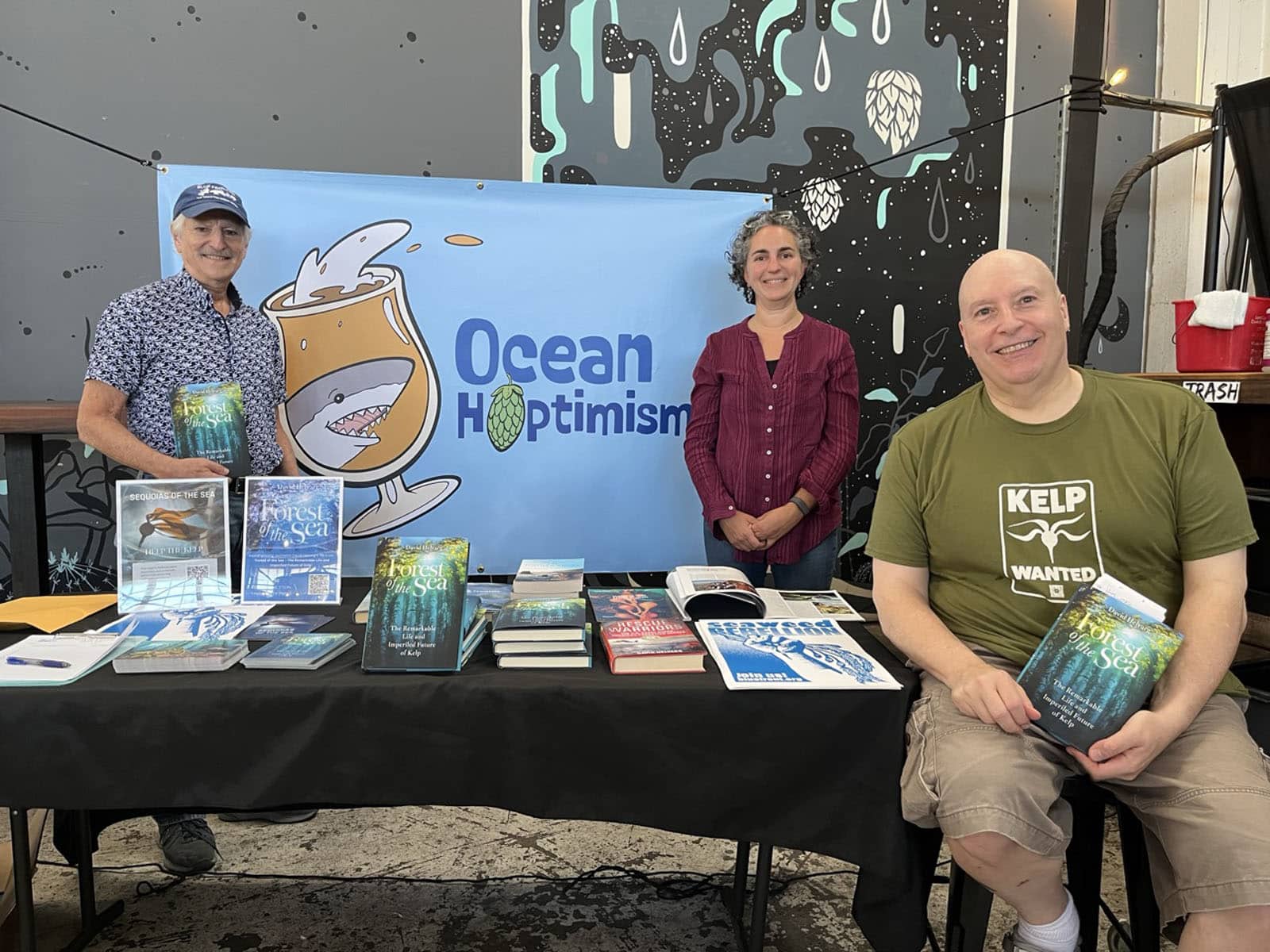
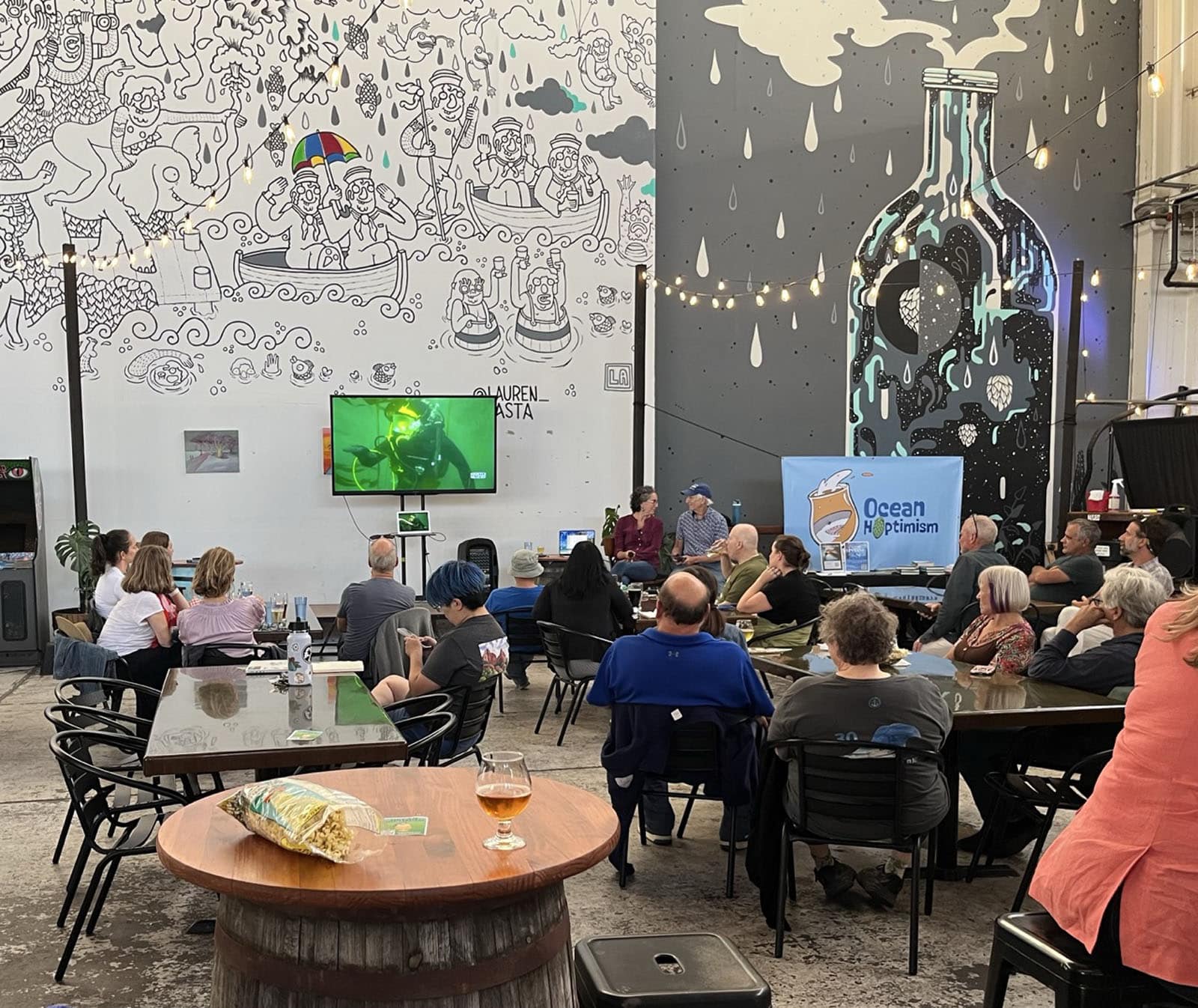
On Thursday, July 23, a gathering of more than 50 people took a break from staring at screens and doomscrolling to enjoy pints and flights of locally brewed beer at Faction Brewing. They had come for Ocean Hoptimism [1], a monthly talk and get-together where participants discuss issues affecting our oceans.
 [2]
[2]Rick MacPherson, a former marine biologist who is now a conservationist, started the series a year ago. While he acknowledged that there are plenty of “doom and gloom” news stories about the state of our oceans, he also wanted to point out that, “There are plenty of hopeful, optimistic stories.”
Ocean Hoptimism is a way to bring ocean enthusiasts together in a relaxed environment where science, policy, and conservation can mesh. MacPherson stressed that the talks are not “sugar coating” reality. “We’re totally committed to evidence-based and reality,” he said. “But we are focusing on those projects around the world or around the Bay that are showing positive results, and why there’s reason for hope.”
The name of the event is a portmanteau of hope and optimism, as well as a nod to the fact that it’s hosted at a brewery. Each month features a different guest speaker and topic. July’s topic was kelp forests, with speakers Natasha Benjamin and David Helvarg from Blue Frontier, [3] an ocean policy nonprofit. Benjamin recently made a film, Sequoias of the Sea [4], and Helvarg was there with copies of his newly published book, Forest of the Sea: The Remarkable Life and Imperiled Future of Kelp [5].
Not just providing hope and optimism, Ocean Hoptimism is also inspiring participants to take action. Reef Check [6], a conservation nonprofit, hosted an information table where people could learn how to use their diving skills to help the kelp forests.
As the audience sipped beer, Helvarg and Benjamin recounted the 2013 heat wave known as “The Blob,” when a rise in ocean temperatures and masses of unusually warm water triggered the massive die-off of kelp forests. Benjamin, whose film focuses on the Northern California coast, talked about the 95% loss of kelp forests. Helvarg’s book is more international in scope, so he spoke about the environmental and economic impact of losing the kelp forests.
Eventually the talk turned to the topic of kelp forest restoration and sea urchins. Kelp forests are able to make a remarkably quick recovery in areas where restoration efforts are taking place. These areas are small compared to the worldwide areas of loss, but it’s a hopeful start.


 [7]
[7]As well as killing off the vast majority of kelp, The Blob also killed off almost all of the sunflower sea stars. Without sunflower sea stars to eat them, the purple urchin population exploded, which in turn ate any remaining kelp. Currently, the overwhelming presence of purple sea urchins is preventing kelp forests from returning, so volunteer divers are being enlisted in areas such as Caspar Cove [8] to remove sea urchins with positive results so far.
In addition to divers present at the event being encouraged to dive for sea urchins, the entire audience was encouraged to support a legislative bill to fund kelp restoration, and to stop using fossil fuels which contribute to marine warming.
The talk ended on a note of realism mixed with optimism. Benjamin told the audience that the kelp forests would not be back to their previous coverage within our lifetime. “There’s hope but it’s not going to be the same.”
Helvarg acknowledged that we need to save what we can and talked about coral reefs as an example. While 65% of coral reefs are under serious threat, Helvarg is interested in the thriving 35% and how and why they survive. In regards to kelp, he said, “If we don’t try, we will lose it and it’s too valuable to lose.”
After the talk, Mary Spicer, an Alameda resident in the audience, told the Alameda Post that she had witnessed the decimation of the kelp forests at Fort Bragg while paddleboarding. “Everything seemed empty and bleached” compared to five years ago, when she saw “tons of sea kelp,” she said. Spicer, who is the executive director of I Heart Oakland-Alameda Estuary [9], has been coming to the Ocean Hoptimism talks regularly. “To have this event here in Alameda is such a gift,” she added.
Another audience member, Grace Stevenson, said that she comes to the talks regularly and was inspired to get her diving certification and then look into volunteer opportunities for kelp restoration projects, Aquarium of the Bay, and Reef Check: “I’ve found lots of avenues through the talks here!”
Jean Chen is a contributing writer for the Alameda Post [10]. Contact her via [email protected] [11]. Her writing is collected at AlamedaPost.com/Jean-Chen [12].