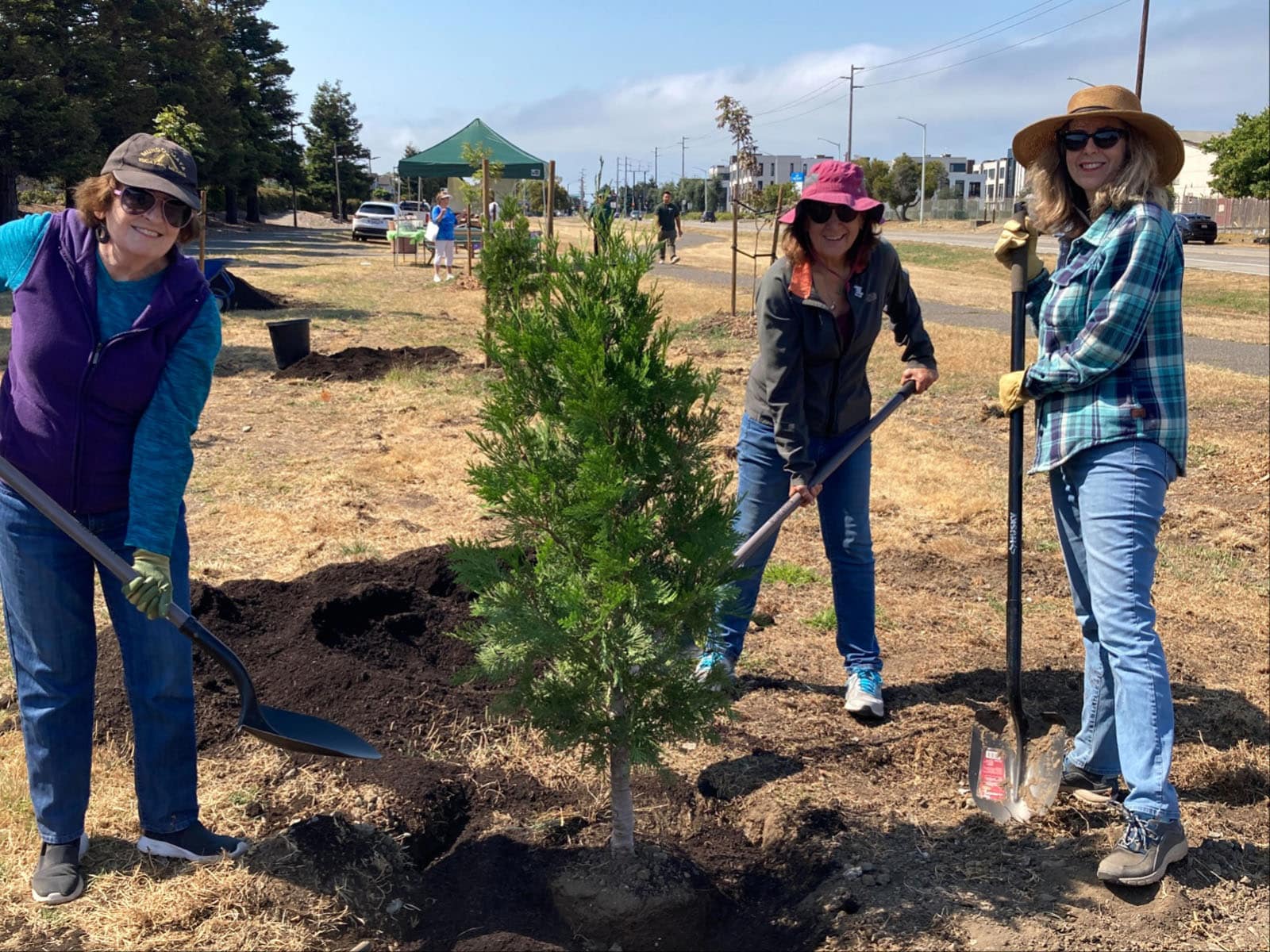
The Rotary Club of Alameda [1] and Community Action for a Sustainable Alameda [2] (CASA) worked together at a tree planting on Saturday morning, July 12, at Main Street Linear Park, just outside of Alameda Point. The event was held in conjunction with the Alameda Recreation and Parks Department [3] (ARPD [4]) and 100K Trees for Humanity [5].
 [6]
[6]CASA was awarded a $1000 matching grant from the Rotary Club of Alameda, thanks to a generous donation of $500 by a Rotarian that was matched by the Alameda Rotary Endowment Foundation. CASA decided the best use of that money would be to plant trees and sequester carbon dioxide from the atmosphere to help Alameda achieve its climate protection goals.
The Rotary Club reached out to ARPD to determine which park needed the trees the most and requested that they choose native trees from their master plan for Alameda. Cedars were selected, and 100K Trees for Humanity ordered and delivered the 10 trees. ARPD workers did a lot of pre-work for the planting day, including digging the holes, laying out irrigation, and prepositioning the trees, stakes, fertilizer, and compost. With all of that prep work complete and a short training session, the 20 or so volunteers from Rotary, Interact Clubs of ASTI and Encinal High, 100K trees, and CASA—with ARPD’s help—got the job completely done in one-and-a-half hours.
The cedar trees look great in their position in Main Street Linear Park, and will provide shade and wildlife habitat for years to come, as well as helping to prevent water runoff and protect the climate.


CASA supports the City of Alameda’s plan to reduce greenhouse gas emissions by 50% by 2030 and to get to net-zero emissions by 2040. The Rotary Club of Alameda does community service and supports nonprofits in Alameda, including tree plantings. CASA also does work around the world for the good of humanity. 100K Trees for Humanity are neighbors who are greening their city. As their website states, they “are planting 100,000 urban trees and plants to increase our urban forest canopies, restore natural habitats, increase urban carbon sequestration capacity to help cities meet carbon reduction goals, and for greater equity for cooler, healthier communities.”
And, as their website states, “ARPD is proud to be the third-oldest park system in the State of California, with over 30 parks and facilities serving more than 15,000 people annually.”
Joyce Mercado is an author and member of Community Action for a Sustainable Alameda (CASA), as well as the Rotary Club’s president. Her columns are collected at alamedapost.com/Joyce-Mercado [7]. She can be reached at [email protected] [8].