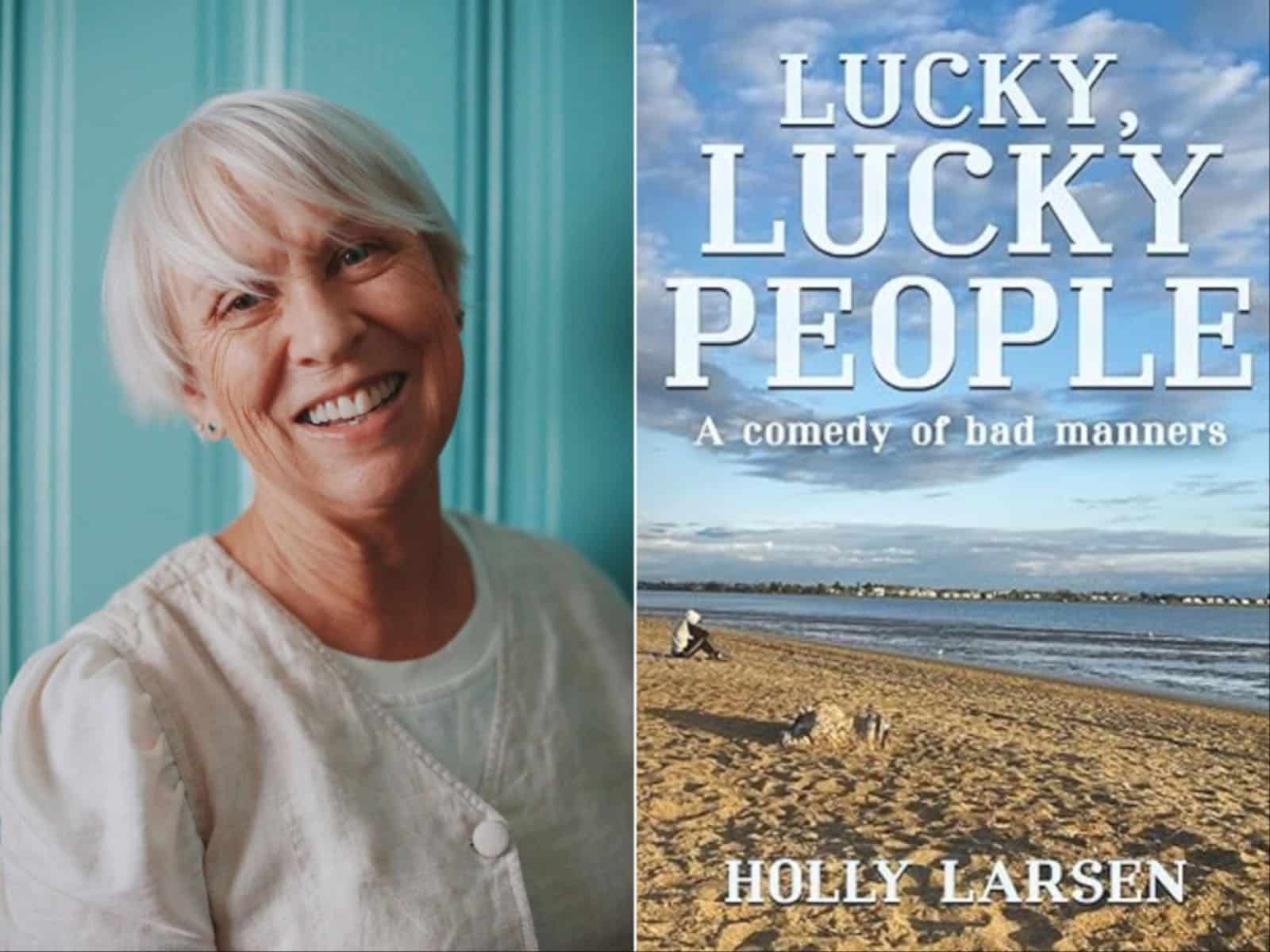
Holly Larsen is the kind of person you’d for sure want as your best friend and someone you’d fear if, for example, you were a government agency that made her mad. She’s got a lot of spunk, sass, sand, and chutzpah. Those qualities manifest as a whole spice shelf of flavors in her latest novel, Lucky, Lucky People. This fictional story, her second after Sisters, Plural, is set right here in Alameda where she lives and raised her family. It tells multiple, overlapping stories about people in various stages of life trying to find happiness and fulfillment, searching for the answer to the profound question — are we having fun yet?
Holly’s approach to creative writing, as she describes it, is the antithesis to the kind of prose she was paid to manufacture from 9 to 5. To borrow the well-used metaphor, after a lifetime of having to color within the lines, she’s purposefully, happily, and intentionally all over the page. The result is a speaking voice rich in joy and energy that shapes her sentences as well.
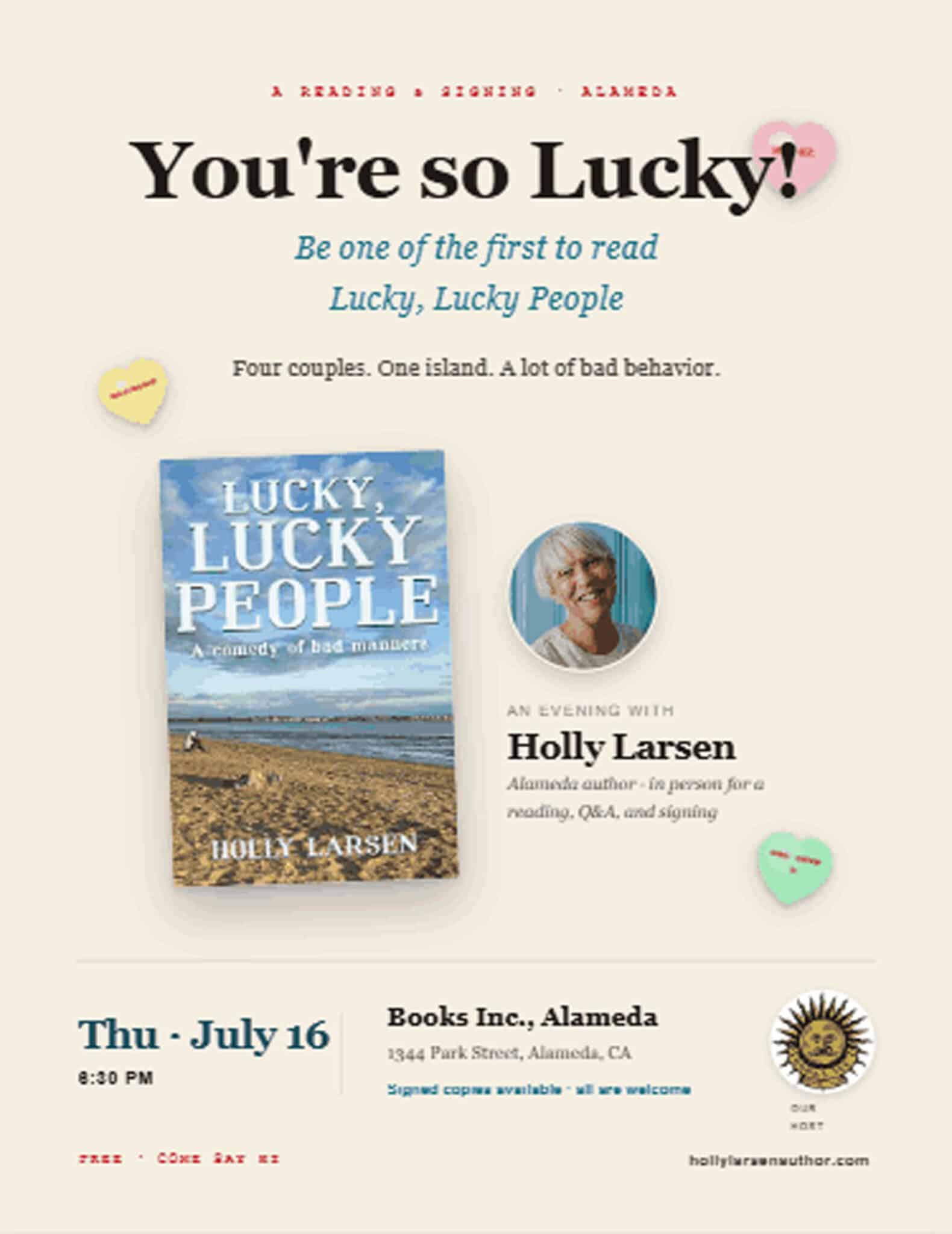
Enjoy her replies here in 5Q4: Holly Larsen — and for even more fun, join her on Thursday, July 16, 6:30 p.m. at Books Inc., 1344 Park Street, where she will sign copies of her books and her husband will join her to read from her latest novel.
 [1]
[1]You’ve set your novel Lucky, Lucky People here in Alameda. How did that come about?
I love Alameda! Who doesn’t? But I’m tired of seeing eyes glaze over when I tell off-islanders about how great Alameda is. With a book, I can spread the word without being exposed to unattractive reactions.
There’s another reason. People always advise you to write about what you know. What they don’t tell you is that writing about what you know is easy—much easier than writing about a place you don’t know, as I learned from experience. So I made the decision based on a mix of love and indolence, which is not entirely off-brand for me.
This is your second novel, your first being Sisters, Plural. How has this experience been different from the first?
The current book was easier to write because it’s all about modern life in a known locale. Also, this book is about people I don’t know. In contrast, Sisters is inspired by my great-grandmother, Jane Lucretia Brown Farr. Though I had only met her a few times when I was a child, I never knew her well. Still, I found I couldn’t create a character based on her that wasn’t unbelievably saintly, which translates into boring. In fact, I had to invent a snotty sister as her foil to carry the plot along.
I also had to research what life was like during her time. What did people eat? How did they launder clothes? How did they make money? I know some authors like to do research, but I get caught up in minutiae and forget what I wanted to find out in the first place.


Full disclosure: I learned the most about writing fiction not from writing, but from receiving a review of another (unpublished) book from a fiction editor, and she schooled me! I had to swallow my pride and rethink my writing, and I’ve become a better writer as a result. Not great, just better.
How much, if at all, have you borrowed from your own life or from your friends and family, for Lucky, Lucky People?
The many things I know about being alive today slipped seamlessly into the book. I need to emphasize that the characters, some of them quite unlikable, are not based on anyone I know. Any resemblance to actual persons is purely coincidental. So where did they come from? A friend of mine theorizes that the characters in books are floating all around us, invisible, waiting for writers to pluck them out of the ether. This thought comforts me, as I am reluctant to believe the characters in my book are a product of my imagination.
 [2]
[2]Talk about your writing process.
The closest I have to a process is trying to remember to write every day, even if just for a few minutes. I don’t plot in advance, as the perceptive reader may readily perceive. Instead, I sit around and wonder what will happen next. In fact, the single time circumstance forced me to plot, I found writing the story excruciating because I absolutely knew what would happen next. Where’s the fun in that? This said, all my stories would likely benefit from a process and a plot. Too bad about that!
Not to brag, I’m a darn good editor, so I’m constantly reworking pages. But I mostly work at the line or paragraph level. I’m grumpy if I have to move sections around, delete stuff, or add detail. But when bigger edits are unavoidable, I grit my teeth and carry on.
Are there any writers and specific books that were an inspiration or any books you read in preparation for writing Lucky, Lucky People?
I love, love, love to read, a pastime that likely contributed to my desire to write. I would be thrilled to have the talent and genius of Jane Austen or Diane Johnson, both superb writers of comedies of manners, my favorite kind of book. Reading and rereading their books has inspired my writing. Sadly, I’m not a genius yet, though I’m still hopeful.
 [3]
[3]
One more question: You’re reading from your book on July 16 at Books Inc. here in Alameda. How much of the plot will you reveal?
When I was still quite young, my mother taught me that it is extremely rude to give away the plot of a movie. So, clearly, I won’t be giving anything away, except prizes for attendees! I’m more preoccupied with keeping people interested, especially those who’ve already heard me talk about the book. I’ve solved the problem of reading aloud (I stumble over words) by asking my husband to do the reading. He has a great voice and a wonderful presence when reading. A lot of my energy is going into getting the word out about the event. If a book reading falls flat in the forest, did it actually happen?
Gene Kahane is the founder of the Foodbank Players [4], a lifelong teacher, and former Poet Laureate for the City of Alameda. Reach him at [email protected] [5]. His writing is collected at AlamedaPost.com/Gene-Kahane [6].