The first time I saw Claire Slattery perform was on the stage at the Frederick L. Chacon Little Theater. She was wearing an outfit from the Renaissance, reciting lines written by William Shakespeare. It was Romeo and Juliet, and she was playing the Capulet’s young daughter. She was, in brief, remarkable. Poised, eloquent, she drew each of us into the tragic love story that, in the end, broke our hearts.
 [1]
[1]Imagine my delight, then, reconnecting with the once fair Juliet, now an adult, married, a mom, and learning of her desires to open an improv studio here in Alameda, in 2025, when it seems more people prefer to engage online than in person. But we met and talked. She shared her vision, along with her passion and determination, for this project at this point in her life and it became clear that, to borrow from the Bard, she has embraced the notion that “all the world’s a stage, and all the men and women merely players.”
She is building that stage over on Central Avenue, and inviting the men, women and kids to not be merely players, but players extraordinaire. Let me step aside here and invite her to the stage, to answer a special collection of 5Q4: Claire Slattery.
Tell us how you decided to take your love of improv and create Improv Central?
I first fell in love with improv comedy as a young actor. I studied Drama and Communication at Stanford University, then worked as a professional actor, improviser, and teaching artist in the Bay Area with We Players, California Shakespeare Theater and American Conservatory Theater.
For the past 15 years, I have practiced and taught improv in all kinds of settings—at comedy festivals, corporate summits, community organizations, and continuing education spaces—and in that time my love of improvisation has evolved. I’ve experienced firsthand how the powerful skills of improvisation inspire courage and confidence in everyday people to more joyfully navigate the stress of our unpredictable unscripted lives. It has become my life’s work to take improv beyond the theater stage and engage everyday people with the transformative experiences and skills that have changed my life and so many others.
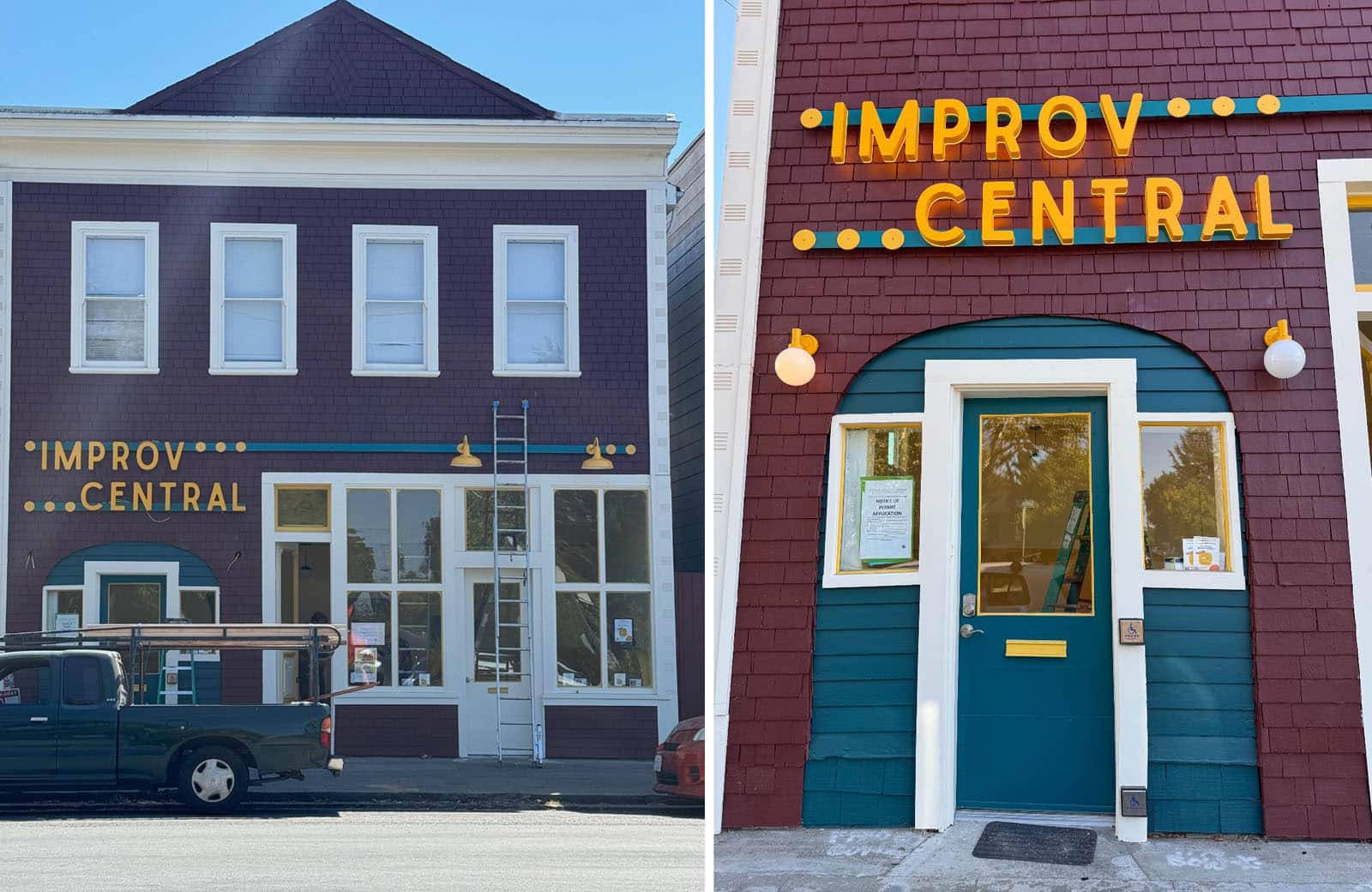
When my husband, my son, and I moved back to Alameda—20 years after graduating from Alameda High School—we ended up moving into a renovated historic building on the West End that had an empty storefront on the ground floor. It was the right moment and the right place to finally create the kind of community space I had been envisioning for years, one where neighbors could come together, not to perform on stage or be funny in front of an audience, but to strengthen the skills that make life’s unscripted moments less daunting and more joyful. The timing, the space, and my personal connection to Alameda all lined up, and Improv Central was born [3], right here, on Central Avenue.
 [4]
[4]You have performed on stage and screen, speaking words learned from a script. What is it about improvisation that is different from that kind of acting experience?
For me, scripted acting and improv are both about the experience of discovery—but they manifest in very different ways. With a script, you discover how to bring someone else’s words and story to life. I love the process of study and rigorous rehearsal, and you can achieve a really satisfying level of depth with a scripted role. With improv, the discovery happens in real time and the breadth of possibilities means you can go in many directions. You don’t yet know who your character is, what your relationships are, or where the story is headed until you step into each moment, committed to developing it with the people in the room.
Improv encourages us to listen more deeply and to build trust in your intuition when you can’t possibly have planned a response. Like in real life, you’re interacting with the world as it happens—collaborating on yet-to-be-finalized projects and products with your coworkers, growing an evolving relationship with your family, building a supportive community where unpredictable moments are met with curiosity and a commitment to empathetic connection.
To me, this is emblematic of being human. How we respond in moments of uncertainty can positively change our words, our stories, our collaborators, and ourselves. Improvisational acting has also always provided me with a safe space to practice responses such as listening more deeply, openly, and curiously, making bold choices, trusting my own intuition, and co-creating something from nothing with other people. I always walk away from an improv class, workshop, or event feeling like I learned, I grew, and my spirit is lighter from laughter.
I continue to love that feeling of discovery—for scripted work it feels more about surprising the audience. With improvisational acting, I feel I get to be truly surprised by what my fellow collaborators and I create as we go. And damn, does it feel so invigorating and satisfying. Every. Time.



Was there a single performer or troupe who inspired you to pursue being an improv actor, and ultimately the founder of Improv Central?
As a freshman at Stanford University, I joined the Stanford Improvisors, coached by Dan Klein. For four years, I got to study with and be mentored by Dan. I didn’t realize it at the time, but Dan Klein was my first model of someone building a successful career as both an improvisational performer and an improv practitioner. A talented improviser and hilarious sketch comedian, Dan is also a gifted teacher, mentor, facilitator, and speaker. Dan Klein was also the first teacher who demonstrated the powerful osmosis of improv skills from the performing world into the real world of learning and life to which I would ultimately dedicate my career.
Joining the Stanford Improvisers and working with Dan Klein gave me a playground to experiment, fail, succeed, and grow, both as a performer and as a person figuring out how to navigate the real world as a young adult. Not only did I hone my skills as an actor but also my confidence in navigating the unknown—something I experienced firsthand when I graduated college in 2009, smack into a recession.
Dan also opened doors for me in the early days of my career, connecting me with freelance opportunities that let me practice my improv facilitation role and build confidence in high-stakes rooms where I was very much the youngest person in the room and often one of the only women. That combination of mentorship, community, and playful experimentation is exactly what I hope to give people at Improv Central—a safe, inspiring space to discover what they’re capable of in life.
The Stanford Improvisors are the troupe that inspired and continue to inspire me. What made my early experience with improv so formative—and joyful—was that the Stanford Improvisers weren’t made up of only actors or people pursuing performance professionally. My troupemates came from all over the country and the world, studying everything from engineering to literature, bringing wildly different perspectives and experiences. That diversity created a much richer sandbox for play, experimentation, and surprise than I found later in professional acting environments, where the commercial acting hustle creates an environment of homogeneity that I found less inspiring and productive.
My experience with the Stanford Improvisors shaped how I think about Improv Central. I want to create a space where everyday people, regardless of background, profession, or experience, can engage with the powerful, playful practice of improv through their own lens. In a time when it’s easy to go inward, fear mistakes, and avoid vulnerability, this kind of shared, unscripted engagement helps us feel less lonely, connect more deeply with our neighbors, and remember that community can be both joyful and sustaining even when unpredictable. That original sense of possibility and connection from the Stanford Improvisors community is what I hope to amplify here.
 [5]
[5]Is there a specific thing or experience, skill, or quality that you want people to come away with after taking classes with you?
My vision is for Improv Central to be a space where the playful meets the profound, where time flies by, and where everyday people can feel fully present with themselves and each other—feeling seen, supported, and inspired to bring that energy back into their lives.
I hope that after a class, workshop, or event at Improv Central, people feel more courageous and confident to navigate our unpredictable and unscripted lives. I want people to experience a respite from the everyday pressure to be prepared, to perform, to be polished, and perfect. I want them to feel like they got to discover delight, curiosity, and connection.
I know the positive and lasting effect it can have on people when they are given the chance to play, explore, and realize a new strength about themselves or fellow community members. We feel more hopeful and motivated, feeling more courageous to express ourselves, to reach out to make connections with others instead of retreat inward, and to take bold creative risks in our day-to-day lives at work, at home, and in our communities, which often inspire the same in others.
You are a mom. In what ways, if any, does being an improviser help out with child rearing?
It helps in so many ways. Becoming a parent has stretched me as an improviser in ways I never expected. The constant change in a child’s development, coupled with our own expectations and societal pressures to “do it perfectly,” can feel relentless. Approaching parenting from an improviser’s mindset helps to remind me that it’s always collaborative, pieced together moment by moment, and full of surprises. Mistakes happen, but they can also lead to surprising and profound experiences of laughter, learning, and connection with my husband and with our kiddo. Improvisation constantly inspires me to pivot, adapt, and respond creatively. Those are the same characteristics I hope to instill in my son—resilience, curiosity, courage, and the ability to navigate life’s unscripted moments with a sense of excitement, exploration, and joy.
Gene Kahane is the founder of the Foodbank Players [6], a lifelong teacher, and former Poet Laureate for the City of Alameda. Reach him at [email protected] [7]. His writing is collected at AlamedaPost.com/Gene-Kahane [8].