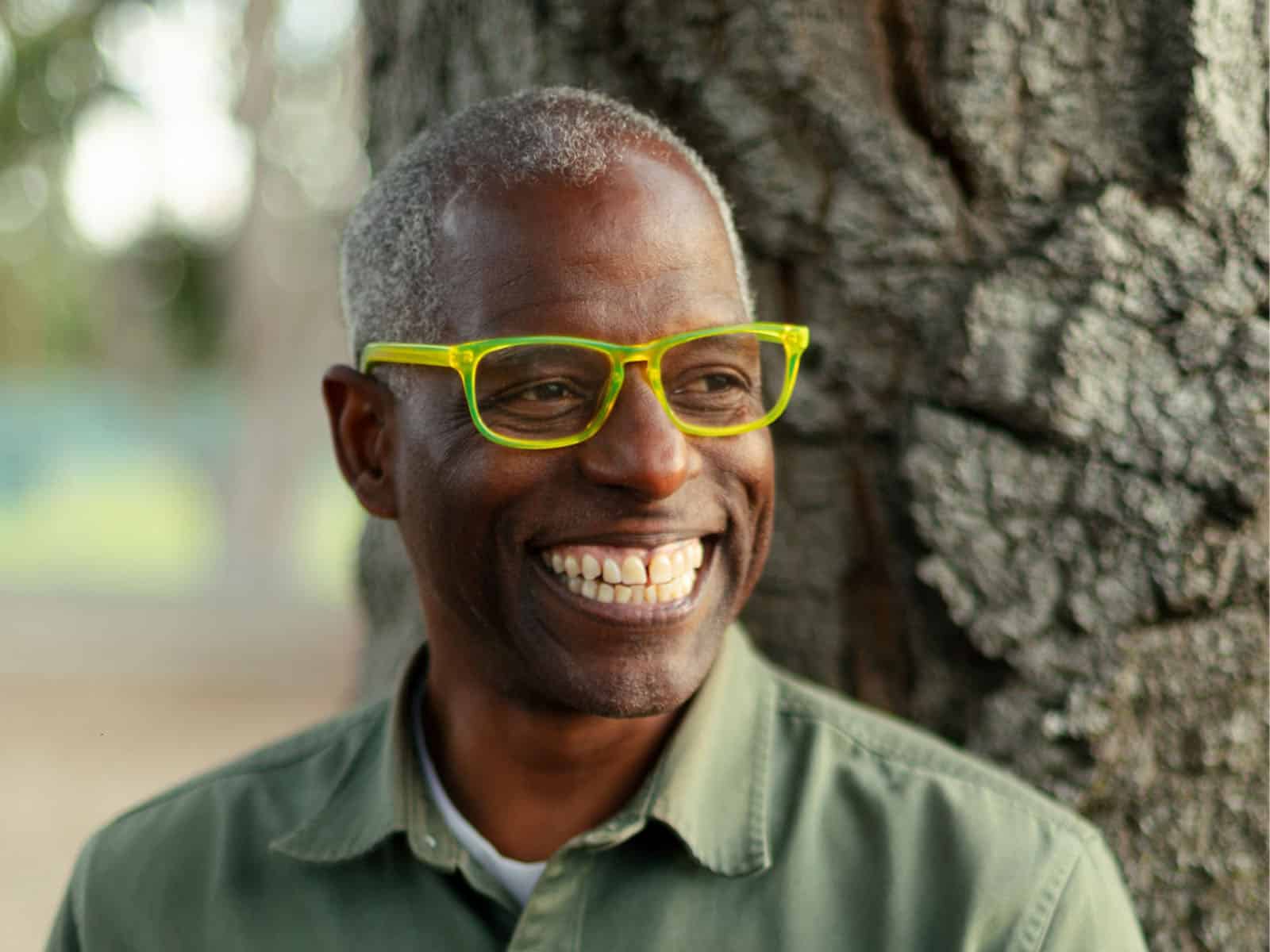
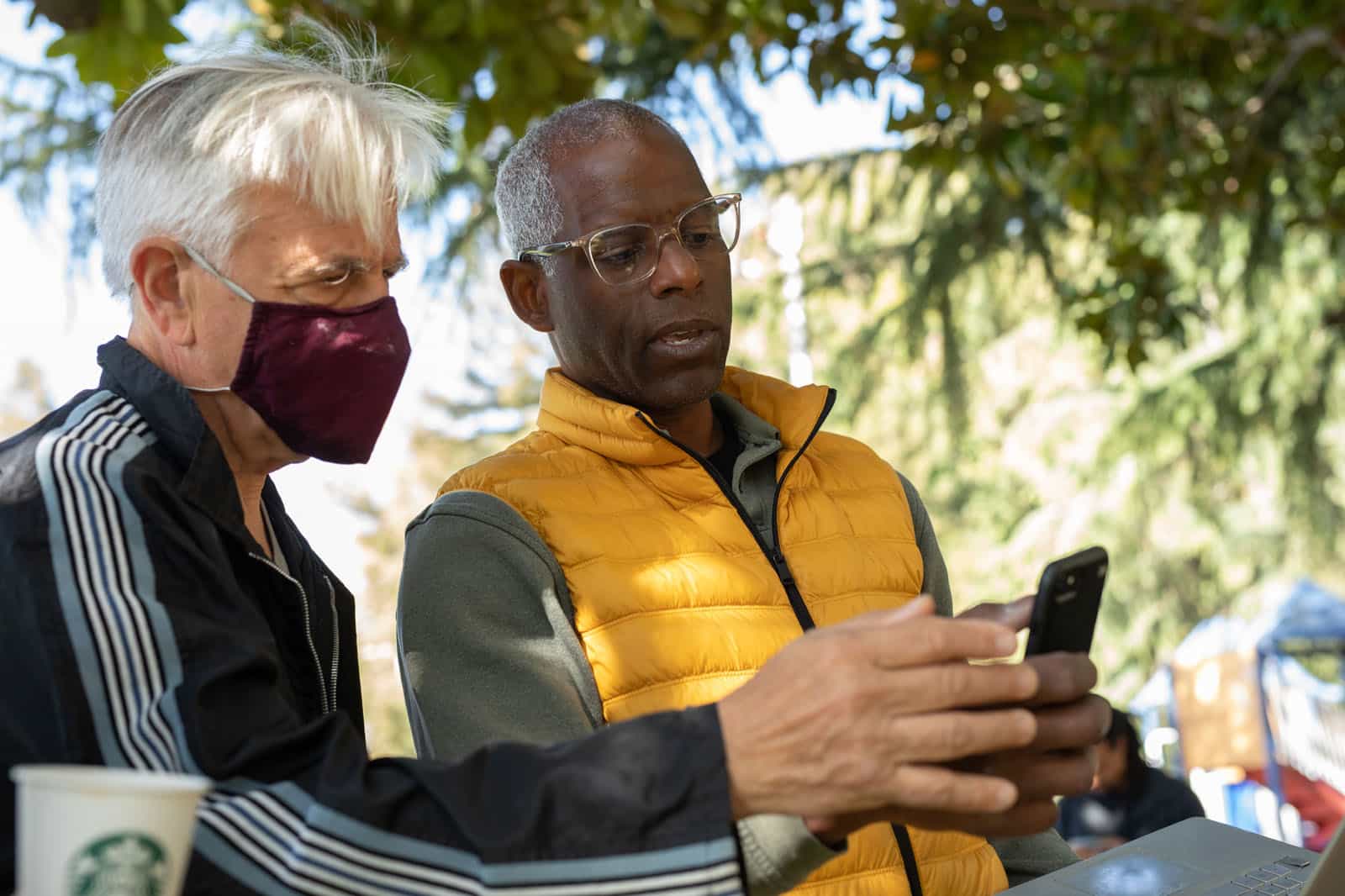
When describing Amos White, an artist profiled here two years ago [1], two terms come to mind: a polymath and a renaissance man. Essentially they mean the same thing—a person with a wide range of knowledge, passionate about many things, the recipient of what was once heralded as a liberal arts education. He has been and continues to be a political activist, an actor, and a poet, but his most recent endeavor is something different. He wants to plant 100,000 trees for humanity and has formed an organization of that very name: 100K Trees for Humanity [2]. So while he once held a microphone, he now more often wields a shovel. But be certain that while the setting has changed, White’s urge to make the world better has not. Read on to hear more about that in 5Q4: Amos White.
 [3]
[3]How and when did you shift your attention from social justice to environmental justice? And can you explain what environmental justice means?
My focus in fighting for people’s rights has never shifted, it has only been refined. The fight for environmental justice is a facet of social justice. Social justice broadly covers the equitable access to our human and civil rights, resources, and opportunities across our society, while environmental justice applies that same social justice lens specifically to the environmental conditions of clean air and safe water, access to nature and trees, and freedom from toxic exposure.
100K Trees for Humanity was born here in Alameda in 2019 when a group of parents and CASA (Community Action for a Sustainable Alameda) members wanted to do something tangible for our children’s future and the planet. We’ve raised over $1.7 million in neighborhood tree funding for Bay Area cities and communities and have planted over 1,000 trees with our partners.
The first Trump administration had announced intent to withdraw from the Paris Agreement in June 2017, which would all but guarantee the acceleration of the climate crisis. It’s what Naomi Klein calls “climate capitalism.” Climate change is the single largest driver of the world’s economy, and is projected to continue to be so.
Trump showed us the link between the climate crisis and the economy after Hurricane Maria devastated Puerto Rico in September 2017, killing some 3,000 people and wiping out their power and water systems. At a press event there, he stood in a room throwing rolls of paper towels to about a dozen cheering, well dressed “locals.” That was his signal to Americans: If you want disaster relief from your suffering and losses, you will have to pay for it and clean it up yourselves.
After Greta Thunberg’s Global Strike for Climate in 2019, I fully grasped the urgency young people had embodied in calling on policymakers—and all adults—to do something now to stop this climate crisis.
Climate change is a global issue that seems almost too large and complex to fully understand and address. In terms of your project, 100K Trees for Humanity, how does the planting of a single tree help improve our lives?
This climate crisis is the disproportionate imbalance in the world’s climate that is being fueled by our ever-increasing fossil fuel carbon emissions. 100K Trees for Humanity is not just a project, it is a mission. Projects are time-limited and have an end date—this climate crisis is not ending in the near future. We must be dedicated to radically change our energy systems to 100% renewable energy—wind, solar, tidal, and geothermal. We must repair and restore our ecosystems, including our urban forests, to draw down the carbon and greenhouse gases out of the atmosphere. We must decarbonize our transportation systems and increase mobility and walkability in our cities.
100K Trees for Humanity works with cities, civic and neighborhood groups, business associations, and educational institutions to plant trees for climate, for equity and for increased public health through cleaner air and cooler communities. Planting just one tree—one oak tree, for example—will store 658 pounds of carbon a year on average. The coast live oak, our local oak trees here in Alameda, are the second greatest tree in storing carbon. They are native, so they provide a wildlife habitat that supports over 300 species of moths, acorns that feed birds and squirrels, and their broad canopy provides cooling shade.
Alameda’s tree canopy is 9%, and we are working to increase it to 30% island-wide. The East End and Bay Farm have tree canopies around 24%, but the West End neighborhoods are as low as 6%. With 78,000 people, if we each just committed to planting one tree, we would be 80% toward our goal of 100,000 trees and 30% canopy.


 [4]
[4]Your most recent project is to plant 1,000 trees in the West End. How does that fit into the history of the West End and efforts to recognize and correct the social injustice the community has experienced?
Alameda residents are coming together to do their part to repair the historical social, racial, and economic injustices levied on the West End and its residents, from taking on historical redlining and unfair housing practices to bringing in more resources for the Webster Street business corridor and neighborhoods, and supporting more lush parks and planting more community trees.
100K Trees for Humanity received a $100,000 foundation grant to improve West End neighborhoods through a community climate initiative called Planting Our Future. We’ve partnered with Alameda Rotary Club to lead the planting of 1,000 neighborhood and park trees. We also are collaborating with the West Alameda Business Association (WABA) to install a wildflower pollinator garden with nearly a mile of streetlamp flower baskets spanning from In-N-Out Burger on Willie Stargel Way to 1400 Bar & Grill on Central Avenue. We are working with ASTI and Encinal students and Alameda Boys & Girls Club in Climate Leadership Teams, where they learn how trees affect climate and air quality, and how that impacts our public health and wellness. Also, The Child Unique Montessori School’s elementary environmental curriculum will teach children to plant acorns and to steward an oak seedling that will be distributed in their community. A thousand seedlings have been grown just this spring with more than five participating schools.
The Planting Our Future positions urban reforestation as both a public health solution and a catalyst for economic growth. By planting 1,000 trees across the West End—home to some of Alameda’s most underserved communities—we will improve air quality, reduce asthma and heart disease risks, and provide much needed shade to protect residents from the increasing extreme heat. These health benefits translate into real economic value through fewer medical emergencies, higher work and school attendance, lower energy costs, and a more resilient workforce.
Greener, shaded streets will also help transform Webster Street into a model for sustainable, thriving business corridors. Expanded tree canopy and multi-use green spaces will make sidewalks more inviting, increase walkability, and draw more residents and visitors to shop, dine, and gather. This fosters community pride and joy. Plus, pollinator wildflowers and grasses attract butterflies and beneficial insects which in turn attract and feed birds and provide habitat. It’s well known that birdsong decreases stress in the body and increases joy in humans.
What kind of support does 100K for Humanity need?
We need Alameda residents to commit to take part and plant a tree—or several trees. This includes shade trees such as oaks, linden, big leaf maple, poplar, and california sycamore, to understory trees like ceanothus, madrone, redbud coffeeberry and fruit trees. We also need volunteers to give away trees at the farmers market and community events and festivals. And we always could use more donations to help scale our work here on the island. It really is a community effort. People are donating through donor advised funds, employee workplace matching funds and direct donations through our nonprofit website.
Here is your chance to stand on a virtual soapbox and speak to the community about why this project is so vital.
100K Trees for Humanity was born right here because Alamedans wanted to do something real and tangible for our children’s future and the planet. We’ve raised over $1.7 million in neighborhood tree funding for Bay Area cities and communities and have planted over 1,000 trees with our partners.
Urban heat is the leading cause of death from climate change. Cooler cities and communities with more trees is the solution. California’s average urban tree canopy is just 13%—lowest in the entire country—and we are losing 2% of our urban trees every year. Plus, in wealthier neighborhoods, tree canopies are two to three times more lush and verdant than in neighboring communities of color. This leaves entire neighborhoods vulnerable and at greater risk to health and safety perils during extreme heat, flooding, and weather events, and from polluted air.
We are digging in, here in Alameda. We are coming together to make a difference now, for our children and grandchildren’s futures and for the environment. If you want to help make a difference in your community, for your business, or for the environment, contact us today at [email protected] [5].
Gene Kahane is the founder of the Foodbank Players [6], a lifelong teacher, and former Poet Laureate for the City of Alameda. Reach him at [email protected] [7]. His writing is collected at AlamedaPost.com/Gene-Kahane [8].